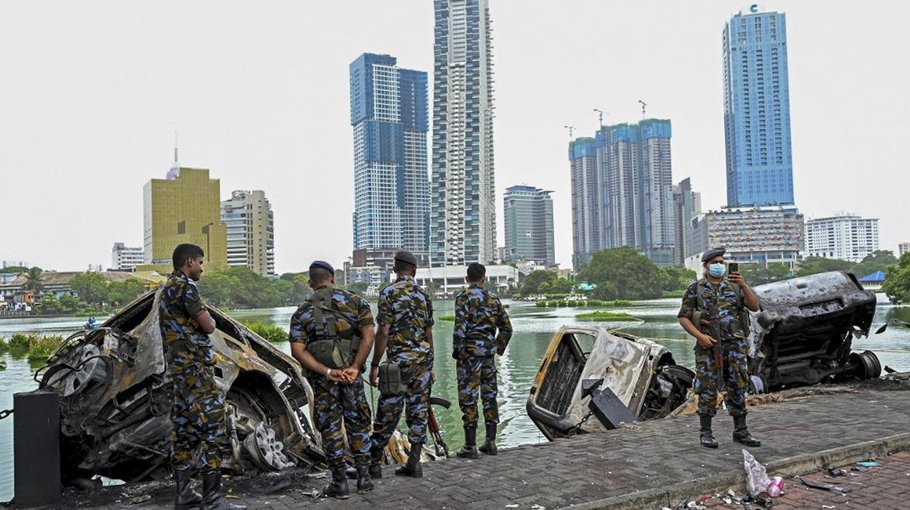
Sri Lanka gave emergency powers on May 10 to its military and police to detain people without warrants, after a day of clashes that killed eight people and injured more than 200, in violence that prompted Prime Minister Mahinda Rajapaksa to resign.
As the Indian Ocean nation battles its worst economic crisis in history, thousands of protesters had defied curfew to attack government figures, setting ablaze homes, shops and businesses belonging to ruling party lawmakers and provincial politicians.
Despite sporadic reports of unrest, the situation calmed by Tuesday, said police spokesman Nihal Thalduwa, adding that about 200 people had also been injured in violence that led to an islandwide curfew until 7 a.m. (0130 GMT), the following day.
The government of President Gotabaya Rajapaksa, the younger brother of the Prime Minister, outlined broad powers for the military and police to detain and question people without arrest warrants. The military can detain people for up to 24 hours before handing them to police, while private property can be searched by force, including private vehicles, the government said in a gazette notification on May 10.
“Any person arrested by a police officer shall be taken to the nearest police station,” it said, fixing a 24-hour deadline for the armed forces to do the same. Some analysts expressed concern over the potential for abuse of the emergency measures.
“In a situation where there is both a state of emergency and curfew who can monitor to ensure these regulations are not abused?” said Bhavani Fonseka, of the Centre for Policy Alternatives think tank based in Colombo. The President had already declared a state of emergency on Friday as protests escalated.
Opposition calls for Mahinda Rajapaksa’s arrest for inciting violence
Sri Lanka's former Prime Minister Mahinda Rajapaksa is facing calls for his arrest from Opposition politicians for inciting violence against peaceful anti-government protesters that claimed at least eight lives, left over 200 people injured and saw arson attacks on the homes of several politicians.
Mahinda Rajapaksa, 76, resigned as Sri Lankan Prime Minister on May 9 amid unprecedented economic turmoil, hours after his supporters attacked anti-government protesters, prompting authorities to impose a nationwide curfew and deploy Army troops in the capital.
The resignation of the Prime Minister has automatically annulled the Cabinet and the country is currently being run by his younger brother and President Gotabaya Rajapaksa.
Mahinda Rajapaksa has been accused by the Opposition of inciting the ruling party mobs to attack peaceful protesters by making a defiant speech while addressing several thousands of his supporters to deflect calls for his resignation.
“Rajapaksa [Mahinda] must be arrested and brought before the law," M. A. Sumanthiran, the main Tamil legislator, said in a message. The same sentiments were expressed by former President Maithripala Sirisena and the main Opposition Samagi Jana Balawegaya party's leader Ranjith Madduma Bandara.
“He must be arrested for encouraging violence. There was no reason to attack the peaceful protesters," Mr. Sirisena said. At least eight people were killed in the violence. The Colombo national hospital said at least 217 people had been admitted to the hospital for treatment.
One of the protesters who had been brutally assaulted by the Rajapaksa supporters remains in a very critical condition. Mahinda Rajapaksa later resigned, saying he was making way for his brother [President] Gotabaya Rajapaksa to set up an all-party interim government.
There were reports from all parts of the island of arson attacks on the homes of ruling party politicians, including on the ancestral house of the Rajapaksa family in the deep southern district of Hambantota.
Mahinda Rajapaksa vacated the official residence Temple Trees
Meanwhile, Mahinda Rajapaksa vacated the Temple Trees, the official residence of the Prime Minister, on May 10 (morning), according to media reports.
The police on Monday used tear gas and fired in the air to stop a mob which was trying to break into Temple Trees, the office-cum-residence of the Prime Minister.
An all-island curfew, which was scheduled to be lifted on Tuesday, was extended last night until Wednesday as arson attacks were reported from most parts of the country.
Army chief General Shavendra Silva called for calm and said the necessary action would be taken to maintain law and order. In the current state of emergency, the troops are given extensive powers to arrest people. The Opposition parties urged the reconvening of the Parliament before the scheduled date of May 17.
Speaker Mahinda Yapa Abeywardena also requested the President to immediately summon Parliament. The trade unions announced that they would launch a continuous strike from Tuesday to protest against the government-backed crackdown on the peaceful protests.
The violence occurred as pressure mounted on the embattled government led by President Gotabaya to form an interim administration to overcome the worst economic crisis facing the country.
Sri Lanka is currently in the throes of unprecedented economic turmoil since its independence from Britain in 1948. The crisis is caused in part by a lack of foreign currency, which has meant that the country cannot afford to pay for imports of staple foods and fuel, leading to acute shortages and very high prices.
Thousands of demonstrators have hit the streets across Sri Lanka since April 9 seeking the resignation of President Gotabaya and Prime Minister Mahinda, as the government ran out of money for vital imports; prices of essential commodities have skyrocketed and there are acute shortages in fuel, medicines and electricity supply.
In a special Cabinet meeting on Friday, President Gotabaya Rajapaksa declared a state of emergency with effect from Friday midnight. This is the second time that an emergency was declared in Sri Lanka in just over a month as the island nation was in the grip of the worst economic crisis.
Attorney General wants investigation on violence
Sri Lanka’s Attorney General on May 10 asked the police chief to conduct an urgent and full-fledged investigation into the violent clashes between anti- and pro-government protesters.
Attorney General Sanjay Rajaratnam has advised the Inspector General of Police (IGP) to conduct a full-fledged investigation into the incidents of unlawful interference into the people’s constitutional rights, the circumstances that led to them; and, the consequent commission of penal offences in the process, News First website reported.
In a letter to the IGP, the Attorney General said as the incident in metropolitan Colombo triggered sporadic acts of violence of serious nature involving people and their property all over the country, the Attorney General advised the police chief to further investigate the aftermath of the incidents, the News First report said.
He urged the IGP to complete the investigation on an urgent priority basis.