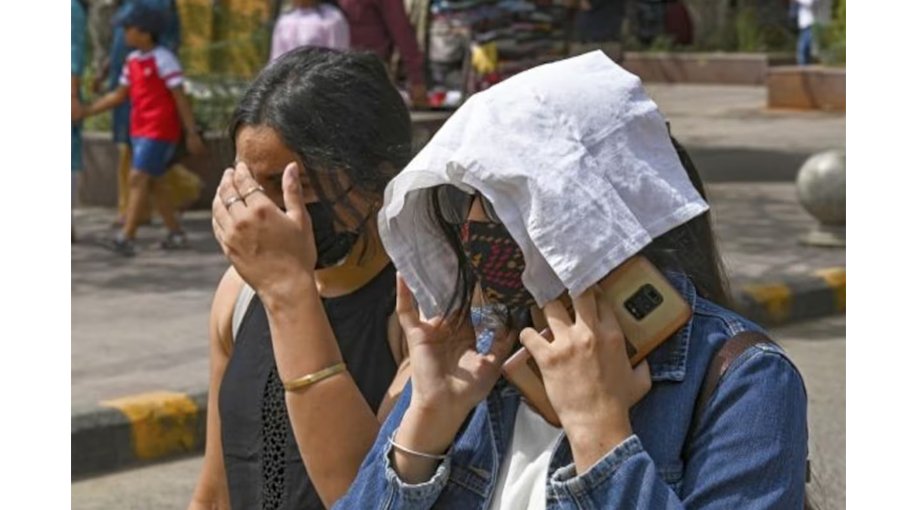
The severe heatwave sweeping over the country continued on Monday (April 17) with little change, making life miserable across the country.
Amid sweltering heat in most parts of the country, Bangladesh Meteorological Department (BMD) has predicted rains and thundershowers at one or two places in Barishal, Chattogram and Sylhet divisions in the next few days.
“Weather may remain dry and partly cloudy sky over the country, having chances of rain or thunder showers at one or two places over Barishal, Chattogram and Sylhet divisions,” said a met office bulletin.
Severe heatwave was sweeping over Khulna division and Dhaka, Faridpur, Gopalganj, Manikganj, Narayanganj, Rajshahi and Pabna districts on Monday. However, mild to moderate heatwave was sweeping elsewhere over the country and it may continue.
The dwellers of Dhaka city have been suffering from the severe heatwave since Pahela Baishakh, the first day of the new year, as temperatures rose to a record high. On Sunday, the capital recorded its highest temperature at 41.1°C - the highest in 58 years. The previous highest temperature in Dhaka was 42°C, recorded in 1965.
On Monday, the temperature of Dhaka dropped a little from the previous day. However, a very severe heatwave was flowing over Chuadanga, Pabna and some other districts.
In Dhaka, the temperature dropped to 38.1 degrees Celsius on Monday from the highest of 40.6 degrees Celsius on Sunday, said Forman Ali, meteorological assistant of BMD.
The highest temperature in Bangladesh this year was recorded in Ishwardi at 43 degrees Celsius, according to BMD.
This year the highest temperature was recorded on Monday in Ishwardi and it is the highest in the recent history of Bangladesh, said Md. Shaheenul Islam, a meteorologist of BMD.
The second highest temperature in Bangladesh this year was recorded in Chuadanga district at 42.5°C on Monday afternoon.
The district administration is warning the general public not to go out without essential work in severe heat.
In general, when the temperature in any area rises to 36 degrees Celsius, it is considered as mild heatwave. When the temperature rises to 38 degrees Celsius, it is considered medium heatwave and when the temperature rises to 40 or above degrees Celsius, it is considered as severe heatwave.
As the heatwave continues to batter people’s lives, hundreds of Muslim devotees on Monday gathered on a playground at Aftabnagar in the capital to offer a special prayer for rain.
Maulana Ahmadullah led the prayer-- Istekhar prayer which is one of the Sunnah prayers offered by Prophet Muhammad (SAWS) during times of drought, famine or during intense heat.
After the prayer, Maulana Ahmadullah and other devotees supplicated for relief from the heat and for Allah’s mercy in the form of rain.
He also called upon everyone to perform special prayers, asking for rain, in their respective areas.
Meanwhile, load shedding amid intense heatwave makes life miserable in some parts of the country, including Khulna.
According to the West Zone Power Distribution Company (WZPDC), the demand for power in 21 districts of the southern region during the peak hours on Saturday was 680 MW while the supply was 615 MW, i.e. load shedding was 65 MW.
At 3:00 pm on Sunday, the demand for electricity in 21 districts was 669 MW and the supply was 606 MW, i.e. load shedding was 63 MW. Load shedding on Sunday night was higher than on other days.
Meanwhile, Khulna recorded 41.3 degrees Celsius temperature on Sunday, the highest temperature in 23 years.
Meteorologist Amirul Azad, in-charge of Khulna Met office said that the heatwave condition is likely to continue for another two-three days. After that, there is a possibility of rain in Khulna.
The jail authorities in Dhaka and other parts of the country have taken initiatives to protect inmates from the heatwave. The jail authorities are keeping them under the shade of the trees inside the jail grounds for the majority of the daytime.
Additionally, oral saline is given to the prisoners in case they get sick. The jail administration has increased the water supply to the jails and inmates are also permitted to bathe more frequently.