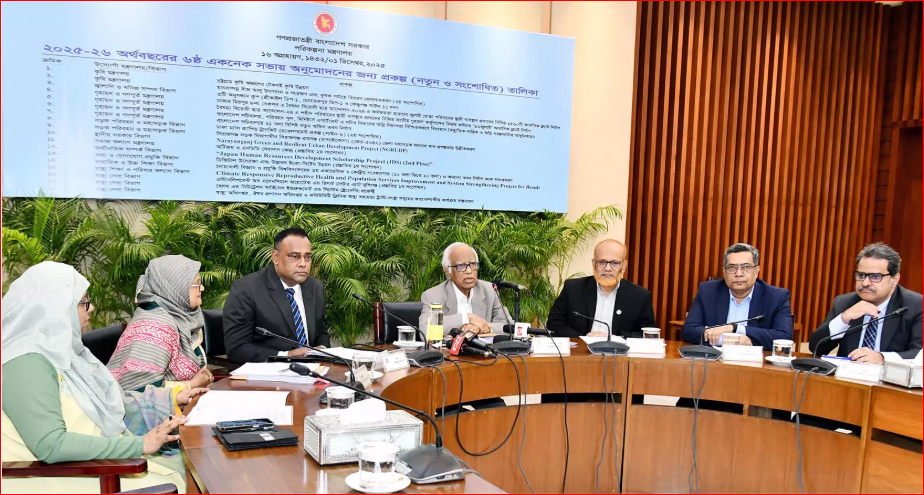
Planning Adviser Dr Wahiduddin Mahmud on Monday said the government’s ambitious reforms to the public procurement system are temporarily slowing down the implementation of the Annual Development Programme (ADP), but the overhaul is essential to dismantle long-standing contractor monopolies and ensure greater transparency in project execution.
While briefing reporters after the ECNEC meeting on Monday, Dr Mahmud admitted that ADP implementation 'has not become dynamic,' despite what he called continual efforts.
“The old problems are still there. The biggest challenge is that people are now reluctant to take up the role of project director, and contractors are no longer showing the same level of enthusiasm as before,” he said.
According to him, this hesitation stems mainly from the introduction of the new Public Procurement Policy 2025, which has brought in far stricter transparency standards.
“For years, a handful of powerful contractors controlled major national infrastructure works—highways, railways, everything. The evaluation system was shaped in a way that ensured that only those who previously secured the contracts would get them again,” he said.
He emphasised that the 2025 policy is a “major reform”, making it impossible for any party to secure contracts anonymously or through proxy arrangements.
“One cannot take a contract under someone else’s name. Anyone winning a contract must disclose full information about their businesses, tax status, and any affiliated enterprises. Everything must be open,” he explained.
Dr Mahmud stated that this transparency requirement has made the contracting environment stricter and has somewhat discouraged habitual contractors.
At the same time, the government has incorporated provisions allowing new and young entrepreneurs—even those without previous contracting experience—to participate as minor partners in large tenders.
“We cannot let the same contractors dominate forever. Those who run their businesses honestly and pay taxes should have the opportunity to enter this sector. Particularly the younger generation must be given space,” he noted.
He added that the new digital and fully online evaluation system—from the upazila level to the highest purchase committees—is also taking time to adjust to, especially for large purchases. “They will have to learn. That’s why there is some delay,” he said.
Commenting on corruption concerns, Dr Mahmud observed that although reports of extortion and irregularities still exist, contractors appear uncertain about whether opportunities for corruption continue within the newly reformed system.
“Maybe they have not yet figured out whether such opportunities are still there,” he said.
The adviser also pointed to structural challenges at the local level. Upazila and district councils—now run entirely by government officials until elected representatives return under a future political government—are saddled with numerous projects but lack the time to supervise them adequately.
To address this, ECNEC has recently attached a set of mandatory conditions to all newly approved locally implemented projects, especially those under the Local Government Engineering Department (LGED).
One key requirement is institutionalised community monitoring, ensuring that beneficiaries and local residents are involved in project oversight. “This is logical. People living in the area know best whether the road, bridge, or construction work is being done with quality materials. They should be able to resist poor-quality work,” he said.
He added that although such conditions existed before, they were rarely enforced. ECNEC is now making these obligations binding.
In addition, project locations must display publicly accessible information—including total cost, progress, contractor identity, and details of materials used. Dr Mahmud noted that similar disclosure rules had been introduced during the late 1990s when he previously served in government, “but after some time everyone forgets”.
The adviser stressed that transparency, local involvement, and strict monitoring are essential as the country faces rising poverty concerns and seeks to boost employment through community-level development works.