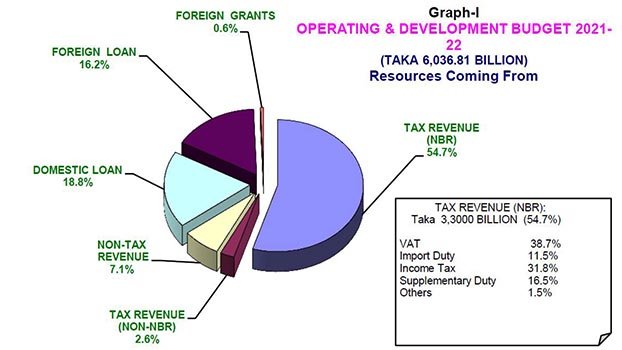
Finance Minister AHM Mustafa Kamal has said that the revenue collection target of the National Board of Revenue (NBR) has been kept unchanged at Taka 3,30,000 crore for fiscal year 2021-22 like the original target of the outgoing fiscal.
He said Tk 3,30,000 crore will be collected through the NBR sources, and tax revenue from non- NBR sources has been estimated at Tk. 16,000 crore, while the non-tax revenue is estimated to be Tk. 43,000 crore.
"We believe that we will be able to achieve the estimated revenue target for the financial year 2021-2022 through effective tax policy, efficient tax management and participation of all stakeholders including the businesspersons," said the finance minister in his budget speech in the Jatiya Sangsad.
In his speech the minister also placed a guideline for achieving the revenue collection target for the coming fiscal year.
The finance minister proposed to cut 2.5 percentage points in corporate tax and keep the individual income tax ceiling unchanged.
He said the government has taken practical measures to provide easy and seamless services to the taxpayers, businessmen and citizens through automation and digitalisation of Income Tax, VAT and Customs Departments under the NBR.
The reform measures taken so far have already been implemented. E-payment services have been initiated through establishment of necessary interfaces with the Bangladesh Bank for online payment of taxes, he added.
Different types of reform activities are going on to enhance the capability of the revenue administration, he said, adding that expansion of revenue administration, including the National Board of Revenue is going on with a view to improving the quality of services and enlarging the scope of tax.
The minister has proposed to reduce the rate of business turnover tax for individual taxpayers to 0.25 percent from 0.50 percent.
Provisions of imposing surcharge along with income tax on the wealthy people depending on size of wealth are already there to meet this objective. For easy and simple application of surcharge, he proposed five slabs in place of the existing seven. Moreover, he proposed to withdraw the provision of paying surcharge on wealth when there is no taxable income, and also to withdraw the provision of paying minimum surcharge.
He proposed to reduce the rate of tax to be deducted at source to 7.5 percent from 10 percent for a resident contractor providing certain services to a non-resident.
He also proposed to make TIN mandatory in cases of obtaining approval of a plan for a building, obtaining registration for a cooperative society and for purchasing sanchaypatra exceeding Taka 2,00,000 and opening a postal savings account exceeding Taka 2,00,000.
The minister proposed provision of tax rebate, amounting to 75 percent of the total salary paid to the workers from the third gender or 5 percent of payable tax, whichever is lower, to the employers who will employ 10 percent of their total work force or more than 100 workers of the third gender.
Kamal also proposed to offer tax exemption, subject to certain conditions, for ten years to industries engaged in processing locally grown fruits and vegetables, producing milk and dairy products, producing baby food entirely from locally grown agricultural products, and manufacturing agricultural machinery.
The finance minister also proposed the existing 6 slabs of Customs Duty structure (0%, 1%, 5%, 10%, 15% and 25%), 3 per cent regulatory duty on goods having highest import duty, and 12 (twelve) slabs of supplementary duty rates (10%, 20%, 30%, 45%, 60%, 100%, 150%, 200%, 250%, 300%, 350% and 500%) on import stage to continue in FY 2021-22.
In addition, he also proposed to keep the existing tariff rates unchanged for a few essential commodities, fertilizers, seeds, life-saving medicines and some raw materials of certain industries.
The minister proposed to reduce the rate of tax on import of raw material related to cement production from 3 percent to 2 percent and cut the rate of tax deduction at source on supply of cement, iron and iron products from 3 percent to 2 percent.
To reduce tax burden for the industrial entrepreneurs of Bangladesh, he proposed to decrease Advance Tax (AT) from 4 (four) percent to 3 (three) percent for import of raw materials for industries.
He also proposed extension of existing 5 percent VAT rate for manufacturing of LPG cylinder for another year, extension of existing VAT exemption facility for manufacturing of refrigerator, freezer and its compressor for one more year, extension of existing VAT exemption facility for manufacturing of polypropylene staple fiber for two more years, extension of existing VAT exemption facility for manufacturing of air conditioner and its compressor for three more years, extension of existing VAT exemption facility for manufacturing of motor car and motor vehicle for five more years.
He also proposed to extend the existing VAT exemption facility on manufacturing and assembling of mobile phones for two more years.
The minister also proposed VAT exemption on local manufacturing of printer, toner cartridge, inkjet cartridge, parts of computer printer, computer, laptop, AIO, desktop, notebook, notepad, tab, keyboard, mouse, barcode/QR scanner, RAM, PCBA/motherboard, power bank, router, network switch, network device/hub, speaker, sound system, ear phone, head phone, SSD/portable SSD, hard disk drive, pen drive, micro SD card, flash memory card, CCTV, monitor (not exceeding 22”), projector, printed circuit board, e-writing pad, USB cable, data cable, digital watch, loaded PCB;
He proposed to provide duty free facility on the import of Implantable ‘Occluder’ used for the treatment of children born with heart defects.
To protect the pharmaceutical industry, the minister proposed to include some of the raw materials for the local production of Active Pharmaceutical Ingredients (API) in the existing concessions.
In order to consolidate the health sector, Kamal proposed to expand the existing concessional facilities for import of raw materials required for the production of medical products.
In order to protect small and medium industries, he proposed to increase the applicable duty on the import of some finished products made by those industries and 1 per cent exemption rate for the import of capital machinery to small and medium enterprises irrespective of commercial and industrial establishments.
Kamal also proposed to include a photosensitive rotary screen, temperature sensor and loaded PCB in the concessionary rate to protect the textile industry.
In order to expand the export diversification of the potential footwear industry, the minister also proposed to provide a concessionary rate for the import of two raw materials for the footwear industry.