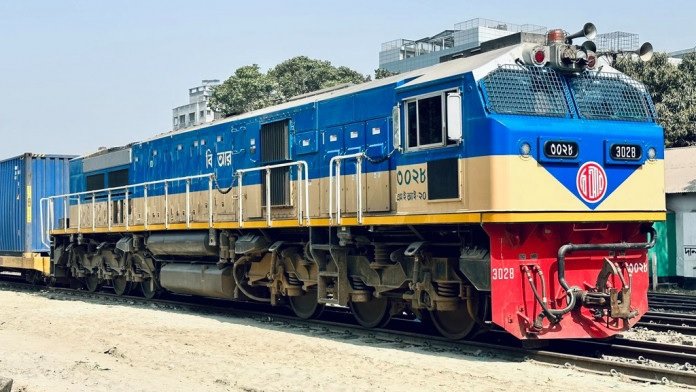
A severe shortage of locomotives has crippled Bangladesh Railway's container transportation services, sharply reducing freight train operations between Chattogram Port and Dhaka, creating congestion at the country's busiest seaport and disrupting supply chains for importers and industries.
Railway data show container train operations on the Chattogram-Dhaka-Chattogram route fell to just 62 round trips in May this year, the lowest monthly figure in nearly 18 months. The decline comes as the railway struggles to allocate enough locomotives for freight services while prioritising passenger trains.
Officials say the shortage has significantly slowed the movement of import and export cargo, causing containers to remain stranded at Chattogram Port and Kamalapur Inland Container Depot (ICD) for weeks, increasing costs for businesses and affecting the timely supply of raw materials.
"Locomotive shortages are the main reason behind the reduced container train services," Bangladesh Railway Director General Md Afzal Hossain said.
"It is not possible to suspend passenger trains because tickets are sold well in advance. We have to allocate locomotives to passenger services first, and whatever remains is used for container trains. We need three to four locomotives daily for container operations, but on many days we can provide only two or three," he said.
Railway officials said the crisis has become so acute that locomotives are sometimes detached from moving freight trains and reassigned to passenger services, leaving cargo trains stranded midway.
As a result, journeys that normally take seven to eight hours are now taking up to three or four days, delaying deliveries of containers, fuel and other essential commodities.
According to railway statistics, container train operations fluctuated throughout 2025. The highest number of trips—140—was recorded in both March and April. The number then declined steadily, falling to 73 in December.
The downward trend has continued this year. After recording 104 trips in January, 106 in February and 119 in March, operations dropped to 102 in April before plunging to just 62 trips in May.
An internal emergency message sent to Bangladesh Railway's Eastern Zone headquarters on June 29 revealed that 13 container train rakes carrying 546 TEUs remained loaded at Chittagong Goods Port Yard (CGPY) awaiting locomotives. Three oil train rakes were also stranded for extended periods.
The message said at least six to seven locomotives are needed daily to clear the backlog, but the railway has been unable to provide them because of the acute engine shortage.
Officials said CGPY, which has a storage capacity of 887 TEUs, at one stage held around 1,658 TEUs, almost double its designed capacity.
Port authorities estimate that at least four pairs of container trains should operate daily to transport around 200 TEUs to Dhaka. Instead, only one to three train pairs have been running on many days, while on some days no container trains operated at all.
Consequently, some containers have remained at the port for three to four weeks, forcing importers to pay additional storage charges and delaying industrial production.
According to Bangladesh Railway, the Eastern Zone requires around 119 locomotives daily, but only 70 to 74 are currently available for operation.
Although around 16 locomotives are needed every day for freight services, only two or three can usually be allocated. On some days, not a single locomotive is available for cargo transportation.
Bangladesh Railway currently has 271 locomotives, of which only 177 are operational. The remainder are undergoing maintenance or repairs.
Of the operational fleet, 90 are metre-gauge and 87 broad-gauge locomotives. Railway officials said nearly 65 percent of metre-gauge and 45 percent of broad-gauge locomotives have already exceeded their economic lifespan, making breakdowns increasingly common.
Eastern Railway General Manager Mohammad Subaktagin said years of underinvestment in new locomotives had led to the present situation.
"Passenger services cannot easily be cancelled because tickets are sold in advance. As a result, freight trains often have to wait. We have increased repair work and initiated projects to procure new locomotives. Once those projects are implemented, cargo services will gradually return to normal," he said.
Additional Director General (Rolling Stock) Fakir Md Mohiuddin acknowledged that the shortage has accumulated over many years.
"Previous procurement initiatives were delayed, which has worsened the crisis. The government has now prioritised both the import of new locomotives and the rehabilitation of old ones. While importing new engines will take several years, repairing existing locomotives should provide some short-term relief," he said.
Transport expert and Bangladesh University of Engineering and Technology (BUET) Professor Md Hadiuzzaman said Bangladesh needed a long-term strategy instead of relying solely on repairs.
"Railway planning has not been sufficiently commercial. A dedicated freight corridor between Dhaka and Chattogram should have been developed long ago, alongside expansion of ICD capacity. Increasing the number of locomotives alone will not solve the problem unless supporting infrastructure for container handling and storage is also strengthened," he said.
Industry representatives warned that prolonged delays in container movement could increase logistics costs, affect export competitiveness and discourage businesses from using rail for freight transportation.
Officials said the government is now working to increase the locomotive fleet and explore greater private sector participation in rail-based cargo transport, but acknowledged that meaningful improvements will take time.