“Among all the Muslim nations, Bangladesh registers an impressive growth in the Islamic finance industry that came into being in the country in1983. Since then, public demand for Islamic banking and financial services from businesses and the general public has been strong due to the country having the most Muslims (91%), constituting around 8% of the world’s total Muslim population. Increasing public demand and policy support have been the drivers of growth of the Islamic finance and banking sector in Bangladesh”, says in IFN Annual Guide 2022.
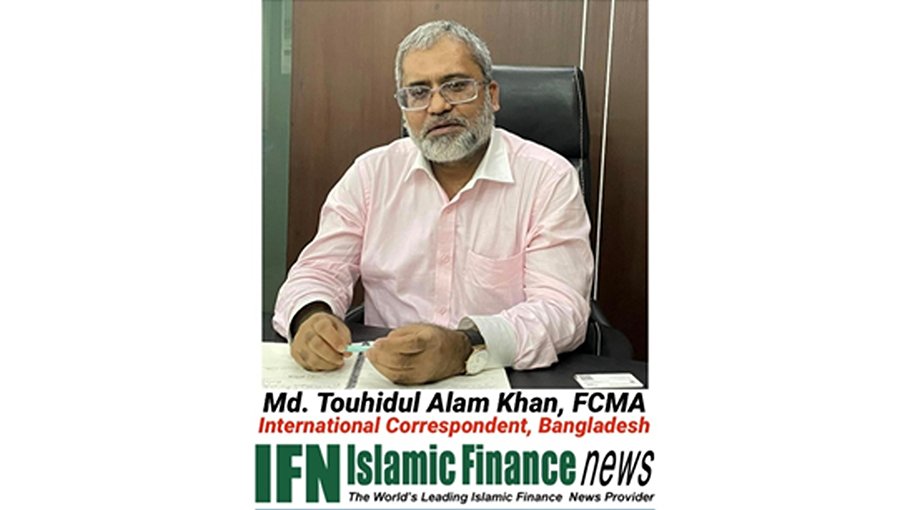
Like every year, Islamic Finance News (IFN), Malaysia, World’s Largest Islamic Finance News Provider published IFN Annual Guide in this January for the year 2022. In the guide, 50 country reports, write-up of 100 industry experts and 42 sector reports have been published. This year the country report on Bangladesh has been authored by Md. Touhidul Alam Khan in the titled “Bangladesh: Islamic finance industry keeps booming” published in January 2022 who is Additional Managing Director of Standard Bank Limited (a Shari’ah based Islami Bank in Bangladesh).
Touhidul Alam Khan is the international country correspondent of IFN, Bangladesh Chapter and he has contributed more than 25 reports during last one year to uphold the image of the country through providing news & reports on robust development of Islamic finance & banking industry in Bangladesh. He is contributing in IFN as author of country report on Bangladesh since 2011.
“As per a report of the central bank, Bangladesh Bank, the deposits in Shariah-based banks in Bangladesh have increased by 12.61% for the period of January to June 2021. It has been observed that the total deposits in Shariah-based banks increased to BDT32.79 billion (US$375.03 million) at the end of June 2021 from BDT29.41 billion (US$336.37million) as of January 2021. In terms of investment for the Shariah-based banks in the country, it increased by 11.53% at the end of the June 2021 quarter from the end of December 2020. It is worth mentioning that excess liquidity in the Shariah-based banks increased to BDT363.65 billion (US$4.16billion) as of June 2021 from BDT293.17 billion (US$3.35 billion) as of December 2020”, mentioned in the country report of Bangladesh.”
“At the end of June 2021, there are 10 fully-fledged Islamic banks operating with 1,569 branches out of a total of 10,788 branches in the whole banking sector. In addition, 39 Islamic banking branches of eight conventional commercial banks and 194 Islamic banking windows of 13 conventional commercial banks are also providing Islamic financial services in Bangladesh. Presently, 33 out of the 60 scheduled banks are offering Islamic banking products and services”.
“Two conventional commercial banks, namely Standard Bank and Global Islami Bank, have converted into fully Shariah-based banks from January 2021, which also contributed to the increase in the overall market share of the Islamic banking industry in the country. Sukuk have been issued by the government of Bangladesh to finance a project toward the supply of safe water which added a new feather in the cap of the Islamic finance industry in Bangladesh”.
The government of Bangladesh should make the necessary amendments to the existing financial Acts, regulations, and laws to ensure that Islamic banks are able to operate smoothly amid a favorable economic environment, and that Islamic insurance companies along with other subsidiary businesses can be established. The central bank should take the initiative to develop certain instruments to manage finance and savings and create a specialized window for Shariah-based transactions.
A fully developed Islamic banking department should be established to analyze, monitor, supervise and guide Islamic banks toward the purposes of sustainable development as well as the overall development.
For Sukuk to be more popular and eventually outperform the country’s traditional bond market, the establishment of a secondary capital market is a plausible idea. In line with this, green Sukuk can be a newfound potential in this region where sustainable banking is strongly relevant. This development necessitates that a group of scholars with expertise in secular financing mechanisms and techniques and Islamic jurisprudence be nurtured. This initiative requires an effective and standard regulatory framework that must be enacted to create a level and fair playing field for all stakeholders of the Islamic finance and banking industry.
Islamic banks along with conventional commercial banks which have Shariah-based banking windows / branches should work to be part of AAOIFI. In addition, these companies need to adopt Shariah compliant fintech systems to ensure that financial transactions are carried out more efficiently.
Islamic Finance News (IFN) is publication of RedMoney Group, Malaysia. IFN is a digital, the journal provides exclusive and comprehensive coverage of the global Islamic financial markets through in-house analysis and expert external contributions, containing over 60,000 exclusive reports, the IFN portfolio also hosts a suite of proprietary tools including the industry’s largest interactive terminology glossary, a directory of over 4,000 global Islamic financial institutions and a portal to Islamic Banking Intelligence, the most comprehensive source of segmented Islamic banking financial data.
The Islamic banking industry of Bangladesh has great potential for growth that would allow it to maintain a position of strength among its neighboring competitor countries. With a promising pipeline for Sukuk and more Islamic banks and financial institutions offering innovative Shariah compliant products , a better outcome can be ensured.
Therefore, a more standardized and comprehensive regulatory infrastructure is required. In Bangladesh, Islamic finance is now one of the fastest and most sustainable financial sectors. At present, the market share of Islamic banks in the entire banking sectors tands at 27.26% in terms of deposits and 27.55% in terms of investments.
Despite the ills of the COVID-19 pandemic, 2021 has already been remarkable with far-reaching effects for the country’s Islamic banking industry due to the economic landscape being positively competitive and strong against the other conventional industries.
“A bigger Islamic banking presence will raise awareness among the Muslim-majority population on financial products that are Shariah compliant. The subsequent rise in demand is likely to out weigh the increased competition, which will in turn drive growth and profitability of the sector,”a Moody’s Investors Service analyst opined.
In the country report, it has been stated that Bangladesh requires an investment of around US$ 300 billion to fulfill the dream of becoming an upper middle-classcountry by 2031which is only possible through infrastructure development. For this purpose, innovation of Islamic finance products like Sukuk and other Shariah-based infrastructure financing tools can bring a new frontier for Bangladesh.
Touhidul Alam Khan in an interview with “Professional Wealth Management“, a publication of The Financial Times, London said, “it needs the monitoring of the Islamic financial institutions through effective supervision by a regulatory authority under Islamic Sharia, a global policy for pricing Islamic financial products, and a uniform accounting standard all over the world.”
Khan also stresses the importance of establishing appropriate risk and liquidity management techniques and greater clarity around Sharia-based legal and tax restrictions in his interview, who is also the fellow member of Institute of Cost & Management Accountants of Bangladesh (ICMAB) and first Certified Sustainability Reporting Assurer (CSRA) in Bangladesh.