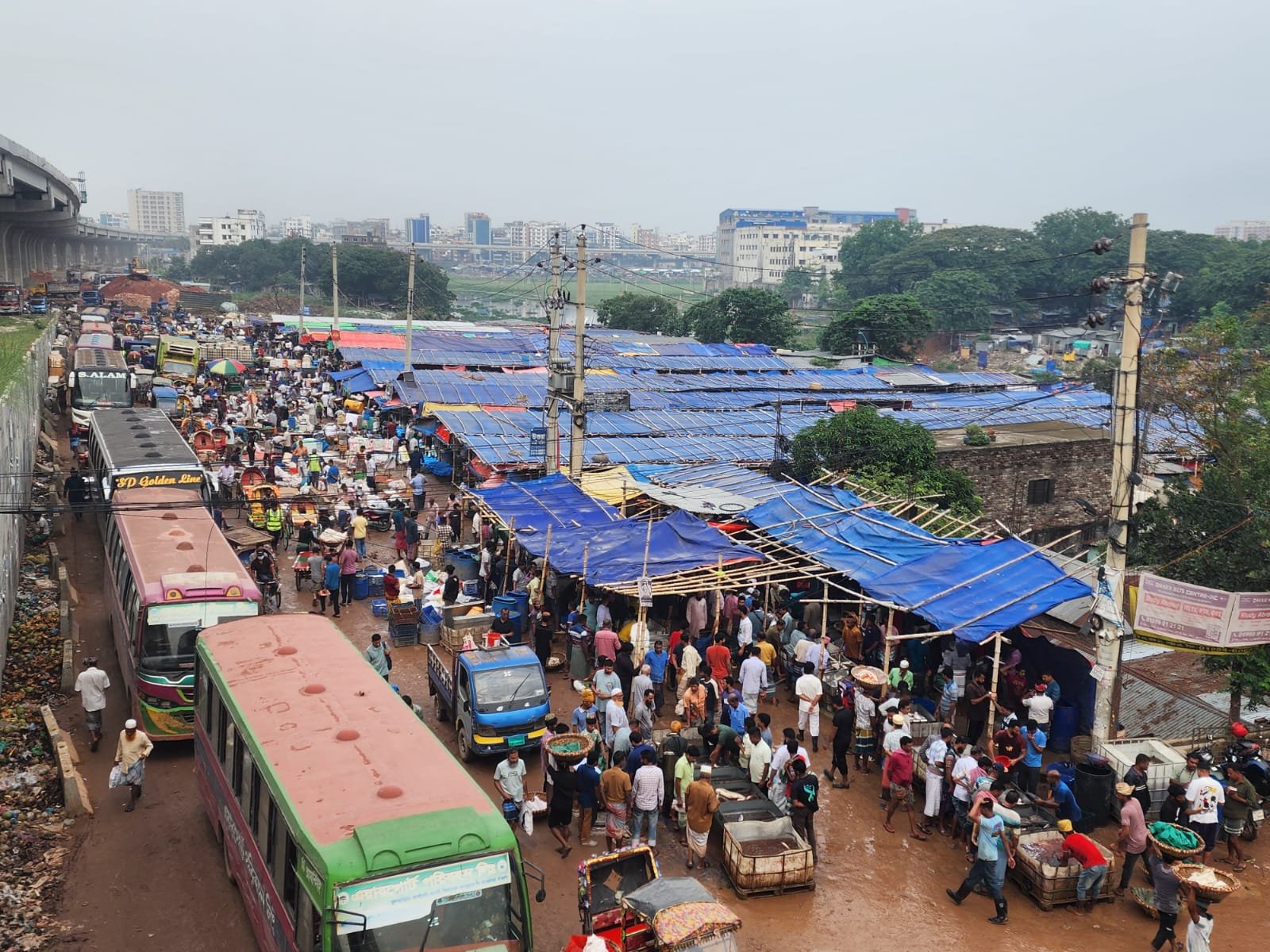
A powerful syndicate has allegedly occupied nearly 1,000 decimals of government land along a section of the Turag River under the ministries of water resources and shipping, turning the area into a lucrative source of illegal income worth several crores of taka annually.
The alleged encroachment, stretching from Abdullahpur to the Ashulia embankment and parts of Khidir Khal, has reportedly taken place with the involvement of a nexus comprising land grabbers, corrupt officials, political actors and local musclemen.
According to allegations and local accounts, the syndicate has established illegal structures, markets and commercial facilities on occupied river land and is collecting between Tk 15 lakh and Tk 17 lakh in rent and extortion every day. Monthly earnings from the illegal operations are estimated to exceed Tk 5 crore.
Locals alleged that portions of the money are distributed among dishonest officials of the Bangladesh Water Development Board (BWDB) and the Bangladesh Inland Water Transport Authority (BIWTA), political leaders, law enforcement personnel and influential land grabbers.
Residents said two large fish wholesale markets have been built by occupying the Tongi canal adjacent to Abdullahpur main road, once considered part of the Turag River.
The occupation was allegedly carried out under the leadership of local land grabbers Rezaul Ahsan Mahmud alias Arun Shah and Billah Hossain Mahmud alias Tarun Shah. SI Tutul, joint convener of Uttara East Thana BNP, and Milon, former expelled convener of Uttara West Thana Jubo Dal, have also been accused of facilitating the process.
Adjacent to the market, a man identified as Haji Jalal Uddin has reportedly installed ownership signboards claiming parts of the occupied land as private property. The signboards have partially obscured official government acquisition notices erected by BWDB.
Residents alleged that the illegal markets have created severe traffic congestion on the Ashulia-Abdullahpur road almost every day from morning until noon.
They said fish-laden trucks arriving from different districts leave mud, waste and garbage scattered across the road, paralysing traffic movement and creating an unhealthy environment.
Locals also alleged that the market areas have become centres for drug-related activities, gradually making the neighbourhood unsuitable for residential living.
During a recent visit, this correspondent found a concrete jetty built by BIWTA at a cost of several lakh taka lying abandoned behind the market area. Locals blamed poor management and lack of oversight for the infrastructure remaining unused.
Truck drivers alleged that extortion is rampant in the area. They claimed Tk 500 is being collected from every goods-carrying truck entering the market zones.
In addition, shop owners are allegedly forced to pay daily fees in the name of the “Abdullahpur Fisheries Traders Cooperative Society Market”.
Sources said that although extortion syndicates temporarily went into hiding following the political transition on August 5 last year, many have since resumed operations allegedly under the protection of local BNP leaders.
Separate extortion rackets are also active in the nearby fruit market adjacent to the switchgate area, locals alleged.
They said that while the market was previously controlled by leaders affiliated with Jubo League, multiple groups are now collecting money there using political influence and identity.
Locals further alleged that despite years of illegal occupation and business activities, no effective action has been taken because of the involvement of influential political figures and corrupt officials.
There are also allegations that money collected from the fish and fruit markets is occasionally used to finance political programmes and events organised by local representatives.
Encroachment along the Turag riverbank has expanded beyond markets.
A private university has allegedly constructed a boundary wall on occupied river land in the Tongi section of the river.
Near the Taltola bus stand bridge under Turag Police Station, a company named Domino Concrete has reportedly established a ready-mix concrete factory by filling parts of the river.
Several river boundary pillars were found inside the factory premises, while additional land on the western side has also been filled, according to local residents.
In Bhatulia area, around 100 feet of river land along the Abdullahpur-Ashulia road has reportedly been occupied in the name of a proposed medical college and hospital project.
Two industrial entities -- Simran Composite Limited and Zara Knit Composite Limited -- have also allegedly filled portions of the river east of the Ashulia-Mirpur connecting road.
Meanwhile, at least 40 occupiers operating between Diabari embankment and Tongi Bridge are reportedly extracting sand from the Turag River using dredgers for commercial purposes.
An investigation report prepared by the land ministry identified several institutions involved in river encroachment and noted irregularities in the installation of river boundary pillars.
According to the report, in some areas boundary pillars were placed far inside the river instead of along the actual river boundary, effectively shrinking the officially recognised river area.
The report also noted that in parts of Birulia, the Turag River has become so narrow due to encroachment that multiple vessels can no longer pass side by side.
Under the Port Rules, 1966, land extending 150 feet from river boundary pillars falls within protected river port zones and cannot be developed without prior approval from the port authority.
However, numerous factories and structures have already been built along the riverbanks without authorisation, while several more are currently under construction.
Contacted, Md Mamunur Rashid, assistant director of Tongi River Port, told The Bangladesh Post that strict action would be taken against individuals illegally claiming ownership of riverside land or constructing structures there.
“Such activities are completely illegal. Those occupying river land and establishing markets or structures are essentially committing fraud and are identified as river grabbers,” he said.
He added that eviction drives against temporary fish and vegetable markets and other illegal establishments would begin once directives are received from the relevant ministry and higher authorities.
Necessary legal steps would also be taken to restore the river’s natural flow and navigability and recover government property, he added.
However, allegations also exist against the same official regarding the collection of regular payments from illegal establishments operating in the area.
Recently, Shipping Minister Sheikh Rabiul Alam informed parliament that the National River Conservation Commission had updated its nationwide list of illegal river encroachers.
According to the updated list, there are currently 21,982 illegal encroachers occupying rivers across the country.
Deputy commissioners have been instructed to publish the lists on official websites and submit action plans for eviction drives.
The government is also preparing a broader initiative focused on the four rivers surrounding Dhaka -- Turag, Tongi Khal, Balu and Shitalakkhya -- aimed at restoring river routes, improving water quality and ensuring sustainable urban and environmental management.
As part of the initiative, the water resources ministry has proposed a project titled “Project Preparatory Study for Metro Dhaka Water Security and Resilience Programme” to the Planning Commission.
The proposed preparatory study is estimated to cost Tk 15.4 crore, including Tk 3.53 crore from government funds and Tk 11.86 crore in foreign grants.
A Project Evaluation Committee meeting held on August 21 last year made four recommendations regarding the project proposal.