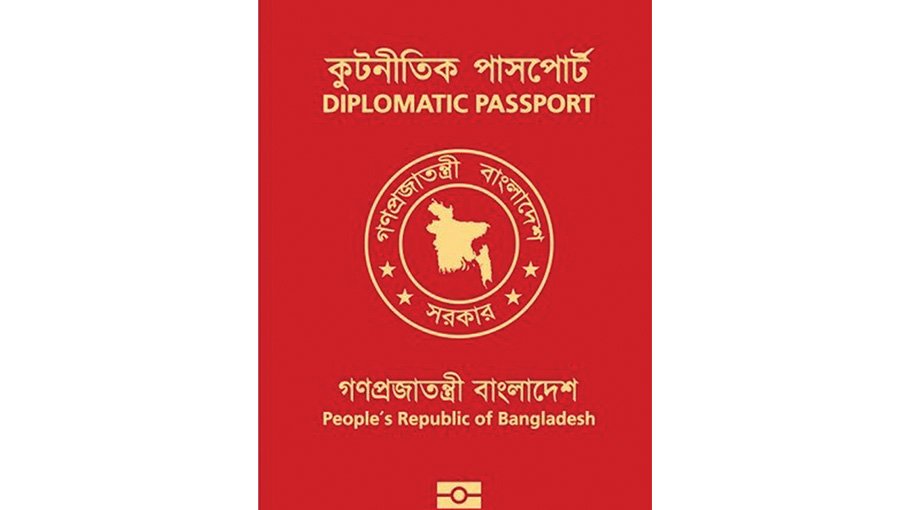
The government has decided to cancel all diplomatic (red) passports, including those allocated for former ministers and Members of Parliament (MPs).
According to officials concerned of the Security Service Division of the Ministry of Home Affairs, the government has already started the process of taking necessary steps in this regard.
The sources said a discussion was held at the ministry in this regard recently, and an order will be issued within the shortest time.
A senior official of the Security Service Division of the Ministry of Home Affairs said, the Department of Immigration and Passports (DIP) has already been directed in this regard and the DIP too started the process. Hopefully, the order will be issued soon.
The move comes over two weeks after the fall of the Sheikh Hasina-led Awami League government on August 5.
Along with members of parliament, their family members also carry diplomatic passports.
Asked about cancelling the MP’s family members’ passport status, the senior secretary said, “As we are cancelling the diplomatic passport of the primary holder, automatically their family members’ passports will also be cancelled.
“If anyone [holding a diplomatic passport]
wants to take a new passport, then the person has to surrender the diplomatic or red passport first and then an ordinary passport will be issued as per law,” he added.
Ministry sources said once the red passport is cancelled, former ministers and MPs who have criminal cases against their names or have been arrested may have to go through a legal process to get ordinary passports.
In that case, they can apply for a general passport only after getting a court order.
Along with the MPs, the officials of Bangladeshi missions abroad also get red passports. Those with red passports do not need a visa to travel abroad. They get a visa on arrival after landing in their respective country. Red passports or diplomatic passports are red in all countries.
Once the cancellation order is issued, former MPs or ministers who are currently abroad have to surrender their red passports to the DIP office in the respective countries or after coming back to Bangladesh.
According to ministry sources, former prime minister Sheikh Hasina was a red passport holder. In the face of a mass uprising against her government, Hasina took refuge in India on August 5 after the fall of the government.
Several former ministers and MPs of the AL government have already been arrested. Some fled abroad before the fall of Sheikh Hasina’s government to avoid arrest.
However, there were no reports of anyone fleeing abroad after the fall.
Many former ministers and MPs are still hiding in the country, and law enforcement agencies are conducting drives to arrest them as over two dozen cases have already been filed against them.
According to the passport department, the ministers and MPs get diplomatic passports (red passports) for five years of the tenure of the parliament after the formation of a new government.
When the term of parliament ends, the validity of the passport also ends.
Dhaka likely to sign intt’l convention on forced disappearances soon
Bangladesh has decided to sign the International Convention for the Protection of All Persons from Enforced Disappearance soon.
The issue has been discussed in the meeting of the Advisory Council of the interim government.
The signing may take place before August 30, Chief Adviser’s press secretary Shafiqul Alam told reporters on Wednesday evening.
He said the interim government is committed to investigate each and every case of enforced disappearances.
Alam said a National Security Adviser will be appointed soon.
There is a discussion to form a commission to look into the cases of disappearances.
The press secretary was briefing the reporters at the Foreign Service Academy.
Alam said the government also wants to bring back laundered money, including from the UK.
Interim Government Chief Adviser Professor Muhammad Yunus sought support from British High Commissioner Sarah Cooke’s support in this regard.
The High Commissioner assured him of looking into it.
Earlier, the British High Commissioner and Japanese Ambassador separately met the Chief Adviser.
Prof Yunus sought Japan’s financial support to rebuild Bangladesh.
He conveyed to both the envoys that Bangladesh is a big family and there is no enmity, and laid emphasis on greater harmony in the country.
Both the envoys conveyed to the Chief Adviser that they stand ready to support the interim government.