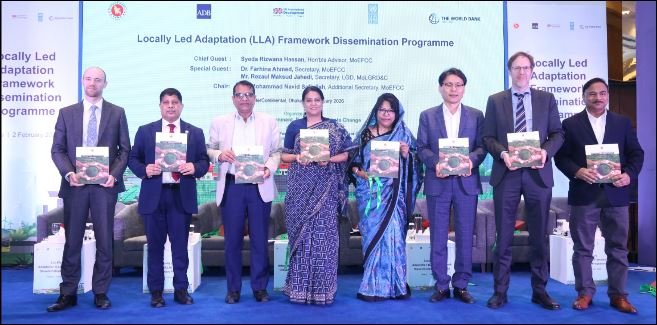
The Ministry of Environment, Forest and Climate Change (MOEFCC), on 02 February, launched the dissemination of ‘The National Framework and Action Plan for Locally Led Adaptation (LLA)’ in Bangladesh, one of the first frameworks of its kind globally. The framework was approved by the Cabinet in May 2025 signifying Bangladesh’s commitment to building a climate-resilient nation.
The event supported by the Asian Development Bank (ADB), the Foreign, Commonwealth and Development Office (FCDO) of the British High Commission, the United Nations Development Programme (UNDP) and the World Bank took place in Hotel InterContinental, Dhaka. Around 150 participants representing governent ministries, development partners, national and international NGOs, climate activists, academia, and civil society. The event was Chaired by Mohammad Navid Shafiullah, Additional Secretary (Climate Change Wing), MOEFCC.
The dissemination marks a major milestone in Bangladesh’s efforts to translate its climate commitments into actionable, locally driven adaptation measures. The framework development process was led by the LLA Framework Formulation Committee, chaired by the Additional Secretary (Climate Change Wing) of MOEFCC. ADB, World Bank, and UNDP provided technical and advisory support in the process. ADB provided technical assistance under its Community Resilience Partnership Program (CRPP).
Speaking as the Chief Guest, Syeda Rizwana Hasan, Hon’ble Advisor, MoEFCC, emphasized the framework’s pivotal role, “This locally led adaptation framework is about connecting policy with implementation, ensuring that plans are not just documents but are translated into action by ministries and local government institutions delivering adaptation on the ground.”
Dr. Farhina Ahmed, Secretary, MoEFCC, highlighted the need for strategic climate finance: “With climate finance being limited and highly competitive, this framework ensures that every resource is used wisely, coordinated effectively, and delivers maximum impact for adaptation across Bangladesh.” She also suggested that the Bangladesh Climate Development Partnership (BCDP) serves as an appropriate platform to translate the framework’s vision into significant action.
Special Guest Rezaul Maksud Jahedi, Secretary, Local Government Division, underscored the importance of collective commitment: “The framework is a strong foundation, but it remains only words on paper without our collective effort. Today’s dissemination marks just the beginning of making it real.”
Reaffirming ADB’s commitment “to supporting the government in turning this vision into action”, Ho Yun Jeong, Country Director, Bangladesh Residents Mission, ADB, noted that “ADB will support enhancing access to climate finance by helping national and local institutions strengthen systems to channel global and domestic climate finance efficiently to local governments and communities. ADB will focus on delivering tangible resilience outcomes, especially for vulnerable household, small holder farmers, women, entrepreneurs and the urban poor.”
Stefan Liller, UNDP Resident Representative, reaffirmed UNDP’s support: “Drawing from global experience and ensuring alignment with national systems, UNDP is proud to have contributed technically to the formulation of this framework in close partnership with MOEFCC, ADB and the World Bank.” He added that the framework will guide the scaling of locally led adaptation under LoGIC Phase II nationwide.
Nathaniel Smith, Team Leader, Climate and Environment, Foreign Commonwealth and Development Office (FCDO), British High Commission, hoped that this framework “will further cement Bangladesh's role as a global pioneer in showcasing what high quality, good locally led climate adaptation looks like in practice.” He asseverated UK’s commitment to “supporting its implementation and to working closely with all of you here today to make this a success.”
Mentioning that the framework creates a pathway to increase the share of climate finance reaching the local level, Kirtan Chandra Sahoo, Senior Environmental Specialist, World Bank, Bangladesh, told that, “Bangladesh has long been a regional leader in locally led resilience, and this framework further consolidates its commitment to operationalizing locally led climate action at scale.” He informed that “The World Bank is committed to collaborate closely with the government of Bangladesh to operationalize this framework, including strengthening institutions, building local capacity and aligning financing mechanisms.”
The key note speaker Arghya Sinha Roy, Director, Climate Change, ADB mentioned, “there's enough evidence globally that risk is best reduced when decisions around risk reduction is made at the local level and resources are made available to local communities and local governments, and this forms the crux of this framework about devolving decision making for local adaptation along with resources.” He added that “The National Adaptation Plan of Bangladesh has identified locally led adaptation as a priority, but more interestingly, it identifies the importance of locally led adaptation.
Because such a process enables us to unlock the potential and creativity of local communities to pursue adaptation.”
The LLA Framework guides community-driven climate action by empowering local governments within national systems.