Although women’s participation is increasing in some arenas, they are lagging behind in the elections and elected bodies in Bangladesh.
The number of women MPs, who have been directly elected from general seats in the 12th National Parliament, has decreased. A total of 20 women won the 12th general elections held this year, while the number was 22 in 2018 general polls.
The representation of women has also decreased in the local elections since the inception of direct elections in different tiers of local bodies at different times.
Experts on woman issues are of the opinion that many women are losing interest in elections as they cannot play the same role as the male elected representatives do. “Women lag behind in getting nominations as money and muscle power come into consideration,” said Lipika Biswas, senior director (women and youth program) of Democracy International. She is involved in a project called ‘Strengthening Political Landscape’ of the organisation. Woman representatives are called under the project for discussion at various times.
According to the World Bank, Bangladesh’s efforts to close the gender gap and ensure equal opportunities for women appear to be stagnating.
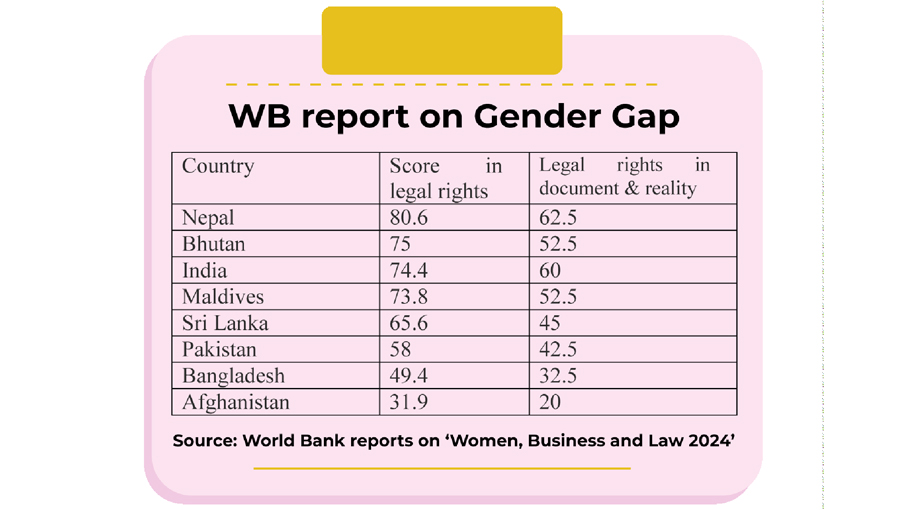
Although women in Bangladesh enjoy one-third of the legal rights of men in the workplace, the country lags behind other South Asian countries over creating women’s economic opportunity. Only Afghanistan is behind Bangladesh.
This scenario has been depicted in the latest report of the World Bank titled ‘Women, Business and Law-2024’.
The groundbreaking new World Bank report on 190 countries and territories was released on Monday, ahead of the International Women’s Day.
The International Women’s Day-2024 will be observed today (Friday) across the country as elsewhere in the world with the theme ‘Invest in Women: Accelerate Progress’. The day is celebrated annually on March 8 to recognise and honour the contribution of women. Marking the day, the Ministry of Women and Children Affairs and different other women, social and political organisations have taken various programmes.
The World Bank report provides a comprehensive scenario of the barriers women face in the workforce. The global gender gap for women in the workplace is far wider than past. On average, women in the world receive 64 per cent of the legal protections compared to men. Although legal protection is on paper, in many cases it is not in practice.
According to the World Bank’s last year (2023) report, the number of Bangladesh in the index of legal rights in documents was 49.4. This time, Bangladesh got the same number in this index. It means Bangladesh could not improve in this field.
The index takes into account eight indicators structured around women's interactions with the law as they move through their lives and careers such as mobility, workplace, pay, marriage, parenthood, entrepreneurship, assets and pension.
The overall score for Bangladesh is lower than the South Asia regional average (63.7) and also the global average score (77.9). However, Nepal (80.6) scored the best in the region followed by Bhutan (75), India (74.4), and the Maldives (73.8).
Meanwhile, Afghanistan scored the lowest at 31.9, followed by Bangladesh and Pakistan (58.8).
While Bangladesh’s position is unchanged over women's economic opportunity and some other indicators, the women in the country is lagging behind in electoral bodies, including National Parliament and local government bodies.
The number of woman MPs in the current Parliament is 20, which was 22 in 11th Parliament formed following 2018 general elections. Between 2008 and 2024, the number of women members directly elected to the parliament ranged from 18 to 22.
Awami League President and Prime Minister Sheikh Hasina won from Gopalganj-3 constituency in the current 12th Parliament, while Speaker Dr Shirin Sharmin Chaudhury from Rangpur-6, Matia Chowdhury from Sherpur-2, Dr Dipu Moni from Chandpur-3,Simeen Hussain Rimi from Gazipur-4, Habibun Nahar from Bagerhat-3, Rumana Ali from Gazipur-3, Syeda Zakia Noor Lipi from Kishoreganj-1, Sagufta Yeasmin from Munshiganj-2, Umme Kulsum from Gaibandha-3, Shahadara Mannan from Bogura-1, Jannat Ara Henry from Sirajganj-2, Sultana Nadira from Barguna-2, Khadizatul Anwar from Chittagong-2, Shaheen Akhter from Cox’s Bazar-4 and Nilufar Anjum Popy from Mymensingh-3.
Four women were elected in the 12th Parliament as independents. They are Joya Sengupta from Sunamganj-2 constituency, while Amatul Kibria Keya Chowdhury from Habiganj-1, Abdullah Nahid Nigar from Gaibandha-1 and Tahmina Begum from Madaripur-3.
However, majority of directly elected women came into politics due to kinship ties, as they have or had male family members who are or were involved in politics and MPs or ministers.
Researchers and experts on the issue said that most of the women who are elected in Parliament came into politics due to political heritage of their birth. “All but a few of the women we see directly elected in parliament come into national politics have established themselves in the politics because of the family connections. Most of those who have been elected to parliament have become MPs after the death of their father or husband or some other family member,” Mohammad Faisal Akber, an assistant professor at Daffodil International University; told the Daily Bangladesh Post. He obtained his M.Phil degree on family dynasty from Dhaka University.
However, many have been established by politics for a long time. One such woman is Tahmina Begum who won from Madaripur-3 constituency. She has been in politics for 44 years. She was MP from the reserved seat for women and the President of Kalkini Upazila Awami League.
Tahmina Begum sought nomination from the party this time; but didn’t get ticket. Later, she became an independent candidate. She said that women’s arrival in politics was treated negatively. Now the attitude is being changed. However, more evaluation is needed in the field of women’s politics, she opined.
A total 1,969 candidates participated in the 12th general election. According to the Election Commission, there were 90 woman candidates among them. Women's participation is lower but the winning rate is higher. This time, more than 21 per cent of women candidates have won. Among the male candidates, about 15 per cent won.
A total of 50 seats are reserved in Parliament for women. However, there is no direct election in the reserved seats.
According to the Representation of the People Order (RPO), the political parties must have 33 per cent women members in all committees. This target was to be achieved by 2020. However, the time has been extended till 2030 due to failure of the political parties.
The women’s representation is decreasing more in local bodies than in Parliament. The local government elections take place in Union Parishad (UP), Upazila Parishad, Zila Parishad, municipality and city corporation in the country. Seats are reserved for women in all the tiers of the local government bodies.
Six UP elections have already taken place in the last 27 years since the system of direct elections in the reserved seats was introduced in 1997. The number of women candidates in the UP elections has been decreasing gradually.
According to a report of Democracywatch, about 90,000 women took part in UP elections in 1997. The women mainly took part in the elections at about 12,000 reserved seats. The number of female candidates for both general and reserved seats was 50,676 in 2003, while 46,200 in 2011, and 39,530 in 2016.
Nargis Begum, a former reserved-seat member of Dakshin Banigram Union Parishad at Kanaighat upazila in Sylhet; told the Daily Bangladesh Post that women members in local government bodies cannot do anything meaningful due to the structural constraints. So, their participation in the elections is decreasing.
The women’s participation in Upazila Parishad elections has also been declining day by day. A reserved vice-chairman post for women was introduced in 2009 elections. About 2900 women contested in that elections in the post and two other posts. The number came down to almost half in the 2014 elections as 1507 women took part in that election.
Maryam Begum, a former vice chairman of Kanaighat Upazila Parishad in Sylhet; said that the representation of women in the Upazila Parishad is basically symbolic. So, she did not take part in the 2019 upazila elections.
Like UP and upazila elections, the number of women contestants is also decreasing in municipal and city corporation elections.
Rights activists said that woman candidates face some challenges. Most of the religious values wanted to restrict women’s rights and equality and intentionally deny women’s political participation. On the other hand, the women generally don’t have huge money and muscle power. Being a male-dominated society, women councilors and members of local level bodies cannot ensure their due role in development activities as they are deprived of adequate government funds and proper working environment.