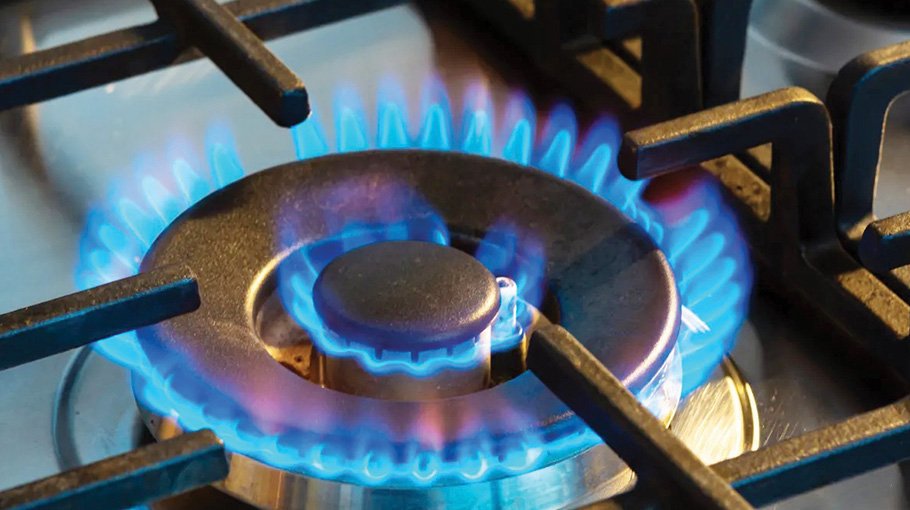
The country is grappling with a growing energy crisis as natural gas production has dropped gradually and demand continued to soar.
A source at the Ministry of Power, Energy and Mineral Resources claims that as of October 2024, gas production from 28 gas wells has fallen below 2,000 million cubic feet of gas per day (mmcfd), making the situation worse.
Bibiyana, the country's main gas field, now produces only 992.1 mmcfd. Earlier, it produced 1,200 mmcfd.
The country's demand reaches 4,200 mmcfd during peak hours. The national grid is still facing a shortfall of more than 1,100 mmcfd even after adding 1,100 mmcfd of LNG.
According to the annual report on gas production, distribution and consumption (2022-23) by Hydrocarbon Unit of the ministry, the average gas production from gas fields was 2,643 mmcfd in the fiscal year 2018–19. During FY 2019–20, it dropped to 2,423 mmcfd. A daily production average of 2,201 mmcfd was recorded during FY 2022–2023.
The authorities concerned are now concentrating on stepping up exploration and drilling efforts, as gas production cannot cope with the country's peak demand, according to the source at the Ministry of Power, Energy & Mineral Resources. Experts, however, caution that the crisis may worsen if the government does not provide support in this regard immediately.
The country currently relies on two Floating Storage Regasification Units (FSRUs) to supply up to 1,100
mmcfd LNG. However, logistic hurdles and issues with securing a steady supply of LNG have limited the full use of these units.
The government recently cancelled a contract signed with Summit Energy to set up a new terminal at Maheshkhali. It has also suspended negotiations with Excelerate Energy on RLNG supply from LNG infrastructure 70 km off the Kuakata beach. In addition, it has suspended negotiations with H Energy and Saudi Bangla Pipeline Company to supply RLNG through a pipeline from India.
Industry insiders say that given these circumstances, increasing gas supply from own fields through successful completion of two Petrobangla and BAPEX projects appears to be the only way to continue or boost production at this time. Because any initiative to increase LNG supply may take three years to go through the formal bidding process.
Experts point out that gas supply from Bhola to the national grid is the only alternative. If right choice is made now, this could also take three or four years. Additionally, the government terminated contract signed with Gazprom to drill Bhola gas field.
However, experts agree that tackling country’s gas crisis will require urgent and decisive action. While efforts are underway to boost local production, the success of these initiatives will depend largely on government support and efficient project execution. Without quick action, energy crisis may deepen.
State-owned Petrobangla and its subsidiary BAPEX are concentrating on boosting domestic production to overcome the crisis.
Janendra Nath Sarkar, chairman of Petrobangla, told the Bangladesh Post that efforts have been made to meet the ongoing demand because the demand is currently low due to winter. By the end of 2025, BAPEX plans to drill 50 new wells and perform 16 workovers, which will provide an extra 500–600mmcfd. In addition, LNG imports will continue, he added.
He also said more ambitious plans are underway. Petrobangla has outlined a broader initiative to drill 100 new wells over the next several years, targeting an additional 985 mmcfd of gas by 2028. These efforts are essential for slowing the rapid depletion of existing reserves and stabilising gas supply.
A source from Petrobangla said so far, 15 new wells have been drilled, exploring 176 mmcfd of gas, but only 76 mmcfd has been added to the national grid. The rest of gas could not be usable due to lack of pipelines.
But experts warn that even with this progress, the target of adding 648 mmcfd by 2025 remains ambitious.
Khondkar Abdus Saleque, an international energy consultant, expressed concerns over the decision to focus on increasing local production. In an article, he said that the success of this strategy hinges on the ability of Petrobangla and BAPEX to overcome significant logistical and financial challenges. The government’s support in terms of timely approval of projects, adequate funding, and administrative backing is critical to ensuring the success of these drilling programs.
Power, Energy and Mineral Resources Adviser Muhammad Fouzul Kabir Khan recently said the government has taken initiative to speed up exploration work for natural gas aimed at mitigating the prevailing energy crisis.
In fact, drilling and exploration projects face significant delays, primarily due to bureaucratic bottlenecks and slow land acquisition process. The approval for Development Project Proposals (DPPs) has also slowed, causing uncertainty over the timeline of these projects. BAPEX currently operates five rigs, but more equipment and workforce are needed to meet growing demand.