Staff Correspondent
Experts have called for establishing an independent, professional and accountable framework to manage the growing volume of non-performing and distressed assets in Bangladesh’s banking sector, including specialised Asset Management Companies (AMCs) and an effective secondary market for distressed assets.
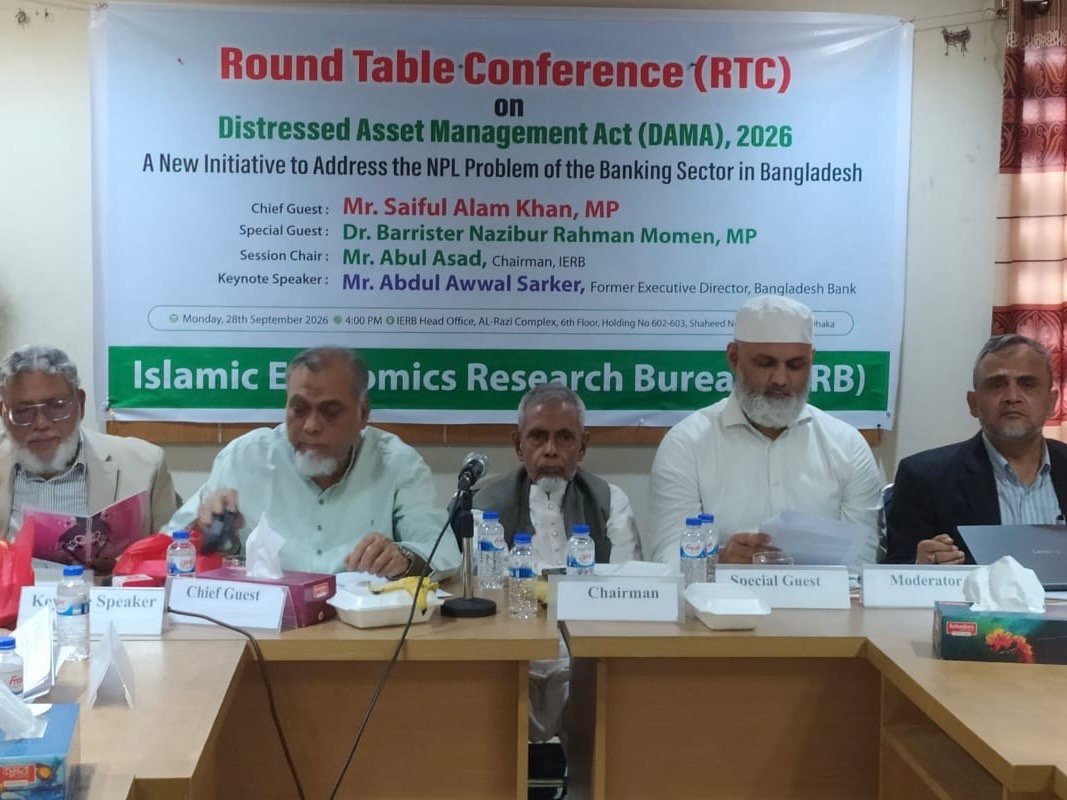
They made the recommendations at a seminar on the proposed Distressed Asset Management Law organised by the Islamic Economic Research Bureau (IERB) at its conference room in Dhaka on Monday.
IERB President Abul Asad chaired the seminar, while MP Saiful Alam Khan attended as chief guest and MP Dr Barrister Najibur Rahman Momen as special guest. Bangladesh Bank Executive Director Abdul Awal Sarker presented the keynote paper. IERB Secretary-General Dr Md Mizanur Rahman moderated the event.
Bankers, economists, researchers, policymakers and financial-sector experts discussed the proposed law, the possible structure of AMCs and international experiences in distressed-asset management.
Speakers said the rising volume of distressed assets was no longer merely a banking-sector concern, as it was directly linked to financial stability, investment, employment, productivity and economic growth.
They said a specialised distressed-asset management system could help banks recover value through restructuring, collateral management, business rehabilitation and asset disposal. Such a system could also reduce pressure on banks’ balance sheets and create scope for fresh lending to productive sectors.
Citing international examples, speakers referred to Sweden’s Securum, the US Resolution Trust Corporation, Malaysia’s Danaharta and South Korea’s KAMCO. They said these experiences showed that state support alone did not guarantee success. Independent decision-making, professional management, transparent valuation, strong legal powers and time-bound disposal were also essential.
Experts stressed that accurate valuation would be critical. Acquiring distressed assets at inflated prices could conceal losses, while excessively low valuations could harm banks, depositors and the financial system. They recommended independent valuations, multiple valuers and competitive auctions where necessary.
Speakers also warned that AMCs should not become institutions where banks simply park bad loans. They should have authority to restructure viable businesses, recover loans and dispose of assets effectively.
They called for faster Money Loan Court and insolvency proceedings alongside the proposed law.
The seminar also highlighted the need for a Shariah-sensitive framework for distressed assets of Islamic banks, with contract-specific restructuring and recovery mechanisms.
Speakers said success should be measured not merely by reducing the NPL ratio, but by actual asset recovery, business rehabilitation, bank-capital restructuring and restoration of normal credit flows.