Staff Correspondent
Experts at a post-budget discussion described the proposed FY2026–27 National Budget as a pragmatic effort to support economic recovery while laying the groundwork for long-term transformation.
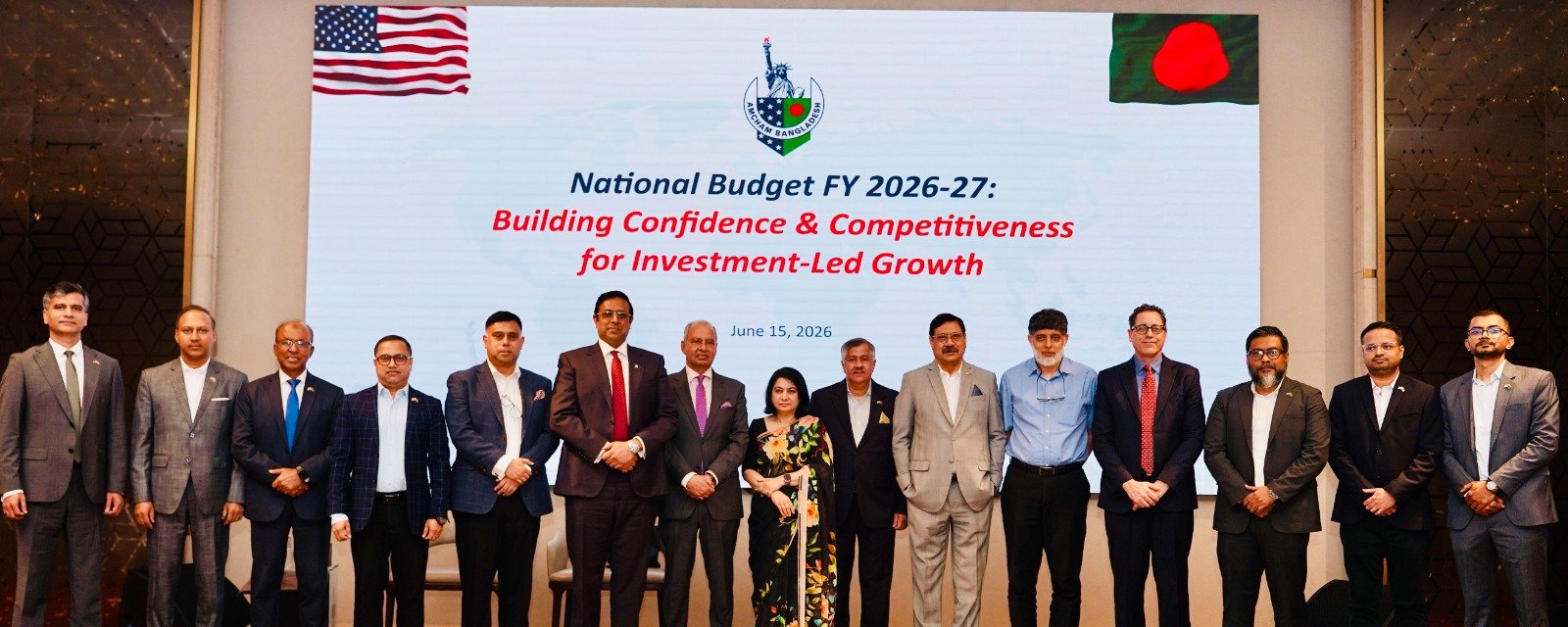
The American Chamber of Commerce in Bangladesh (AmCham) hosted the Post-Budget Panel Discussion titled “National Budget FY2026–27: Building Confidence & Competitiveness for Investment-Led Growth” on Monday at the Sheraton Dhaka.
Syed Mohammad Kamal, President of AmCham, welcomed measures such as the VAT exemption on recycled cotton, 0% turnover tax incentives for startups and technology-driven businesses, and continued support for renewable energy through tax exemptions and rebates.
While acknowledging these positive steps, he noted that some concerns of the business community remain and emphasized the importance of further tax rationalization to support investment, business growth, and long-term economic development.
Dr. M. Masrur Reaz, Chairman and CEO of Policy Exchange Bangladesh, presented keynote paper that provided a comprehensive overview of the proposed National Budget for FY2026–27.
Dr. M. Masrur Reaz described the proposed FY2026–27 National Budget as a pragmatic effort to support economic recovery while laying the groundwork for long-term transformation.
He noted that the budget sends positive signals for private sector-led growth through measures aimed at easing the burden on businesses, encouraging investment, and strengthening social protection.
At the same time, he observed that achieving the budget’s objectives will require overcoming significant challenges, including an ambitious 6.5% GDP growth target, a substantial increase in revenue mobilization, persistent inflationary pressures, and vulnerabilities in the banking and energy sectors.
The session was moderated by Ala Uddin Ahmad, Chief Executive Officer of MetLife Bangladesh, and featured Syed Mohammad Kamal, President of AmCham and Vice President of Mastercard; Naser Ezaz Bijoy, former CEO of Standard Chartered Bank Bangladesh; Dr. Fahmida Khatun, Executive Director of the Centre for Policy Dialogue (CPD); and Ahsan Khan Chowdhury, Chairman and Chief Executive Officer of PRAN-RFL Group, who shared their perspectives on the budget’s opportunities, challenges, and implications for the country's economic outlook.
During the panel discussion, speakers highlighted weak revenue mobilization as a key challenge for the FY2026–27 Budget, noting that revenue targets remain ambitious amid a subdued economic environment.
They cautioned that increased government borrowing from the banking system to finance fiscal deficits could crowd out private sector credit, placing upward pressure on interest rates and limiting access to financing for businesses.
In response to a question on the impact of inflation on vulnerable groups, panelists acknowledged the Government’s efforts to expand social protection measures but pointed out the need for stronger governance and targeting mechanisms.
AmCham Bangladesh welcomed several positive measures in the FY2026–27 National Budget, particularly those supporting sustainability, entrepreneurship, digitalization, and renewable energy.
While acknowledging the Government’s efforts to promote investment and economic stability, the Chamber noted that several key recommendations remain unaddressed and emphasized the importance of continued policy reforms to enhance competitiveness, strengthen investor confidence, and accelerate private sector-led growth.