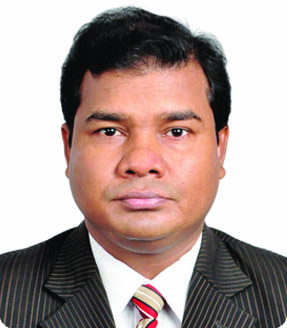
Ahammad Parvej Khan
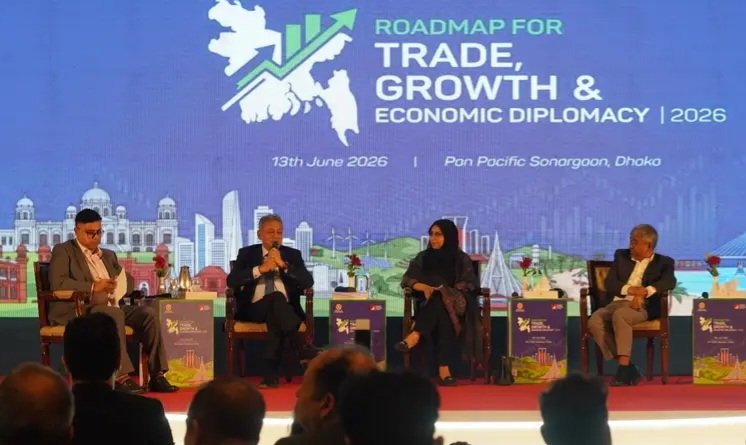
The Government of Bangladesh hosted one of the year's most consequential economic diplomacy forums, bringing together senior ministers, heads of mission, development finance institutions, multinational corporations and business leaders for Roadmap for Trade, Growth and Economic Diplomacy: Conference 2026.
Convened by the Ministry of Foreign Affairs and the Bangladesh Investment Development Authority (BIDA), the conference served as a platform to align policy, investment and international partnerships around a shared vision for sustainable growth, competitiveness and economic resilience.
Themed "Navigating Risks: Leveraging Resilience," the gathering assembled Bangladesh's senior-most policymakers alongside diplomatic missions, country directors of leading multilateral institutions, resident multinationals and apex chamber leadership to forge a concrete economic diplomacy agenda for the year ahead.
The conference was inaugurated by Foreign Minister Dr. Khalilur Rahman, President-Elect of the 81st United Nations General Assembly, who set out Bangladesh's forward-looking economic diplomacy vision before a high-level audience.
Executive Chairman of BIDA Chowdhury Ashik Mahmud Bin Harun presented Bangladesh's investment proposition, laying out the reform agenda and opportunities available to international partners. Foreign Secretary Asad Alam Siam moderated the opening session.
The first plenary, "The Policy Compass: Advancing Trade and Investment," brought together State Minister for Foreign Affairs Shama Obaed Islam, MP, and three Prime Minister's Advisers: Humaiun Kobir on Foreign Affairs, and Dr. Mahdi Amin on Education, Expatriates' Welfare, Labour and Employment, Session moderator Asad Alam Siam, Foreign Secretary. The session produced a clear public articulation of Bangladesh's 2026 economic diplomacy direction, covering market access priorities, LDC graduation transition strategy and the government's signals on investor confidence and competitiveness.
The second plenary, "Capital for Growth: Finance, Commerce and Trade," was led by Finance Minister Amir Khosru Mahmud Chowdhury, MP. Mr. Md. Abdur Rahman Khan Chairman, National Board of Revenue (NBR), and Barrister Jahrat Adib Chowdhury, MP, Former Deputy Managing Director of Banglalink, contributed to a wide-ranging discussion on financing reform, capital mobilisation and digital financial infrastructure. M Masrur Reaz, Chairman and Founder of Policy Exchange Bangladesh, moderated the session.
The third plenary, "The New Stage: Govt. Policy for AI, Creative Industries & Sport," highlighted emerging sectors as drivers of Bangladesh's future growth. Mr. Rehan Asif Asad, Hon'ble Adviser to the PM (Posts, Telecommunications, ICT & Science & Technology), delivered the special address. Mr. Ali Newaz Mahmud Khaiyam, MP, Hon'ble State Minister for Cultural Affairs, and Mr. Aminul Haque, Hon'ble State Minister for Youth and Sports, participated as panelists.
Representatives from the World Bank Group, Asian Development Bank, AIIB, IsDB and the IMF participated alongside foreign missions, resident multinationals and leading business chambers, making the conference one of the most diverse economic gatherings hosted by the Bangladesh government in recent years.
The conference concluded with a structured working luncheon at which the Bangladesh Partnership Dossier was distributed as a live working document across tables.
Delegates were also invited to submit a Partner Engagement Note, the responses from which will drive a series of closed-door follow-up roundtables to be convened by the ITIT Wing and BIDA in the months ahead. The Dhaka Forum Initiative served as Enterprise and Outreach partner.
The conference sent an unambiguous signal to the international community: Bangladesh is reform-minded, partnership-oriented and building new engines of growth with the same strategic seriousness it has long applied to its traditional sectors.
The outcomes of the day will now be translated into the Embassy Economic Engagement Matrix and the Confidential Signals Note, ensuring that the work of a single day drives Bangladesh's economic diplomacy agenda well into the second half of 2026.