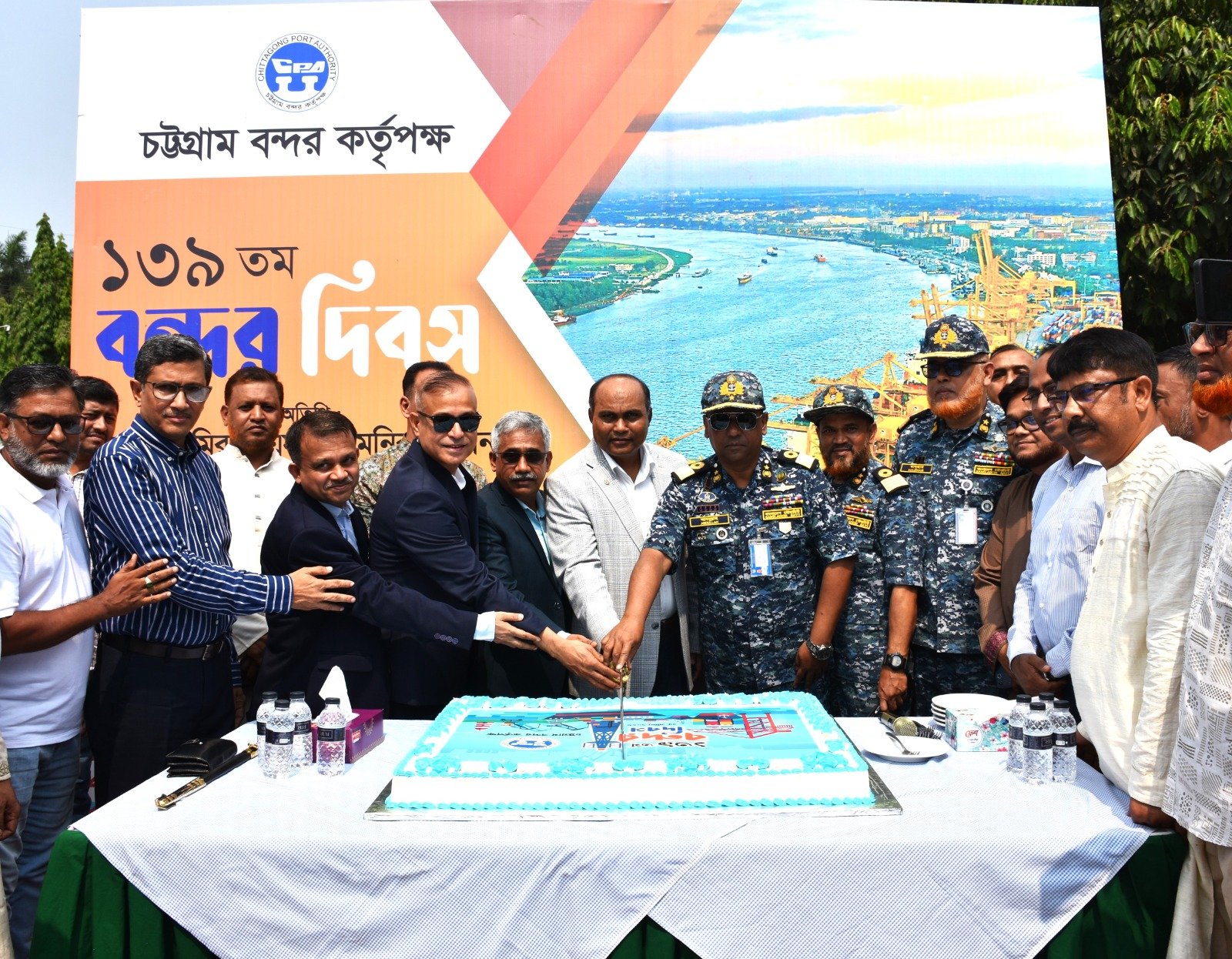
The 139th founding anniversary of the Chattogram Port Authority (CPA) was celebrated with due dignity and a festive spirit, featuring day-long programs to mark the occasion.
The celebrations began at 11:01 am on Saturday (April 25), when all ships and vessels under the port simultaneously sounded their whistles for one minute, marking “Port Day 2026.” Special prayers were also held at mosques, temples, and other places of worship within the port premises, with officials and employees participating to seek peace, prosperity, and continued development of the port.
On the day, special meals were served to inpatients at the port hospital.
Educational video presentations on port activities were arranged for students of port-run schools and colleges, alongside a day-long exhibition at the newly constructed One Stop Building. Key port installations were decorated with colorful banners and festoons.
As in previous years, the formal proceedings began with the hoisting of the national flag by Port Chairman Rear Admiral S M Moniruzzaman.
Members of the port, including those in charge of Harbour Master, Finance, Engineering and Administration & Planning, along with project directors of the Matarbari Deep Sea Port and Bay Terminal projects were present at the program.
Following the flag hoisting, the celebration continued with cake-cutting and exchange of greetings. Addressing the program, the chairman extended his wishes to port officials, employees, users, and stakeholders, emphasizing that the Chattogram Port serves as the lifeline of the country’s economy. He said that ongoing development projects would further accelerate economic growth and create more employment opportunities.
Special greeting advertisements were also published in local and national newspapers to mark “Port Day 2026.”
Like every year, April 25 is observed as Port Day, but this year carries added significance. The port has achieved a milestone by handling 3.4 million TEUs of containers, breaking a 48-year record. With a legacy spanning 139 years, the port has established itself not only as the backbone of the national economy but also as a key player in Bangladesh’s international trade.
The history of Chattogram Port dates back centuries, with its commercial importance recognized since the Portuguese era. The formal journey began after the British government enacted the Port Commissioners Act in 1887, which came into effect on April 25, 1888.
Port operations were conducted through wooden jetties along the Karnaphuli River. The first two temporary jetties were built in 1860, followed by the formation of the Port Commission in 1877. Two mooring jetties were established in 1888, and between 1899 and 1910, four permanent jetties were constructed. Railway connectivity was also introduced, boosting trade activities.
In 1926, the port was declared a major port. During the Pakistan era, it was transformed into a Port Trust in 1960, and after Bangladesh’s independence, it was reconstituted in 1976 as the Chattogram Port Authority, now operating as an autonomous government organization.
Currently, around 92 percent of the country’s import-export trade is handled through the Chattogram Port. Due to its strategic geographic location and regional connectivity, the port holds global significance and plays a vital role in keeping Bangladesh’s economy moving.
Modernization and Technological Advancement
The port is rapidly advancing towards modernization through business-friendly management, efficient cargo handling, digital transformation, automation, infrastructure development, and long-term investments.
The introduction of terminal operating systems, 5G networks, e-gates, e-billing, and digital payment systems has significantly improved service delivery. The ‘CPA Sky’ Port Single Window platform has integrated services, including those of the National Board of Revenue, into a unified system.
With the introduction of pre-arrival processing, customs clearance is completed even before ships arrive, reducing turnaround time, increasing capacity, and nearly eliminating vessel waiting times.
In the 2024–25 fiscal year and in 2025, the port handled 3.4 million TEUs, surpassing all previous records. Efficient management and technological advancements are considered key drivers behind this success, also contributing to reduced logistics costs.
The port has achieved “zero observation” in implementing the International Ship and Port Facility Security (ISPS) Code. Following guidelines from the International Maritime Organization, it has also undertaken “Green Port” initiatives, moving towards an environmentally sustainable and eco-friendly port system.
The port aims to transform into a world-class, secure, and competitive regional logistics hub. Direct shipping links with Europe and the Americas are expected to reduce costs further and open new horizons for Bangladesh’s export trade, officials said.