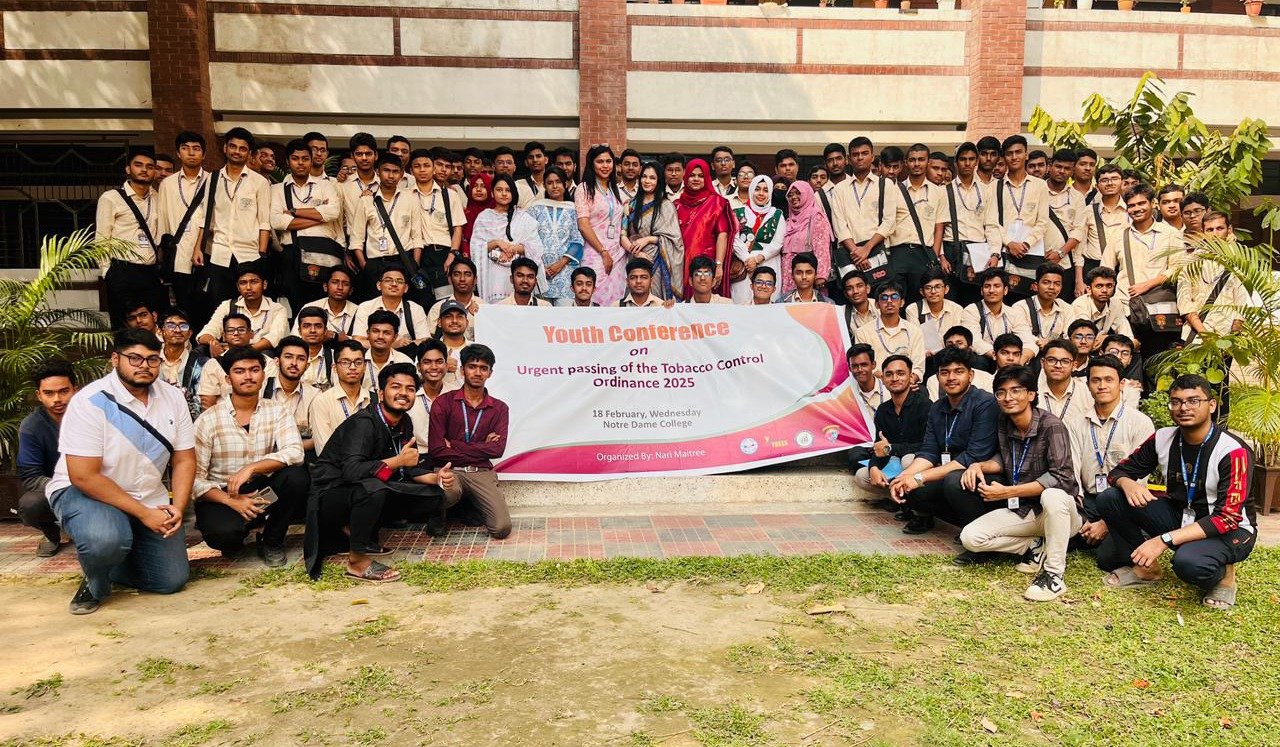
Bangladesh’s renewed journey began through the sacrifices and united movements of its youth. Yet today, it is young people who face the highest risk of death from the deadly grip of tobacco. To ensure their own protection, youth have strongly demanded that the approved Tobacco Control Ordinance be enacted into law at the very first session of the newly formed National Parliament.
On Wednesday (18 February), this demand was raised at a youth assembly titled “Demand for Enacting the Tobacco Control Ordinance into Law,” jointly organized by Nari Maitree and the Notre Dame College Socio-Economic Club at Notre Dame College. Farzana Hossain, a faculty member of the Department of Management at Notre Dame College and moderator of the Socio-Economic Club, was present as a special guest.
The assembly noted that, according to the World Health Organization’s Tobacco Atlas 2025, approximately 21.3 million people aged 15 years or older in Bangladesh use tobacco. Each year, nearly 200,000 people die from tobacco-related diseases—an average of more than 545 deaths per day. Tobacco use causes an estimated annual economic loss of BDT 392 billion, effectively turning the situation into a “tobacco epidemic.”
Against this backdrop, the Advisory Council approved the Smoking and Use of Tobacco Products (Control) (Amendment) Ordinance, 2025, proposed by the Ministry of Health and Family Welfare, at its meeting on 24 December 2025. The approved ordinance expands the definition of “tobacco products” to include nicotine pouches and any other nicotine products declared by the government from time to time, regardless of their name. It prohibits the use of all tobacco products in public places and public transport, bans the use, production, and marketing of emerging tobacco products, and makes designated smoking areas subject to government directives. The ordinance also broadens the definitions and scope of “public place” and “public transport,” bans all forms of advertising, promotion, and display of tobacco products—including online—and increases the size of health warnings on tobacco packaging from 50 percent to 75 percent of the surface area.
Farzana Hossain stated that the tobacco control ordinance approved by the interim government is a significant step toward reducing tobacco-related diseases and mortality. However, she warned that if it is not enacted into law at the first session of the newly elected parliament, its impact will remain limited.
She urged the newly elected government to give the highest priority to transforming the approved ordinance into law, ensuring it is not confined to paper but effectively implemented in the interest of public health.
She further added that although the tobacco sector generates around BDT 400 billion in annual revenue, the country suffers losses exceeding BDT 870 billion due to healthcare costs, loss of productivity, and premature deaths caused by tobacco use. The ordinance was approved to reduce these losses and prevent deaths, and its sustainable implementation requires passage by parliament.
Speaking on behalf of the youth, Md. Sabbir Foraji said, “Young people like us are the primary target of tobacco companies, because once a young person becomes addicted, they remain long-term consumers of tobacco products. In this context, the interim government’s approval of the tobacco control ordinance proposed by the Ministry of Health is undoubtedly a positive step. Now, it is the responsibility of the newly elected government to enact it into law—especially since political parties made commitments on this issue in their election manifestos. Therefore, to move forward with the goal of building a tobacco-free country, we strongly demand that the ordinance be passed into law at the very first session of the new parliament.”
More than a hundred students participated in the day-long youth assembly.