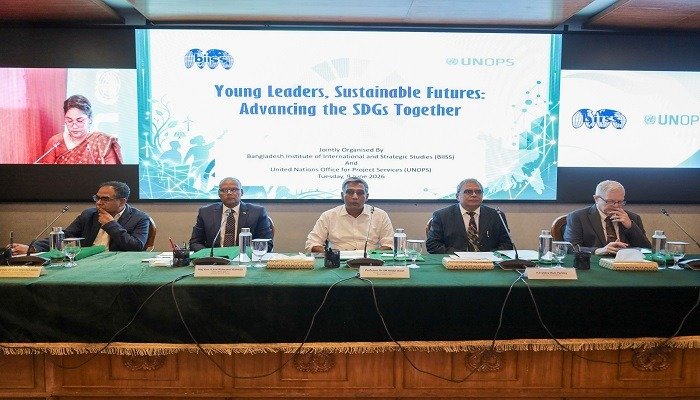
Young people can play a transformative role in advancing the Sustainable Development Goals (SDGs) and shaping a more sustainable, inclusive and resilient future for Bangladesh, speakers said at a seminar held in Dhaka on Tuesday.
The seminar, titled “Young Leaders, Sustainable Futures: Advancing the SDGs Together,” was jointly organized by the Bangladesh Institute of International and Strategic Studies (BIISS) and the United Nations Office for Project Services (UNOPS) at the BIISS Auditorium.
The event brought together policymakers, development practitioners, academics, youth leaders, representatives of civil society organizations and development partners to explore ways of strengthening youth engagement in achieving the SDGs and accelerating progress toward the 2030 Agenda.
Participants underscored that Bangladesh’s large youth population represents a significant asset for national development and that empowering young people through education, innovation, entrepreneurship and meaningful participation in policymaking can help address many of the country’s social, economic and environmental challenges.
Two keynote presentations were delivered during the seminar by Md Rafid Abrar Miah, Research Fellow at BIISS, and Professor Dr Kazi Maruful Islam, Department of Development Studies and Director of the Centre on Budget and Policy at the University of Dhaka.
The speakers highlighted the growing role of youth-led innovation, community engagement and policy advocacy in advancing sustainable development at the grassroots level. They also examined the opportunities and challenges facing young people, including access to resources, skills development, employment opportunities, technological adaptation and participation in decision-making processes.
Delivering the welcome address, Major General A S M Ridwanur Rahman, Director General of BIISS, emphasized that youth are among the most important stakeholders in Bangladesh’s development journey. He stressed the need to create an enabling environment that allows young people to contribute effectively to public policy discussions, social innovation and community development initiatives.
He noted that achieving the SDGs requires harnessing the creativity, energy and leadership potential of young citizens and ensuring that their voices are reflected in development strategies and national planning processes.
Secretary General of the BIMSTEC, Indra Mani Pandey, attended the event as the Guest of Honour, while Professor Dr S M Abdul-Awal, Principal Coordinator (SDG Affairs) at the Prime Minister’s Office, joined as the Special Guest.
Sudhir Muralidharan, Country Manager of UNOPS Bangladesh and Bhutan, delivered welcome remarks and reiterated UNOPS’ commitment to supporting youth engagement, localization of the SDGs and multi-stakeholder partnerships aimed at promoting sustainable development.
In his remarks, Muralidharan said young people should not be viewed merely as beneficiaries of development programmes but as active partners and drivers of change. He emphasized the importance of investing in youth leadership, innovation and entrepreneurship to accelerate progress toward the SDGs.
Addressing the gathering, Indra Mani Pandey highlighted the importance of regional cooperation and youth participation in tackling common development challenges across the BIMSTEC region. He said young leaders can play a vital role in promoting innovation, regional connectivity and sustainable growth while contributing to peace and prosperity in the region.
Professor Dr Abdul-Awal reaffirmed the government's commitment to implementing the SDGs and stressed the importance of incorporating youth perspectives into national development planning and policy formulation. He said meaningful youth participation is essential for ensuring inclusive and sustainable development outcomes.
During the discussions, participants emphasized that stronger collaboration among government institutions, development partners, academia, civil society organizations, the private sector and youth-led organizations is necessary to achieve the SDGs within the stipulated timeframe.
They called for expanding opportunities for youth leadership, strengthening institutional support mechanisms, promoting digital innovation and creating platforms that enable young people to actively contribute to local and national development initiatives.
The seminar concluded with a collective commitment to enhancing youth participation in SDG localization efforts and fostering partnerships that empower young people to become catalysts for sustainable development and positive social transformation across Bangladesh.