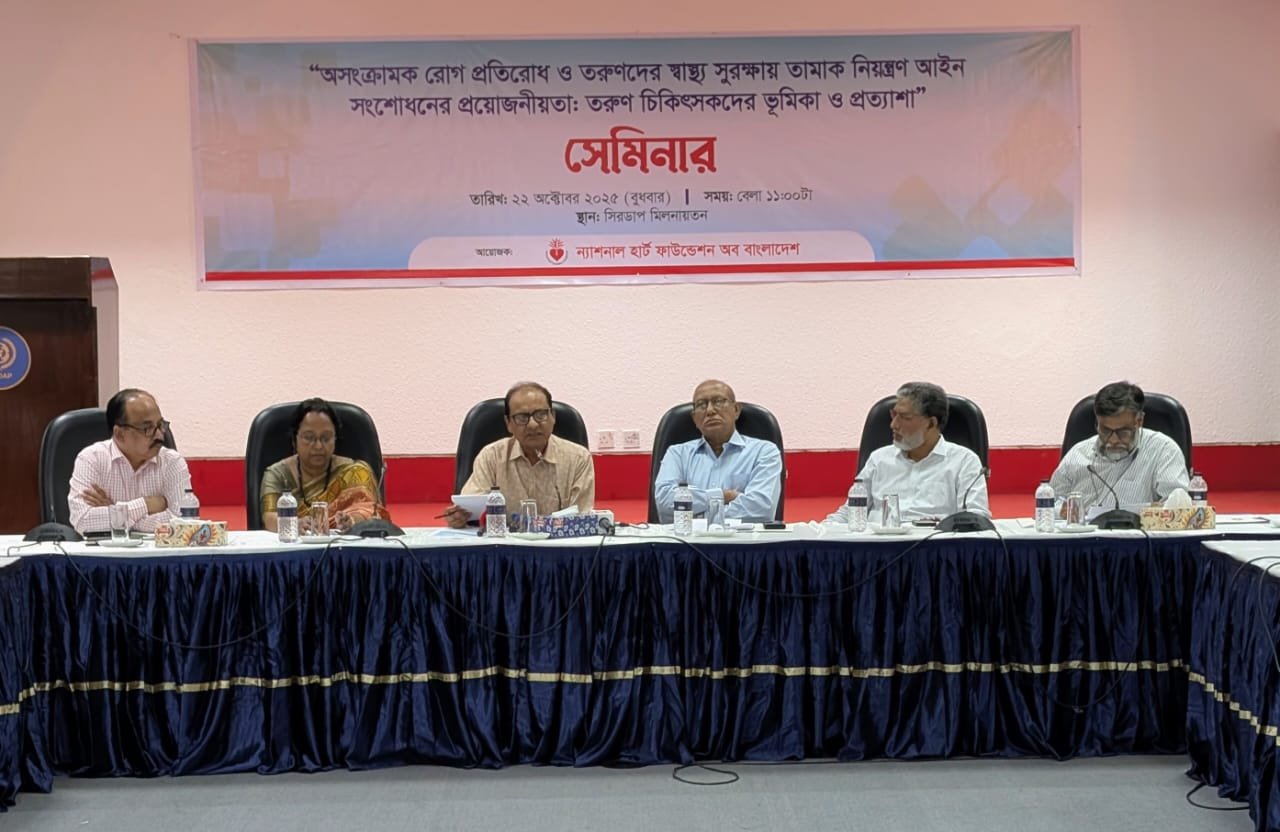
Young doctors have called for the immediate amendment of the Tobacco Control Law to curb the rising burden of non-communicable diseases (NCDs) such as heart disease, stroke, and cancer, and to safeguard children and youth from tobacco-related harms.
They warned that without urgent action, Bangladesh’s progress in public health and the Sustainable Development Goals (SDGs) could be undermined.
The demand was made on Wednesday at a seminar titled “Need to Amend the Tobacco Control Law for NCD Prevention and Youth Protection: The Role of Young Physicians,” organised by the National Heart Foundation of Bangladesh at the CIRDAP Auditorium in Dhaka.
In her keynote presentation, Dr. Farzana Rahman Munmun, Joint General Secretary of the Platform Doctors Foundation, highlighted data from the Global Youth Tobacco Survey (2013), which revealed that 9.2% of boys and 2.8% of girls aged 13–15 in Bangladesh smoke cigarettes, while 6.2% of boys and 2.9% of girls use smokeless tobacco. Moreover, 59% of students are exposed to secondhand smoke in public places and 31.1% at home.
Dr. Munmun warned that global tobacco and e-cigarette use among adolescents is increasing due to aggressive digital marketing by tobacco companies. She stressed that the proposed amendment to the Tobacco Control Act, initiated by the Ministry of Health, must be passed without delay to protect future generations.
Speaking as Chief Guest, Professor Dr. Bidhan Ranjan Roy Poddar, Adviser to the Ministry of Primary and Mass Education, described tobacco as a “silent killer” that damages not only the lungs but also the heart and brain.
“Hundreds of people die prematurely every day due to tobacco-related diseases, creating a major barrier to human resource development and economic growth. The law must be updated urgently to protect public health and prevent NCDs. I will personally communicate with the relevant authorities to expedite this amendment,” he said.
Dr. Mahfuzur Rahman Bhuiyan, Additional Director of the Bangladesh Hypertension Control Initiative under the National Heart Foundation, said secondhand smoke severely harms children, women, and the elderly. Over 61,000 children under 15 in Bangladesh suffer from diseases caused by exposure to secondhand smoke.
He urged the abolition of Designated Smoking Areas (DSAs), banning of tobacco product displays at points of sale, and prohibition of tobacco industry ‘Corporate Social Responsibility (CSR)’ activities, which often target youth.
Chairing the session, Professor Dr. Khondker Abdul Awal Rizvi noted that tobacco is a leading cause of NCDs, claiming over 161,000 lives annually in Bangladesh. He reiterated the need to enact the proposed amendments swiftly to protect the young generation.

The seminar presented six policy recommendations aligned with the FCTC: Abolish designated smoking areas (DSAs) in all public places and public transport; Ban the display of tobacco products at points of sale; Prohibit tobacco industry CSR activities; Introduce effective measures to regulate e-cigarettes for youth protection; Ban the sale of single-stick and loose tobacco products; and increase the size of pictorial health warnings on tobacco packaging from 50% to 90%.
The event was attended by Sheikh Momena Moni, Additional Secretary (World Health Division), Ministry of Health and Family Welfare; Sharaf Uddin Ahmed Choudhury, Divisional Commissioner, Dhaka Division; Md. Akhtaruzzaman, Director General (Joint Secretary), National Tobacco Control Cell; Professor Dr. Sohel Reza Choudhury, Head, Department of Epidemiology and Research, National Heart Foundation Hospital and Research Institute; Md. Naimul Azam Khan, Adviser, Tobacco Control Program, National Heart Foundation; Dr. Aruna Sarker, Program Coordinator; and Abu Jafor, Senior Communication Officer, along with representatives from various anti-tobacco organisations.
AU/BP