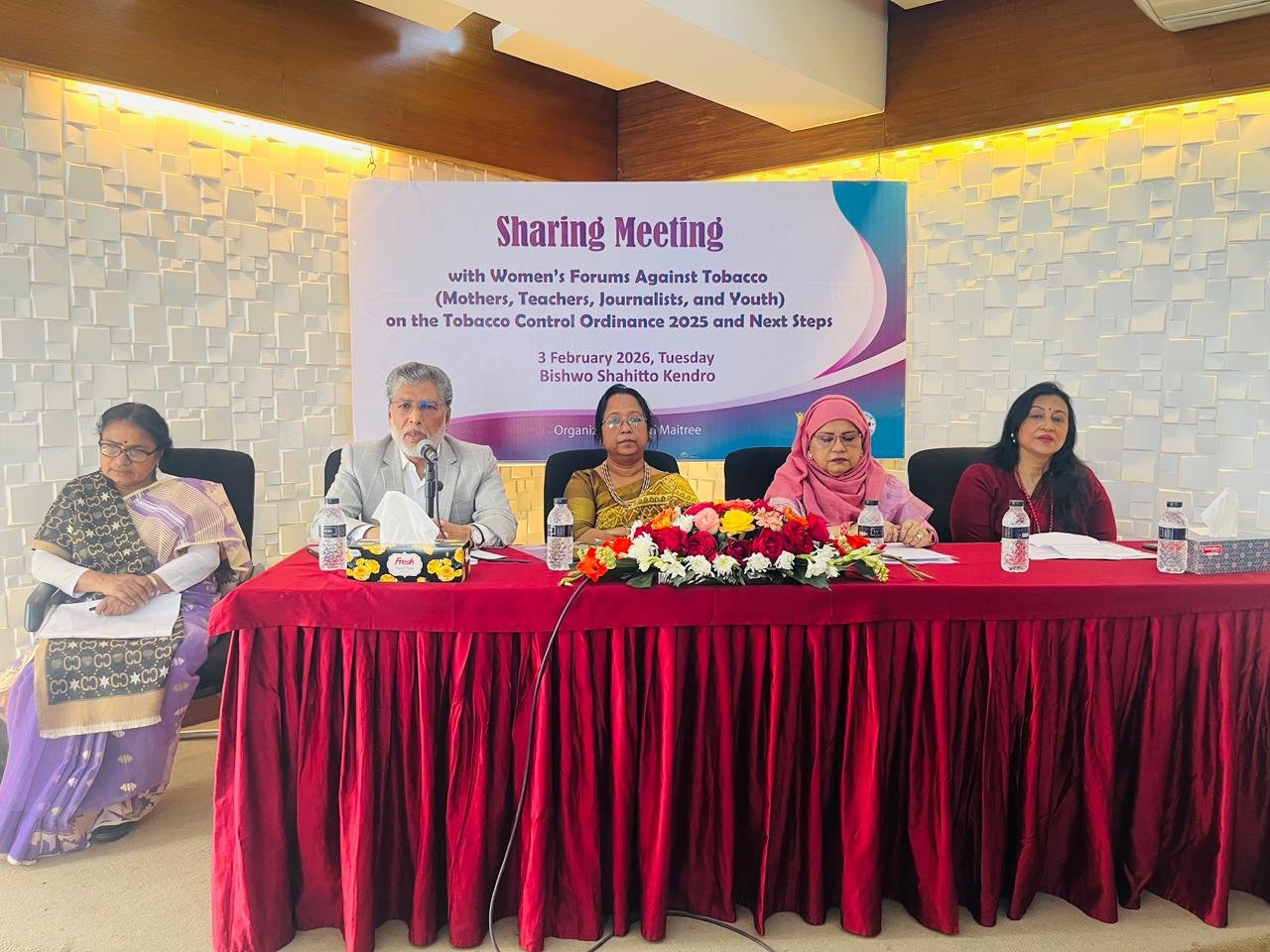
Women professionals from various sectors on Tuesday urged the authorities to pass the recently approved Tobacco Control Ordinance in Parliament during the first session of the upcoming legislature, warning that failure to do so could render the ordinance ineffective.
They made the call at a sharing meeting titled “Tobacco Control Ordinance 2025 and Next Steps”, organised by Nari Maitree at Bishwo Shahitto Kendro in the capital.
Speakers said that while the approval of the ordinance was a major milestone, the real challenge lay in ensuring its enactment and effective implementation so that it does not remain merely a policy document.
The meeting was chaired by Shaheen Akhtar Dolly, executive director of Nari Maitree. Additional Secretary (World Health Wing) of the Health Services Division Sheikh Momena Moni attended the programme as chief guest, while former BCIC chairman Md Mostafizur Rahman was present as a special guest.
Citing data from the World Health Organization’s Tobacco Atlas 2025, participants noted that more than 21.3 million adults aged 15 and above in Bangladesh use tobacco. Nearly 200,000 people die every year from tobacco-related diseases—around 545 deaths a day—while tobacco use causes an estimated annual economic loss of Tk 392 billion.
Given this widespread health and economic toll, speakers described tobacco use as an epidemic requiring urgent and decisive action.
In this context, they welcomed the approval of the Smoking and Use of Tobacco Products (Control) (Amendment) Ordinance, 2025 at the Advisory Council meeting held on December 24, 2025, following a proposal by the Health Services Division under the Ministry of Health and Family Welfare.
Under the approved ordinance, the use, production and marketing of emerging tobacco products have been banned, while nicotine pouches have been brought under the definition of tobacco products. The ordinance also prohibits the use of all forms of tobacco products in public places and public transport, alongside smoking.
It further expands the definitions of public places and public transport, bans all forms of tobacco advertising, promotion and display—including at points of sale and through digital or other media—and increases the size of mandatory health warnings on tobacco packaging from 50 percent to 75 percent of the surface area. Provisions for designated smoking areas have been kept subject to government directives.
Speakers stressed that passing the ordinance in Parliament at the earliest was crucial to ensure its proper enforcement.
In her welcome speech, Shaheen Akhtar Dolly said tobacco-related harm extended far beyond individual health, affecting families, society and the national economy. Referring again to Tobacco Atlas 2025, she said more than 11 percent of women in Bangladesh die from tobacco-related diseases.
She thanked the interim government for approving the amended ordinance and expressed hope that its effective implementation would help protect future generations from the devastating effects of tobacco use.
Addressing the meeting, Sheikh Momena Moni said although the government earns around Tk 400 billion annually from the tobacco sector, the overall losses exceed Tk 870 billion due to healthcare expenses, reduced productivity and premature deaths.
She said the approval of the ordinance demonstrated the interim government’s strong commitment to public health and added that there should be no obstacle to passing the law if the next elected government maintained the same position.
She also urged political parties participating in the upcoming elections to clearly support the enactment of the law.
Md Mostafizur Rahman said the ordinance must be passed into law in the very first session of the next Parliament and emphasised the need to mobilise public support to make tobacco control a nationwide demand.
Other speakers, including Shibani Bhattacharya, convener of Nari Maitree Mothers’ Forum; Dr Khaleda Islam, convener of the Teachers’ Forum; and youth advocates Raisul Islam and Shahreen Ferdous, echoed the call.
They said coordinated efforts by people from all professions and social groups were essential to ensure the ordinance’s implementation and its transformation into law.