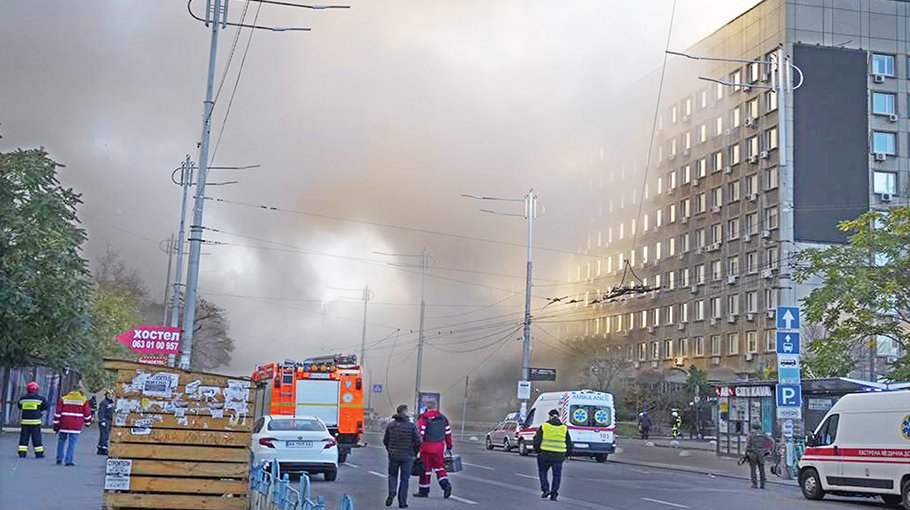
Waves of explosive-laden suicide drones struck Ukraine’s capital Monday, setting buildings ablaze and sending people scurrying for shelter or attempting to shoot down the kamikazes — a week after Russia unleashed its most widespread strikes against the country in months.
Air attacks in central Kyiv had become a rarity in recent months, and the concentrated use of drones, their blasts echoing across the city, sowed terror and frayed nerves. One of the drones slammed into a residential building, killing three people, said the deputy head of the president’s office, Kyrylo Tymoshenko. Energy facilities were also among the targets.
Drones used in the attack appeared to include Iranian-made Shaheds. Previous Russian airstrikes on Kyiv were mostly with missiles. Intense, sustained bursts of gunfire rang out Monday as the drones hummed overhead, apparently soldiers trying to shoot them down. Others headed for shelter — though city life quickly resumed in a country that has become grimly accustomed to attacks.
In what many fear could become more common occurrences in urban centers nearly eight months in to the war, the barrage came in successive waves of 28 drones, Kyiv’s mayor, Vitali Klitschko, said. Five of them plunged into Kyiv itself, said Ukrainian Prime Minister Denys Shmyhal.
In the Kyiv region, 13 or more were shot down, all of them as they flew in from the south, said a spokesman for the Ukrainian Air Force, Yurii Ihnat.
One strike appeared to target the city’s heating network, hitting an operations center. Another slammed into a four-story residential building, ripping a large hole in it and collapsing at least three apartments on top of each other. In addition to the three people killed there, Tymoshenko said 19 were rescued from the rubble, four of them wounded. Rescue workers searching for victims scrambled over the debris from which gray smoke billowed.
An Associated Press photographer who was out shooting morning scenes of Kyiv caught one of the drones on camera, its triangle-shaped wing and pointed warhead clearly visible against the blue sky.
“The whole night, and the whole morning, the enemy terrorizes the civilian population,” Ukrainian President Volodymyr Zelenskyy said in a social media post. “Kamikaze drones and missiles are attacking all of Ukraine.”
“The enemy can attack our cities, but it won’t be able to break us,” he wrote. The Iranian-made Shaheds, which Russia has rebranded as Geran-2 drones, pack an explosive charge and can linger over targets before nosediving into them. They can be fired one after the other.
Andrii Yermak, the head of the Ukrainian president’s office, confirmed in a social media post that Shahed drones were among those used in the strike. Iran has previously denied providing Russia with weapons, although its Revolutionary Guard chief has boasted about providing arms to the world’s top powers, without elaborating.
The drones have also been repeatedly used by Russia elsewhere in Ukraine in recent weeks to target urban centers and infrastructure, including power stations. They are comparatively cheap, costing in the region of US$20,000. Their use in swarms presents a challenge to Ukrainian air defenses, said Ihnat, the Air Force spokesman. Western nations have promised to bolster Ukrainian air defenses with systems that can shoot down drones but much of that weaponry has yet to arrive and, in some cases, may be months away.
“The challenges are serious because the air defense forces and means are the same as they were at the beginning of the war,” Ihnat said. Some air defense weaponry supplied by Western nations can only be used during daylight hours when targets are visible, he added.
After months during which strikes in central Kyiv were rare, early morning strikes last week put Kyiv as well as the rest of the country back on edge. Russian President Vladimir Putin said those strikes were in retaliation for the bombing of a bridge connecting the Crimean peninsula with the Russian mainland. Putin blames Ukraine for masterminding the blast, which suspended traffic over the bridge and curtailed Moscow’s ability to supply Russian troops in the occupied regions of southern Ukraine.
The strike on Kyiv comes as fighting has intensified in the eastern regions of Donetsk and Luhansk in recent days, as well as the continued Ukrainian counteroffensive in the south near Kherson and Zaporizhzhia. Zelenskyy said in his Sunday evening address that there was heavy fighting around the cities of Bakhmut and Soledar in the Donetsk region.
The Donetsk and Luhansk regions make up the industrial east known as the Donbas, and were two of four regions annexed by Russia in September in defiance of international law.
On Sunday, the Russian-backed regime in the Donetsk region said Ukraine had shelled its central administrative building in a direct hit. No casualties were reported.
AFP adds from Paris: Russia's invasion of Ukraine and the resulting economic fallout have thrown four million children into poverty across eastern Europe and Central Asia, the UN children's agency said Monday.
"Children are bearing the heaviest burden of the economic crisis caused by the war in Ukraine," UNICEF said.
The conflict "and rising inflation have driven an additional four million children across eastern Europe and Central Asia into poverty, a 19 percent increase since 2021", it said.
UNICEF drew its conclusions from a study of data from 22 countries.
Russian and Ukrainian children have been most affected since Moscow's attack on its neighbour in February.
"Russia accounts for nearly three-quarters of the total increase in the number of children living in poverty due to the Ukraine war and a cost-of-living crisis across the region, with an additional 2.8 million children now living in households below the poverty line," UNICEF found.
The blow to Russia's economy from Western sanctions combined with its large population to produce the outsize effect.
"Ukraine is home to half a million additional children living in poverty, the second largest share," UNICEF added.
Romania followed closely behind, with a further 110,000 children in poverty.
"Children all over the region are being swept up in this war's terrible wake," said UNICEF regional director for Europe and Central Asia, Afshan Khan.
"If we don't support these children and families now, the steep rise in child poverty will almost certainly result in lost lives, lost learning, and lost futures."
The poorer a family is, the greater the proportion of its income it must spend on food and fuel, leaving less for children's healthcare and education, the agency explained.
They are also "more at risk of violence, exploitation and abuse".
This could well translate into an additional 4,500 children dying before their first birthdays, and an additional 117,000 children dropping out of school this year alone, UNICEF said.