
By Dr. Majid Rafizadeh
The global space race, once dominated by the US and the Soviet Union during the Cold War, has undergone a profound transformation.
Where space exploration and technological development were previously concentrated in the hands of a few superpowers, the field has become increasingly multipolar, which offers strategic opportunities for Arab countries.
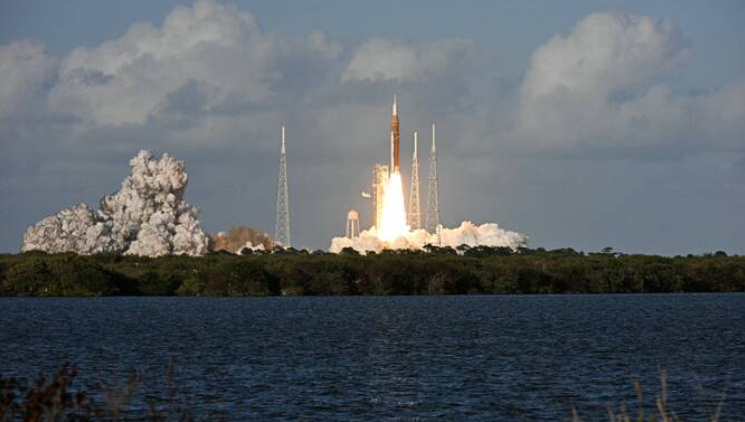
Recent developments, including the US return to the moon this week through its Artemis program, points to renewed interest in lunar exploration and interplanetary missions. This highlights the fact that space is once again a domain for strategic competition, as well as technological prestige.
The factors that lie behind the resurgence of interest in space include advancements in rocket and satellite technology, artificial intelligence and, more importantly, the participation of the private sector. These changes have opened the door for emerging economies, including those in the Middle East, to assert themselves in relation to global space activities.
The region should not view space as merely a scientific curiosity. Instead, it represents a strategic frontier in which four pillars intersect: economic diversification, technological advancement, national security and international prestige. Arab countries have a unique opportunity to integrate with this field in ways that can secure both immediate and long-term benefits.
The shift from a superpower-dominated space environment to a multipolar landscape represents a critical opportunity for the Middle East. In the past, space programs were largely tools of geopolitical competition, showcasing military and technological superiority.
Now, however, the global space sector can be viewed as interplay between the public and private sectors, as well as rapidly evolving commercial markets. For Middle Eastern states, this is a vital development because the region can no longer afford to rely solely on foreign partners for its satellite services and space-based communications systems.
Capitalizing on this opportunity will require investments in national space agencies, research and development, and partnerships with participants in the sector worldwide. Any country that follows such a path will be positioning itself as a credible actor in the global space sector.
Several countries in the region have already demonstrated substantial progress toward achieving this. Saudi Arabia recently accelerated its space agenda, for example, by investing in the Saudi Space Agency, launching satellites for communications and Earth observation, and actively working with international partners, including the US.
Bahrain also entered the space arena by launching its first domestically developed satellite last year, and establishing programs designed to foster STEM (science, technology, engineering and mathematics) talent and aerospace research.
The UAE has emerged as a regional leader in space innovation as well. It launched its Emirates Mars Mission in July 2020, which successfully placed the Hope probe in orbit around Mars in February 2021. This achievement, together with domestic satellite programs and plans for lunar exploration, highlight the capacity of the UAE to design, build and operate advanced space technologies.
Egypt, meanwhile, has a long-standing satellite program that has grown in sophistication over the past decade through the deployment of communications and remote-sensing satellites.
These examples indicate a broader trend across the Arab world in which space initiatives are increasingly seen as instruments of national development and technological modernization, as well as international prestige.
Economic diversification represents one of the most compelling motivations for regional engagement with the space race. Middle Eastern countries that fail to diversify will leave their economies vulnerable to fluctuations in global energy markets.
Investment in space technology offers another path toward sustainable economic growth, because it stimulates innovation across several sectors.
Firstly, space initiatives require advanced engineering, software development, robotics and artificial intelligence skills. Advancements in these areas strengthen domestic industrial capacity and create opportunities for high-skilled employment.
Therefore, Middle Eastern countries have a chance to position themselves as centers for space innovation. This offers several other benefits, including opportunities to attract international investment, establish competitive domestic markets, and create a foundation for long-term economic growth.
In addition, shaping a culture of innovation helps to improve the region’s overall level of technological competitiveness.
It is not only a matter of the economic benefits on offer. Space-related activities have critical implications for national security and strategic autonomy. Satellites serve as essential instruments for communications, surveillance and navigation, which helps countries respond effectively to regional and global threats.
If a country remains dependent on foreign satellite services, it leaves itself vulnerable, particularly in times of rising geopolitical tensions. It follows, then, that indigenous satellite and launch capabilities provide Middle Eastern countries with strategic assets that enhance national security and reduce reliance on external powers.
Secondly, space-based intelligence systems can provide data that is critical for defense and border control, as well as maritime monitoring.
Thirdly, participation in the space race carries profound implications for national prestige and soft power. Scientific achievements in space exploration are indicators of technological sophistication and the capacity of a country for innovation.
For example, Saudi Arabia’s growing investment in space infrastructure and international collaborations signals a shift toward technological leadership within the Arab world.
Finally, accomplishments in space serve as a source of national pride. Programs can also be catalysts for STEM education, helping to inspire young people to pursue careers in science, research and innovation. This is particularly important in a region characterized by its rapidly growing youth population.
In a nutshell, the Middle East is at a pivotal moment in terms of the new, rapidly evolving global space race. Arab nations have an unprecedented opportunity to assert themselves in this domain, which will definitely help shape the future of global power.
It offers many benefits, ranging from economic diversification and technological development to enhanced national security and international prestige. This is therefore an essential strategic imperative for Arab nations.