Saliem Fakir
As the world pursues decarbonization, the concept of a “just transition” has become ubiquitous, particularly when describing the shift away from fossil fuels in emerging and developing economies.
Emissions targets at the global and national levels are viewed as the main drivers of the energy transition, and the climate policies developed to meet those targets must balance environmental and social objectives.
But decarbonization is not always the product of a planned emissions-reduction pathway. In fact, with the cost of renewables continuing to fall, many emerging and developing countries now see the phasing out of fossil fuels as a matter of economic survival and energy security.
For example, in January 2024, Ethiopia banned the import of petrol and diesel vehicles with immediate effect. The move was striking precisely because it was framed not as a climate commitment, but as a way to reduce its annual fossil-fuel import bill of more than $5 billion, which consumed a huge share of the country’s scarce foreign-currency reserves.
With the country constructing Africa’s largest hydroelectric dam, it made little economic sense to remain dependent on expensive fuel imports to power transport. Chinese-made electric vehicles quickly filled the market gap created by the ban; the streets of Addis Ababa are now teeming with BYD cars.
Tax exemptions and import duty waivers for electric vehicles, coupled with the rising costs of second-hand internal-combustion-engine vehicles, have accelerated this shift in consumer behavior. The Grand Ethiopian Renaissance Dam, which officially opened in September 2025, produces enough surplus hydropower to run these electric vehicles cheaply.
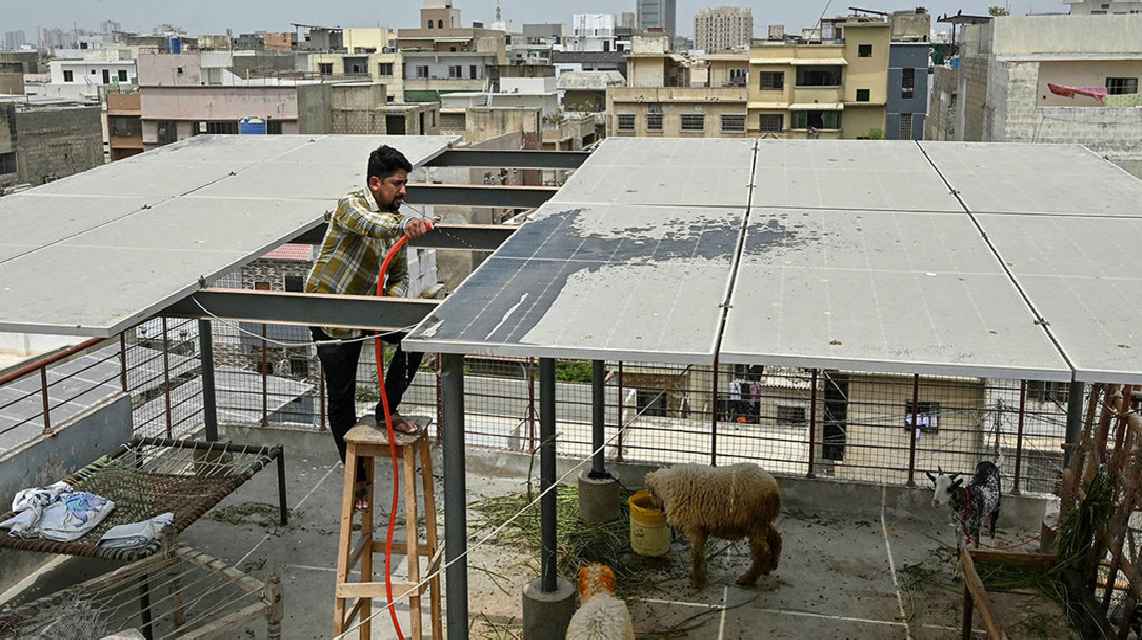
Crucially, economic and energy-security concerns, rather than any formal emissions-reduction framework, were responsible for such rapid decarbonization. A similar pattern seems to be on display in Pakistan; the country’s swift uptake of solar power reflected factors that created an opportunity for disruptive change, and not green advocacy or a national climate plan.
In 2022, a massive flood left about one-third of the country under water and caused more than $30 billion in economic damage, straining government budgets, reducing household incomes, and undermining the state’s ability to operate public utilities. With energy costs rising, there was a clear need for an alternative to diesel generation.
Meanwhile, China had surplus solar-panel production, and the US had imposed import restrictions. Pakistan took advantage of discounted Chinese solar panels to adopt renewable generation at a rapid clip. Between December 2021 and December 2025, the share of electricity in Pakistan generated by solar increased fivefold. A late mover in confronting unique energy-security challenges, Pakistan benefited from cost advantages created by global trade dynamics.
Similarly, the liberalization of South Africa’s power market, coupled with load shedding (imposed blackouts) and rising electricity tariffs, led to a 349 percent increase in installed solar rooftop capacity in one year. While the country has been following an emissions-reduction pathway for decades, it was an affordability crisis that ultimately drove widespread decarbonization.
These countries are moving away from fossil fuels largely because of mounting economic and energy pressures, then, rather than a narrow focus on emissions reductions. But this does not mean the question of justice disappears.
Lower-income households account for a smaller share of the roughly 8 gigawatts of rooftop solar capacity installed in South Africa, reflecting the high upfront costs. Crisis-driven decarbonization still requires efforts to improve affordability and ensure that people from all walks of life can participate in the energy transition.
Policymakers have used the concept of a “just transition” to make a morally and emotionally compelling case for decarbonization. But they should be focusing on how to foster systemic change. Understanding that the primary drivers of solar uptake in South Africa and Pakistan, or the adoption of electric vehicles in Ethiopia, were structural and economic could help policymakers develop better tools and systems.
This also has direct implications for the ways in which philanthropists and governments allocate resources. Channeling funding toward grid capacity, storage infrastructure and affordable-financing mechanisms will likely produce more durable results than funding for climate education and communication. Investing in efforts that aim to improve people’s lives, from lower energy bills to unfettered electricity access, will do more to accelerate decarbonization — and to change hearts and minds.
Certainly, the world must reduce emissions to prevent the planet from overheating. To achieve this goal, it should focus on efforts to expand energy access and ensure affordability. This means recognition of and adequate responses to the external pressures that can support decarbonization pathways in emerging and developing economies.
Ethiopia, Pakistan and South Africa have shown that economic factors can provide better entry points for scaling green solutions and catalyzing systemic change than top-down, morally driven transition plans.
Saliem Fakir is founder and executive director of the African Climate Foundation.