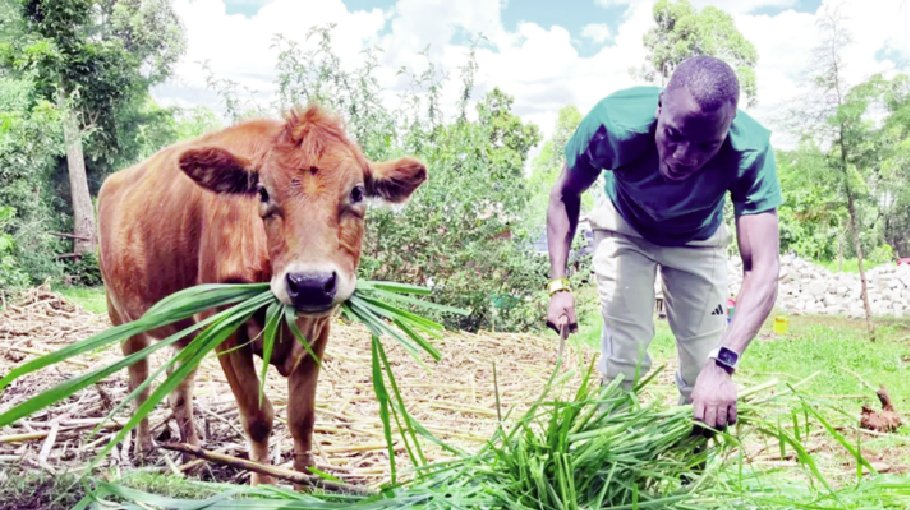
Growing up in extreme poverty in a small village in western Kenya, Emmanuel Wanyonyi's daily life was marked by hardships.
Forced out of school aged 10, he worked long hours herding cattle. Sometimes he earned less than $2 (£1.58) a month.
Wanyonyi endured exploitation, switching jobs regularly after sometimes going unpaid, yet the man who would become the reigning Olympic 800m champion persisted because shelter and food were provided.
"Life, and looking after cattle as a kid, was tough," Wanyonyi told BBC Sport Africa.
"I thought of quitting the job and going back home but remembered that I would still face the same challenges I was running away from.
"When I got something small, I would take it home to my siblings so they could have something to eat."
One of 11 children, Wanyonyi had no choice but to leave school as his family could not afford exam fees of just 40 Kenyan shillings ($0.30/24 pence).
He eventually managed to return to education with some of the earnings gathered from his time as a herdsboy and a stint as a labourer, and discovered a sense of purpose and escape in athletics.
Then came the sudden and unexplained death of his father, who worked as a caretaker at a dam, in 2018.
"He had just dropped by the school to give me some money to buy running shoes with the payment he got that day," Wanyonyi, now 20, explained.
"It's like he was strangled and placed by the water. He was found with a mark on his head as if he was hit.
"What I think happened is that he placed his clothes there to swim and then someone came to rob him."
With no official post-mortem, Wanyonyi says his family "never found closure".
"That day, my world fell apart. It was painful but I didn't have the luxury of grieving. I had to become the man of the house immediately."
Wanyonyi is the joint second-fastest man of all time over 800m, level with Wilson Kipketer of Denmark and only behind compatriot David Rudisha
In the absence of his father, Wanyonyi hoped to pursue a career in athletics to help provide for his family.
But he initially faced ridicule because, unlike other parts of Kenya, his home region is not known for producing elite runners.
"When [Emmanuel] was running, people were mocking and laughing at him," Wanyonyi’s mother Margaret Nasimiyu recalled.
"I was crying and feeling sad about it, but my boy told me: 'Don't cry, mum. One day I will buy you land and you will live a good life'.
"I thought it was just a joke, but God was with him."
Following his return to school, Wanyonyi had no money for proper running shoes.
"If I found shoes, I would train. If not, I would run barefoot in the fields," he added.
"Sometimes the shoes would break in one day and I'd have to wait until I could find another pair. But I never let that stop me."
However, Wanyonyi credits his early years - and the issues he overcame - as strengthening him mentally.
"There is no challenge in life that can shock me," he said.
"When people doubted me or laughed at me, I didn't let it break me."