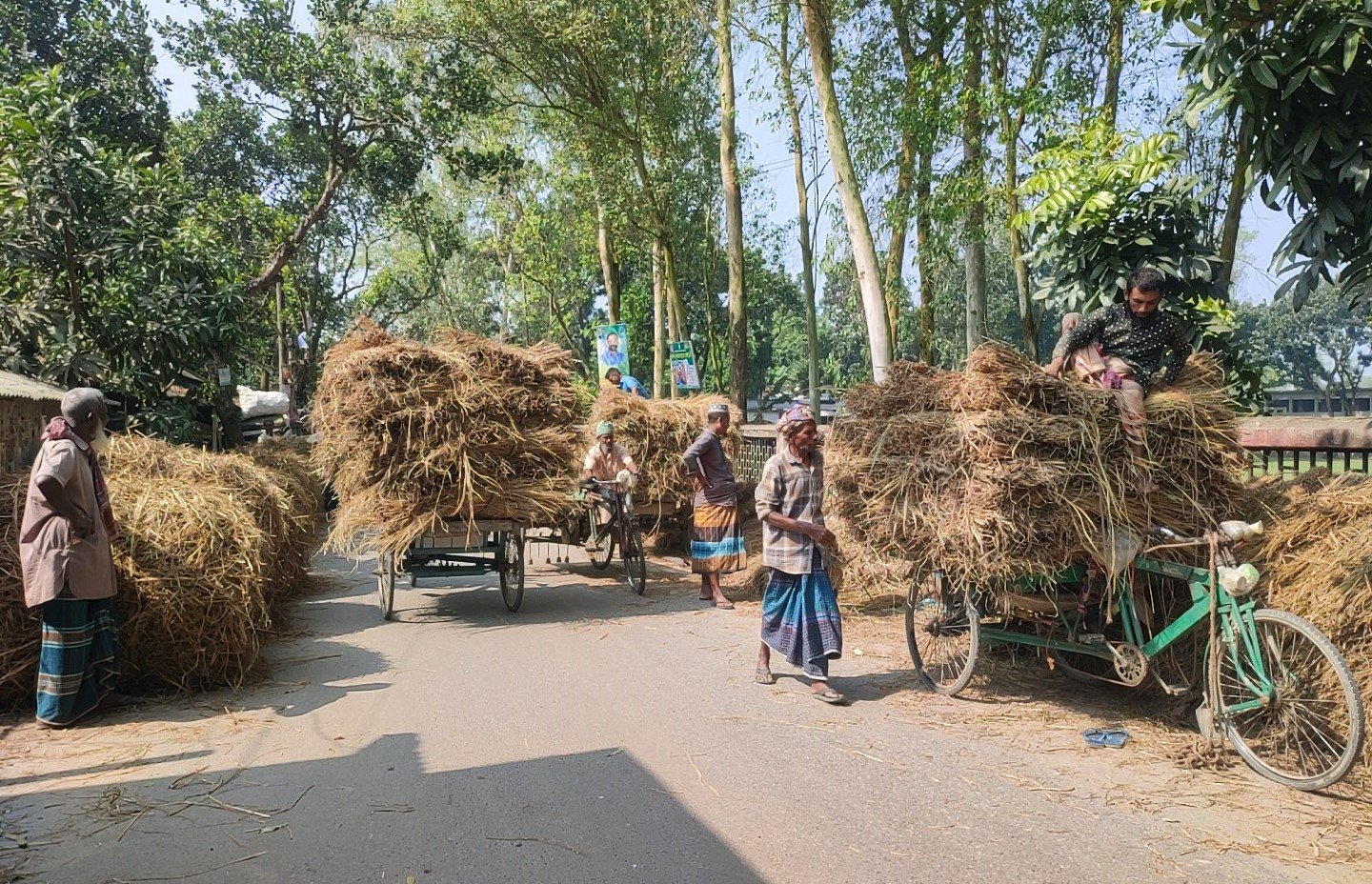
A sudden surge in the price of straw has left cattle farmers in Sarishabari upazila of Jamalpur in a dire situation. Whereas just one month ago, straw was sold for 8 to 10 taka per kilogram, the price has now skyrocketed to 25 to 30 taka per kg.
Farmers in riverine and char areas are particularly affected, as recent floods and river erosion have caused a severe shortage of grass. Consequently, farm owners and cattle rearers are being forced to depend entirely on straw and other animal feed, placing small and large farmers alike in a difficult position.
The increased demand has led to straw being sold at a higher price than paddy in some cases.
Upazila Livestock Officer, Dr. Habibur Rahman, informed that according to the latest survey, there are approximately 99,800 cattle in the eight unions and municipality of Sarishabari upazila. He noted that more cattle are being reared now than before, with about 50,000 to 60,000 of them being raised in various char areas.
Cattle farmers explained that each animal requires four to five kilograms of straw daily. Straw is the most cost-effective and essential feed, especially for dairy cows, as it directly impacts milk production. Currently, a kilogram of straw is selling in the market for an average of 25 to 30 taka. A high-quality maund of straw now costs 1,100 to 1,200 taka, which is equivalent to the current market price of a maund of paddy.
Shah Jalal Parhan, a cattle rearer from Chargach Boyra village in Pogoldigha Union, said, "I have five cattle. Each one needs about three to four kilograms of straw daily. Along with straw, I also have to provide bran, rice polish, and oilcake. The rising prices of all animal feed are making it very difficult to manage."
Nasir Uddin Najmul, another cattle farmer, stated, "I had ten cattle. Due to the price hike and shortage of straw, I sold one last week and used the money to buy straw for the remaining nine. I am helpless in rearing cattle now. We are forced to buy straw at high prices."
Upazila Agriculture Officer, Agriculturist Anup Singh, said, "Straw has become as valuable as paddy to farmers. The price of straw is expected to decrease once the full-scale rice harvesting begins within the next two to three weeks."