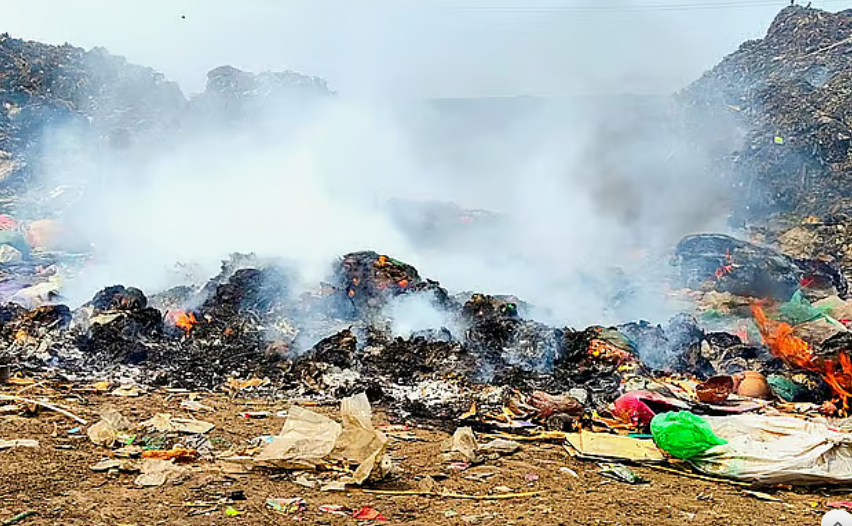
Dhaka is choking—and this is no metaphor. The capital’s air has become a daily health emergency, driven not only by traffic, construction dust, and brick kilns, but increasingly by a failure that is entirely preventable: mismanaged waste. The city’s landfills have turned into toxic mountains, and the consequences are now impossible to ignore.
According to a report of the Bangladesh Post, at Aminbazar, the situation reflects years of neglect. Designed to hold waste up to 30 feet, the landfill now towers at nearly three times that height. Though it officially reached capacity in 2017, it continues to receive hundreds of truckloads of garbage every day. This relentless dumping has created a volatile mass that emits methane—a potent greenhouse gas—and poses constant risks of fire and collapse. It is a stark symbol of institutional inertia.
On the other side of the city, Matuail presents a different but equally dangerous reality. Here, waste is routinely burned in the open, releasing thick plumes of toxic smoke into surrounding communities. For residents, clean air has become a luxury; windows remain shut, and respiratory illness is on the rise. When this smoke mixes with dry-season dust and emissions from brick kilns, Dhaka’s Air Quality Index frequently crosses 300—well into the “hazardous” category.
This is not merely an environmental issue; it is a public health crisis. Long-term exposure to such air increases the risk of asthma, cardiovascular disease, and premature death. The most vulnerable—children, the elderly, and low-income communities living near dumping sites—bear the heaviest burden.
Authorities are not unaware of the problem. Plans have been announced, promises made. The Dhaka South City Corporation has spoken of transitioning to waste-to-energy systems and resource recovery. A 2021 agreement involving the Bangladesh Power Development Board, Dhaka North City Corporation, and China Machinery Engineering Corporation aimed to generate 42.5 MW of electricity from waste. It was hailed as a turning point—a step toward modern, scientific waste management.
Yet, years later, progress remains elusive. The project that could have reduced landfill pressure and curbed emissions has stalled. Bureaucratic delays, lack of coordination, and weak accountability have turned a promising initiative into another missed opportunity. Had it been implemented on schedule, Dhaka might not be facing this acute crisis today.
The cost of inaction is rising. Public frustration is growing, and rightly so. No city aspiring to be livable can allow entire neighborhoods to be poisoned in the name of administrative convenience. Waste management is not an optional service—it is a core function of urban governance.
What must be done is clear. First, an immediate ban on open waste burning must be enforced, with strict monitoring and penalties. Second, landfill operations must be modernised to include proper layering, methane capture, and controlled disposal. Third, waste segregation at source should be introduced citywide to reduce the burden on landfills. And most critically, the waste-to-energy project must be fast-tracked with transparency and urgency.
Dhaka does not lack plans; it lacks execution. This gap must be closed now. The current government has both the responsibility and the opportunity to act decisively. Cleaning up the city’s waste system will not only improve air quality but also contribute to energy generation and climate commitments.
The people of Dhaka cannot afford to wait any longer. The toxic drift must be stopped—now.