Md. Ashikur Rahman
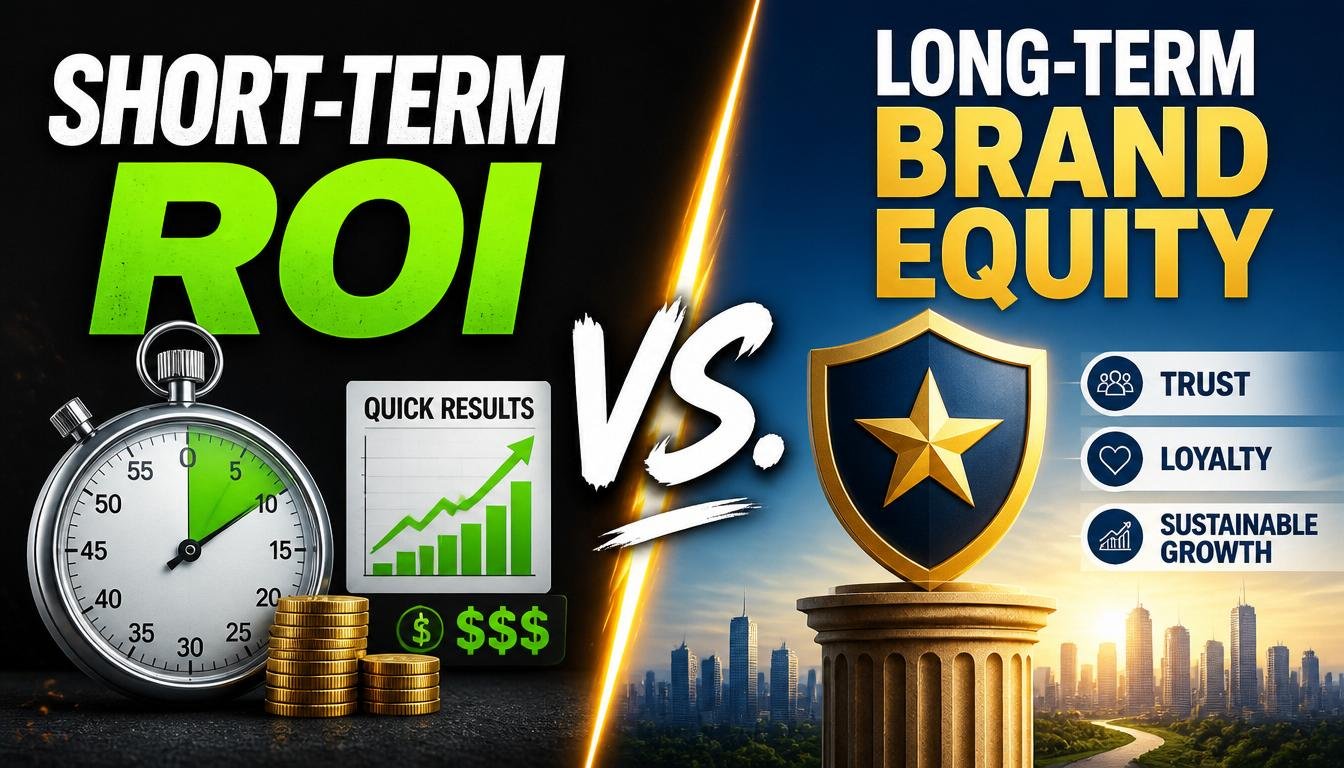
In today’s hyper-measurable marketing landscape, business leaders are increasingly confronted with a fundamental dilemma: should they prioritize short-term returns or invest in building long-term brand strength? With the rise of digital platforms, where every click, conversion, and cost can be tracked in real time, the temptation to focus exclusively on immediate ROI (Return on Investment) has never been stronger.
Yet, an overemphasis on short-term gains raises a critical question: are organizations sacrificing sustainable growth at the altar of instant results?
What the Data Tells Us: A growing body of global research suggests that the most effective marketing strategies are those that strike a balance between performance-driven activities and long-term brand building. Studies indicate that an optimal marketing mix often allocates around 60% of investment to brand building and 40% to short-term activation, delivering superior overall returns over time.
Similarly, research highlights that brands investing consistently in long-term equity outperform their competitors in areas such as market share growth, pricing power, and customer retention.
On the other hand, organizations heavily reliant on performance marketing tend to experience diminishing returns within 12–18 months, often facing rising customer acquisition costs (CAC) and declining customer loyalty.
The implication is clear: short-term ROI and long-term brand equity are not competing priorities; they are complementary forces.
Performance marketing has transformed how organizations approach growth. With precise targeting, real-time analytics, and measurable outcomes, it offers unparalleled efficiency in driving immediate sales.
Its advantages are compelling:
Rapid revenue generation
Clear attribution and accountability
Agile campaign optimization
However, this approach is not without its drawbacks. Over-reliance on discounts, promotions, and conversion-focused messaging can gradually erode brand value. Customers may become conditioned to transact only when incentivized, weakening both loyalty and perceived brand differentiation.
In essence, while short-term ROI drives transactions, it does not necessarily build relationships.
Brand equity, though less tangible, is a powerful long-term asset. It is built over time through consistent messaging, meaningful customer experiences, and trust.
Strong brand equity enables organizations to:
Increase customer lifetime value (CLV)
Command premium pricing
Maintain resilience during market volatility
The question, therefore, is not whether to choose one over the other; but how to integrate both in a disciplined and strategically coherent manner. The most effective marketing organizations recognize that short-term performance and long-term brand building are not competing agendas; rather, they are interdependent levers of sustainable growth.
A balanced strategy, in this context, requires a deliberate and structured approach:
• Dual Investment Models: Organizations should consciously allocate resources between brand-building initiatives and performance-driven activities. This is not merely a budgeting exercise, but a strategic commitment to ensuring that while immediate revenue targets are met, the brand’s future equity is continuously strengthened.
• Integrated Campaign Design: Campaigns should not operate in silos of awareness versus conversion. Instead, they must be designed holistically—where storytelling builds emotional resonance, and performance layers drive action. A well-integrated campaign ensures that every customer touchpoint contributes both to immediate response and long-term brand recall.
• CLV-Centric Decision Making: Moving beyond short-term metrics such as cost per acquisition (CPA), organizations need to evaluate success through the lens of Customer Lifetime Value (CLV). This shifts the focus from one-time transactions to long-term relationships, encouraging investments that enhance retention, loyalty, and overall customer profitability.
Such an approach ensures that short-term gains are not pursued at the expense of future growth. Rather, it creates a reinforcing cycle, where immediate revenue fuels continued investment in brand equity, and strong brand equity, in turn, enhances the efficiency and effectiveness of future revenue generation.
Short-term ROI fuels momentum, but long-term brand equity sustains it. One drives immediate performance; the other secures enduring relevance. In an era dominated by data and dashboards, it is easy to optimize for what is immediately visible. However, true marketing effectiveness lies in balancing the measurable with the meaningful. Because ultimately, the strength of a brand is not defined solely by what it sells today, but by the trust it earns for tomorrow.
Md. Ashikur Rahman , Lead – Brand, Communication & Marketing, Bangladesh Finance PLC