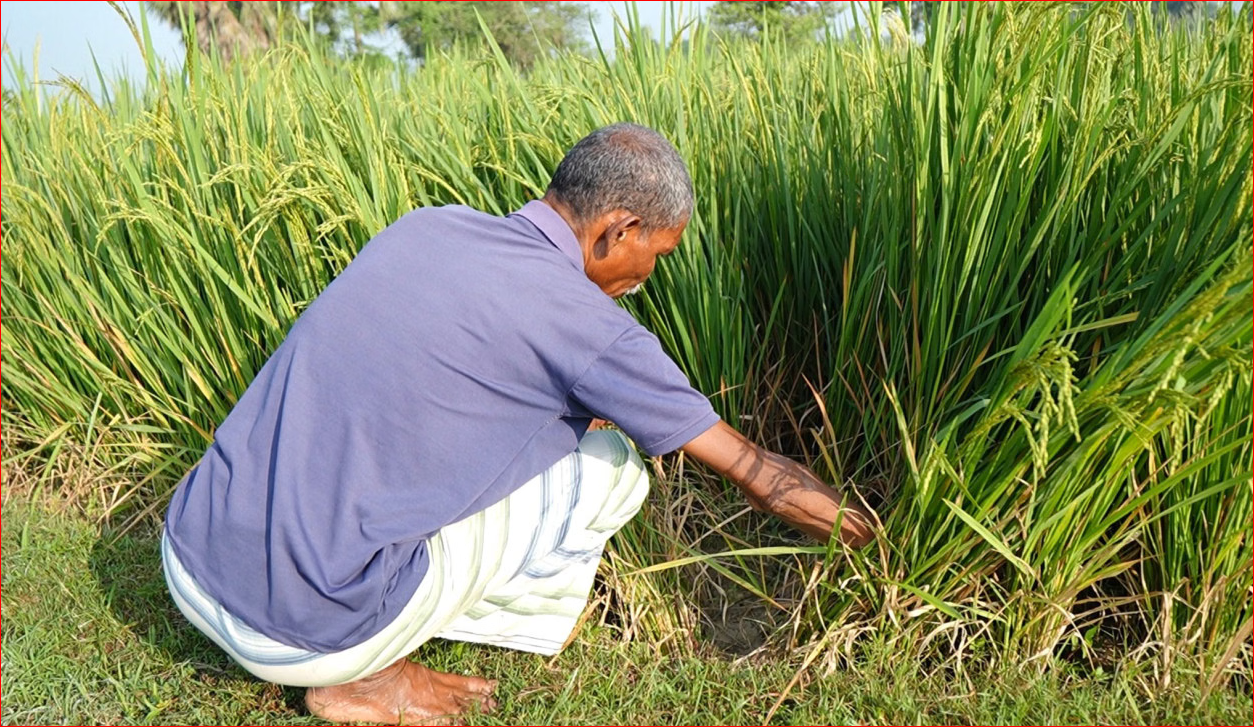
Barind in Rajshahi region now faces a major crisis with groundwater levels declining fast and temperature rising rapidly amid a change in rainfall patterns. Marginal farmers are battling climate woes that are crippling crops leaving the future uncertain.
Tanore and Godagari upazilas particularly fall in the water-stressed Barind region, known as the rice bowl of Bangladesh.
The region was Comparatively a barren area even in the mid-1980s, with very limited sources of surface water. In the 1990s, the Barind Multi-Purpose Development Authority (BMDA) introduced deep tube-wells, enabling farmers to cultivate three crops a year. All the Crops and fruits grown here are heavily dependent on ground water extraction.
But now the region is hit by an acute water crunch. Crops like Aman, which are traditionally rainfed, now require frequent irrigation. But Cracks developed in the parched paddy field because the soil dried out and fractured without irrigation. Many of the farmers could not procure money in the first week of October to buy water from deep tube-well operators for irrigation. Though it rained a bit more this year than the last, the field still needs irrigation every week.
Only a decade ago, groundwater could be found by digging around 30 feet. Now one may have to dig as deep as 80 feet to get water because of the steady decline in groundwater level.
Changing climate is primarily responsible for the crisis in Barind agriculture. A Study for the Bangladesh Meteorological Department reveals that rainfall in Rajshahi region is declining by 54mm per decade, while temperature are rising at the country’s steepest rate: 0.5degrees Celsius Per decade. The monsoon, the lifeblood of traditional agriculture, is turning less reliable, replaced by downpours that the hard clay of Barind region cannot absorb. This results in severe disruption in the groundwater recharge and delicate balance of agriculture.
Another Serious problem is more than excessive exploitation of a finite resource-the groundwater. Farmers are forced to dig deeper every year - from 3o feet a decade ago to 80 feet today. By this they are mining the precious groundwater, which is an unsustainable practice that cannot continue perpetually. Besides, the drop in rainfall has resulted in a steady rise in temperature, triggering a surge in Pest population and disrupting pollination. To check infestations of pest, farmers need to use pesticides, which in turn pose a grave risk to food safety.
The government is preparing guidelines to limit the use of water in the area, but this is not a real solution to the problems. The impact of the fast declining groundwater on agriculture and marginal farmers shows how the environment, the economy, and human desperation are inextricably linked.
The plight of Barind farmers are the crises of climate change and resource management.
Water- stressed Barind shows that a development model built on the intensive use of a single resource are bound to be a fiasco in the face of Climate change.
Financing must be directed not just at clean energy, but at climate resilient water management and agriculture. The silent Killer of climate change brings a devastating drought, a falling water table and makes the farmers field a barren and waste-land.