Hassan Al-Mustafa
Saudi Arabia is addressing the US–Iranian negotiations, sponsored by Pakistan, with utmost seriousness and meticulous attention. Although not a party to these discussions, the Kingdom will not be sidelined.
In other words, its absence from the negotiating table in Islamabad has not excluded Riyadh, its national interests, and its national security from the considerations of the negotiators and the Pakistani mediator. This is evident in the continuous communication between Saudi Arabia on the one hand, and the US, Iran, and Pakistan on the other.
Saudi diplomacy is noticeably active on several fronts: first, solidifying the truce between Iran and the US to ensure that war does not resume and thus guarantee that Iranian hostilities will not be launched again against the Kingdom and the Gulf Cooperation Council states; second, supporting Pakistan’s mediation efforts, given Islamabad’s trust in Riyadh and the existence of a joint strategic defense agreement between the two countries; and third, building regional and international understandings aimed at the swift and permanent reopening of the Strait of Hormuz to guarantee safe navigation, the resumption of oil and gas exports, and the return of trade through Gulf ports.
These efforts are being pursued in parallel with a future Saudi vision for relations with Iran, because Riyadh knows that regional security cannot be achieved without a clear understanding between the two countries, based on frankness and seriousness, that resolves the most pressing outstanding issues: Iranian armed attacks, sleeper cells, armed militias, and maritime security in the Arabian Gulf. These are urgent issues that require a specific roadmap, a clear commitment from Iran, and the provision of tangible and verifiable guarantees.
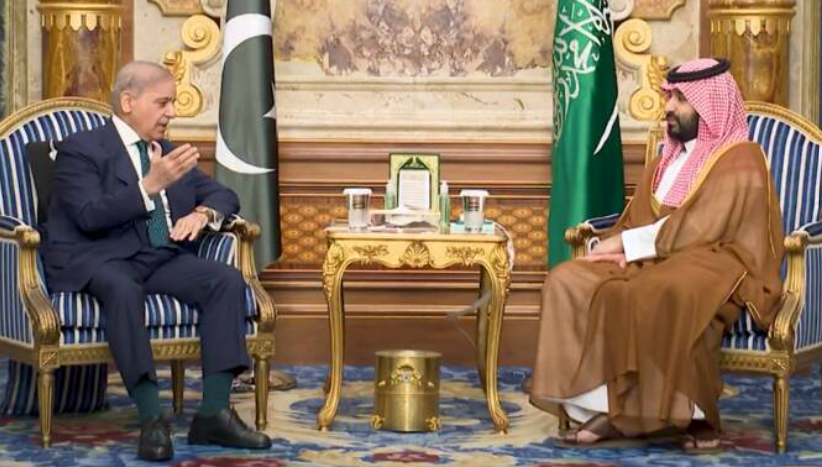
As part of these political efforts, Saudi Crown Prince Mohammed bin Salman met with Pakistani Prime Minister Shehbaz Sharif during his visit to Jeddah on April 15. They discussed the latest regional and international developments, particularly the course of events in the region and the talks between the US and Iran hosted by Pakistan. They also emphasized the importance of continuing diplomatic efforts to restore stability in the region.
The talks reflected explicit Saudi support for Pakistan, with the crown prince commending the efforts of the Pakistani prime minister and Field Marshal Asim Munir, Pakistan’s chief of army staff.
Riyadh does not view war as an inevitable fate, but rather seeks political outcomes and security understandings that will lead to a post-war phase in which Tehran respects its neighbors and refrains from aggression.
This was the clear political message conveyed by the meeting between the Saudi crown prince and the Pakistani leader following communication between the two countries’ foreign ministers and a meeting of senior officials from the foreign ministries of Saudi Arabia, Pakistan, Egypt, and Turkiye.
The meeting took place in Islamabad on April 13, with the Saudi delegation headed by Prince Abdullah bin Khalid bin Saud Al-Kabeer Al-Saud, director-general of the Kingdom’s foreign ministry. It was part of the “quadrilateral consultative framework,” during which discussions focused on “developments in the region and ways to enhance joint coordination to serve the region’s security and stability,” according to a statement issued by the Saudi Ministry of Foreign Affairs.
In parallel, Pakistan’s army chief paid a visit to Tehran, where he met with the Speaker of the Islamic Consultative Assembly, Mohammad-Bagher Ghalibaf, and Foreign Minister Abbas Araghchi, before meeting President Masoud Pezeshkian on April 16.
The meetings carried messages exchanged between Iran and the US, alongside Pakistani efforts to bring the two countries closer together ahead of a potential second round of dialogue, which is expected to be held soon in Islamabad. This comes amid emerging positive signals from Washington, where President Donald Trump said that “Iran has agreed to almost everything” and that “the chances of reaching an agreement are great,” adding: “We have very good relations with Iran, and this is unbelievable.”
Trump, in his remarks on Friday, gave greater impetus to Pakistan’s role, revealing that he “might visit Pakistan if the agreement with Iran is concluded there.”
In sum, these developments indicate that a political framework is being developed and that understandings have been reached, even if not yet finalized, despite the heightened media rhetoric from both Iran and the US.
This rhetoric may be aimed at boosting morale on the one hand, or improving negotiating positions on the other, as well as serving as a means of addressing domestic audiences and those sympathetic to each side, in consideration of internal “public opinion” in each country.
Since Pakistan announced a two-week temporary ceasefire between Iran and the US, two phone conversations have taken place between Saudi Foreign Minister Prince Faisal bin Farhan and his Iranian counterpart.
In this context, Riyadh issued a statement supporting “the mediation efforts undertaken by Pakistan to reach a permanent agreement that achieves security and stability,” emphasizing “the necessity of keeping the Strait of Hormuz open to navigation in accordance with the 1982 UN Convention on the Law of the Sea, without any restrictions,” as well as the need for “a comprehensive and sustainable de-escalation that enhances regional security.”
Therefore, “any attacks or policies that infringe upon the sovereignty, security, and stability of the region’s countries must cease,” according to the Saudi Foreign Ministry statement issued on April 8.
The statement stipulates a key point, as it stressed the importance of these efforts addressing “all the issues that have caused instability and insecurity over several decades.”
In other words, Saudi Arabia seeks to prevent the return of war after years of relative de-escalation, a goal that requires strong and solid understandings as well as a clear commitment from Iran. In this context, Iran now carries the responsibility of rebuilding trust with its larger neighbor, Saudi Arabia, and of demonstrating that it is willing to pursue advanced and sustainable relations.
This will benefit both countries and enhance security in the Arabian Gulf. However, the responsibility for proving good intentions through actions, not words, falls primarily on Iran. The question remains whether it can meet these expectations.
Hassan Al-Mustafa is a Saudi writer and researcher specializing in Islamist movements, the evolution of religious discourse, and relations between the Gulf states and Iran. X: @Halmustafa