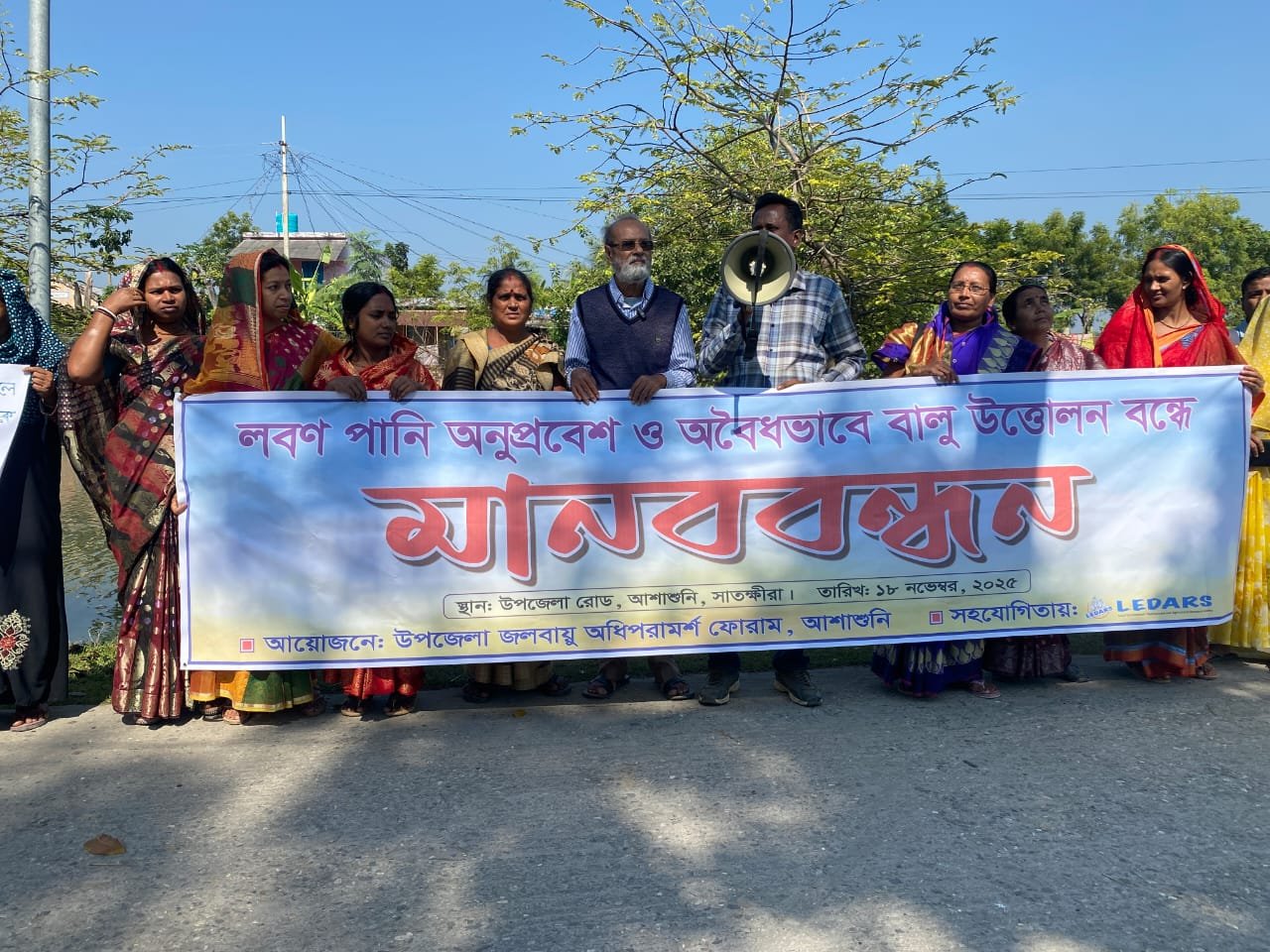
Residents of Assasuni upazila in Satkhira have raised alarm over the worsening crisis caused by persistent saline water intrusion and illegal sand extraction, which they say are destroying agricultural land, damaging homesteads, contaminating freshwater sources and threatening the region’s ecological balance.
On Tuesday the Upazila Climate Advisory Forum organised a human chain demanding urgent action, with participation from conscious citizens, local journalists, affected farmers, women, youth and the general public.
After the demonstration, a memorandum was submitted to the Upazila Nirbahi Officer (UNO) urging immediate government intervention.
Speakers at the event said the coastal belt of Assasuni has long been vulnerable due to climate change, but the situation has deteriorated sharply in recent months. They pointed out that weakened embankments, lack of dredging, unplanned fish enclosures and rampant illegal sand extraction have intensified the intrusion of saline water across vast parts of the upazila.
Thousands of bighas of farmland have become uncultivable, while homestead trees, vegetables and paddy fields are being repeatedly damaged as saltwater enters agricultural land. With freshwater ponds and tube wells gradually becoming saline, local residents are struggling to access drinkable water, forcing many families into financial hardship as crop losses push them deeper into debt.
The human chain, held in front of the upazila complex and presided over by Forum President and freedom fighter Abdul Hannan, called for immediate and long-term solutions. Participants demanded the construction and repair of embankments to prevent saline water entry, a complete ban on illegal sand lifting, re-excavation of rivers and canals to restore natural water flow, and rehabilitation of affected households.
They warned that failure to act would worsen the humanitarian, economic and environmental conditions in Assasuni and urged the administration to adopt sustainable, climate-resilient policies.
Following the demonstration, representatives of the Forum submitted a memorandum to the UNO, stressing that urgent action is necessary to prevent further deterioration of the region.
A representative of the UNO received the memorandum and assured the protesters that the administration would take necessary measures. Locals expressed hope that proactive steps by the authorities would finally bring relief to the people of Assasuni, who have been grappling with saline intrusion and environmental degradation for years.
AU/BP