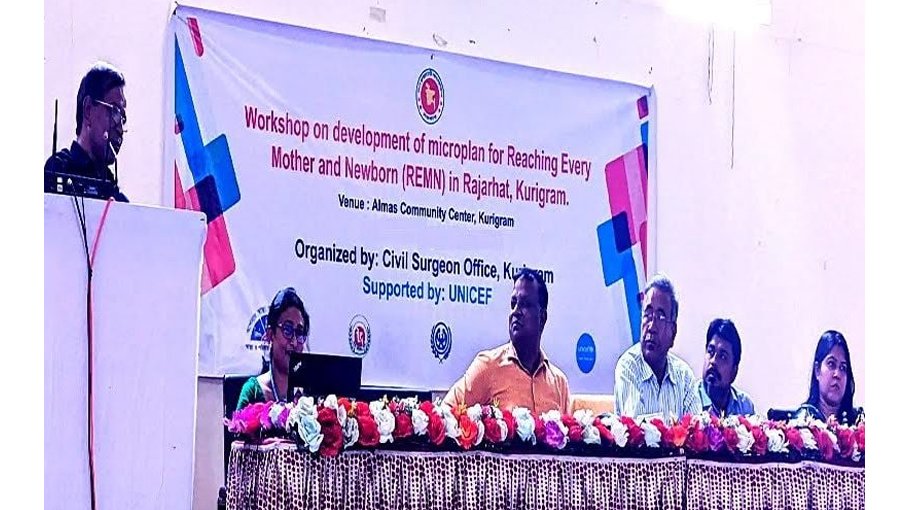
The 'Reaching Every Mother and Newborn' (REMN) programme is effectively enhancing the capacity of local healthcare workers and community engagements to improve maternal and neonatal health services in rural areas.
The health and family planning departments launched a series of initiatives under the UNICEF-supported REMN programme in April last at Rajarhat upazila of Kurigram in Rangpur division like other 10 upazilas in 10 separate districts. The initiatives include consultations and capacity-building activities for healthcare workers on introducing quality of care standards, bottom-up micro-planning, supportive supervision, monitoring and evaluation system and establishing community engagement mechanisms.
Kurigram Civil Surgeon Dr Md Monjur-e-Murshed said, "We launched REMN programme with increasing antenatal care (ANC) and postnatal care (PNC) at one facility in every ward of Rajarhat upazila where facility-level delivery is growing rapidly."
Deputy Director of the Department of Family Planning for Kurigram Md. Modabber Hossain, said, "REMN programme is a timely initiative to ensure quality maternal and neonatal health services visibly bringing more pregnant mothers to seek facility services." UNICEF Chief for Rangpur and Rajshahi Divisions AH Towfique Ahmed said "The REMN programme is being piloted in 11 upazilas of 11 districts to replicate it across the country to improve maternal and neonatal health services with quality care."
Through the REMN programme, UNICEF is supporting one facility in each ward of Rajarhat upazila in Kurigram of Rangpur division where pregnant and lactating mothers are getting quality ANC, safe institutional delivery, PNC and essential newborn care. "Different community engagement sessions are being organized at health facilities in the form of mothers' rallies, courtyard meetings and publicity using loud speakers to remove community hesitation to seek care due to cultural and social barriers," he said.
Besides, counseling on birth spacing, severe risks of child marriage and teen pregnancy are also covered in these sessions.
UNICEF is supporting maternal and neonatal care through community approach in the northern region as primary healthcare is an essential component of all healthcare systems everywhere across the world, including Bangladesh.
Despite recent huge improvements in the country's heath sector, there are still many concerns and bottlenecks that should be addressed to improve the quality of basic healthcare.
One key concern is the insufficient availability and accessibility of quality basic healthcare services, particularly in rural and remote areas.
"Despite a rise in the number of clinics, union sub-centers and union health and family welfare centers, challenges such as a lack of sufficient and quality human resources, equipment and supplies in such institutions still persist," Ahmed said.
As a result, individuals turn to private health care providers, particularly unqualified doctors in remote areas.
Many healthcare professionals are under-trained and lack the necessary knowledge, skills and instruments to offer good care due to a lack of capacity building.
Citing Bangladesh Demographic Health Survey (BDHS)-2022, Ahmed said ANC with medically qualified service providers drops from 82.5 percent of pregnant women for the first ANC to 14.3 percent for the fourth ANC with quality care resulting in high-risk pregnancy and high rate (37.4 percent) of home-based delivery in Rangpur division.
"Besides, teenage pregnancy is still highest (31 percent) in Rangpur division. Another concern is low healthcare personnel retention, particularly in rural areas," Ahmed said quoting the BDHS-2022.
At the same time, healthcare professionals typically relocate to cities resulting in a shortage of workers and a loss of continuity of care, both of which can be damaging to maternal and newborn health.
"To address these challenges, REMN strategy is focusing on ensuring ANC, safe institutional delivery, PNC, essential newborn care, timely referral for complication management and follow-up at the primary health care level to achieve the SDGS by 2030 next," Ahmed added.