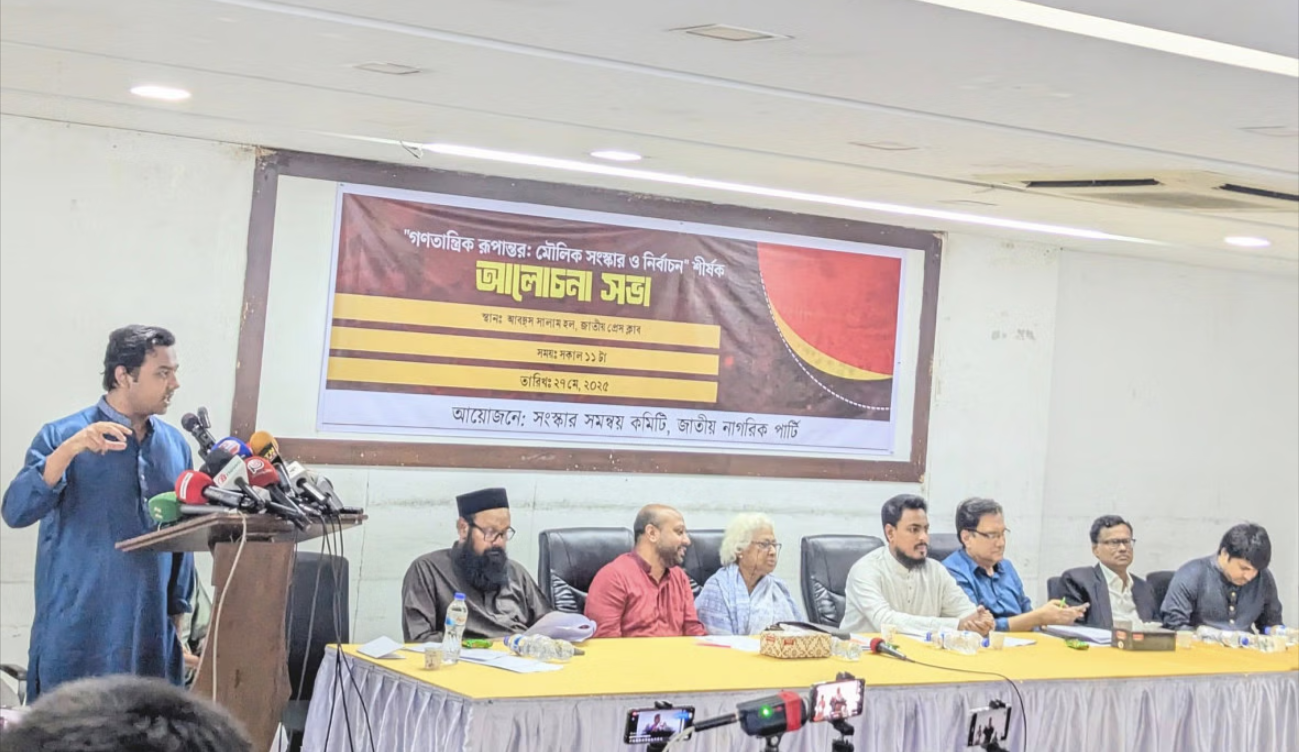
Leaders of newly formed National Citizen Party (NCP) on Tuesday said fundamental reforms must come first to establish balance among state institutions and prevent any single individual from exercising unchecked authority.
Holding elections without reforming the current structure of power would not bring meaningful democracy to Bangladesh, they said.
Speaking at a discussion titled "Democratic Transformation: Fundamental Reforms and Elections" at the Jatiya Press Club, NCP Joint Convener Sarwar Tushar said, "We want a permanent system where no one can remain in power for even a single day without the people's vote. That is what we mean by fundamental reform."
The event was organised by the NCP's Reform Coordination Committee, which unveiled a comprehensive 10-point proposal to restructure the country's constitutional and institutional framework.
Tushar said many political actors only focus on holding elections, while remaining silent about the institutional design that allows parties in power to alter the constitution and expand executive control without accountability.
"Those who only talk about elections are not serious about fairness. For them, elections are simply a means to capture power," he said. "In contrast, those who are speaking about fundamental reform are the ones genuinely advocating for free and fair polls in this country."
He said that whenever a ruling party gains a two-thirds majority in parliament, it tends to make sweeping constitutional changes that serve the interests of its leadership, often bypassing public consent or intra-party deliberation.
"These changes don't reflect collective decision-making, they come from the will of one person who holds majority control. That's how the character of the state keeps shifting, not through democratic process, but through personal discretion," he said.
He referred to several historical instances: the introduction of BAKSAL in 1975, the 14th amendment passed by the BNP-led government in 2004, and the abolition of the caretaker government system in 2011 under the Awami League.
"These didn't arise out of national consensus. They were decisions taken at the top, enforced through numerical advantage in parliament," said Tushar.
He said such excessive concentration of power had turned Bangladesh's political framework into a system centered on one person, where even internal party differences are often suppressed.
"If reforms are pushed back until after the polls, we will repeat the same cycle. This has happened before, and we've seen the consequences."
He said the next election cannot take place under the existing framework.
"That would go directly against the spirit of the July 24 mass uprising, where citizens, especially young people, clearly expressed the kind of country they want," he said, adding, "This is no longer about party tactics. It's about the future of the republic. Ignoring the people's demand for reform will only deepen the crisis."
He urged all political parties to agree on a roadmap for reform before the next election. "Whether it's done through a Constituent Assembly, a referendum, or any inclusive process, it must happen before polls are held."
Earlier in the programme, Javed Rasin, a member of the NCP's Reform Coordination Committee, presented the key issues of the party's fundamental reform proposal.
These are: restructuring the constitutional framework, balancing executive authority, ensuring an independent and effective Election Commission, introducing public referendums on major constitutional amendments, guaranteeing judicial independence, reforming appointments to constitutional positions, introducing a non-partisan caretaker government during elections, reforming the Anti-Corruption Commission, reforming local government elections, and launching public administrative reforms.
Chief Coordinator of NCP Nasiruddin Patwari, member secretary Akhtar Hossain, and Asaduzzaman Fuad of Amar Bangladesh Party were also present at the programme.