Abdus Salam, Dinajpur
Nearly 65,000 children in five upazilas of Dinajpur are receiving food support under a school feeding programme aimed at reducing hunger and nutritional deficiencies and improving school attendance.
The programme is being implemented in Birampur, Ghoraghat, Kaharole, Biral and Bochaganj by the Eco-Social Development Organisation (ESDO), under an initiative of the Directorate of Primary Education.
According to officials, 64,998 students are covered based on a 90 per cent attendance calculation among 72,475 students at 602 government primary schools in the five upazilas.
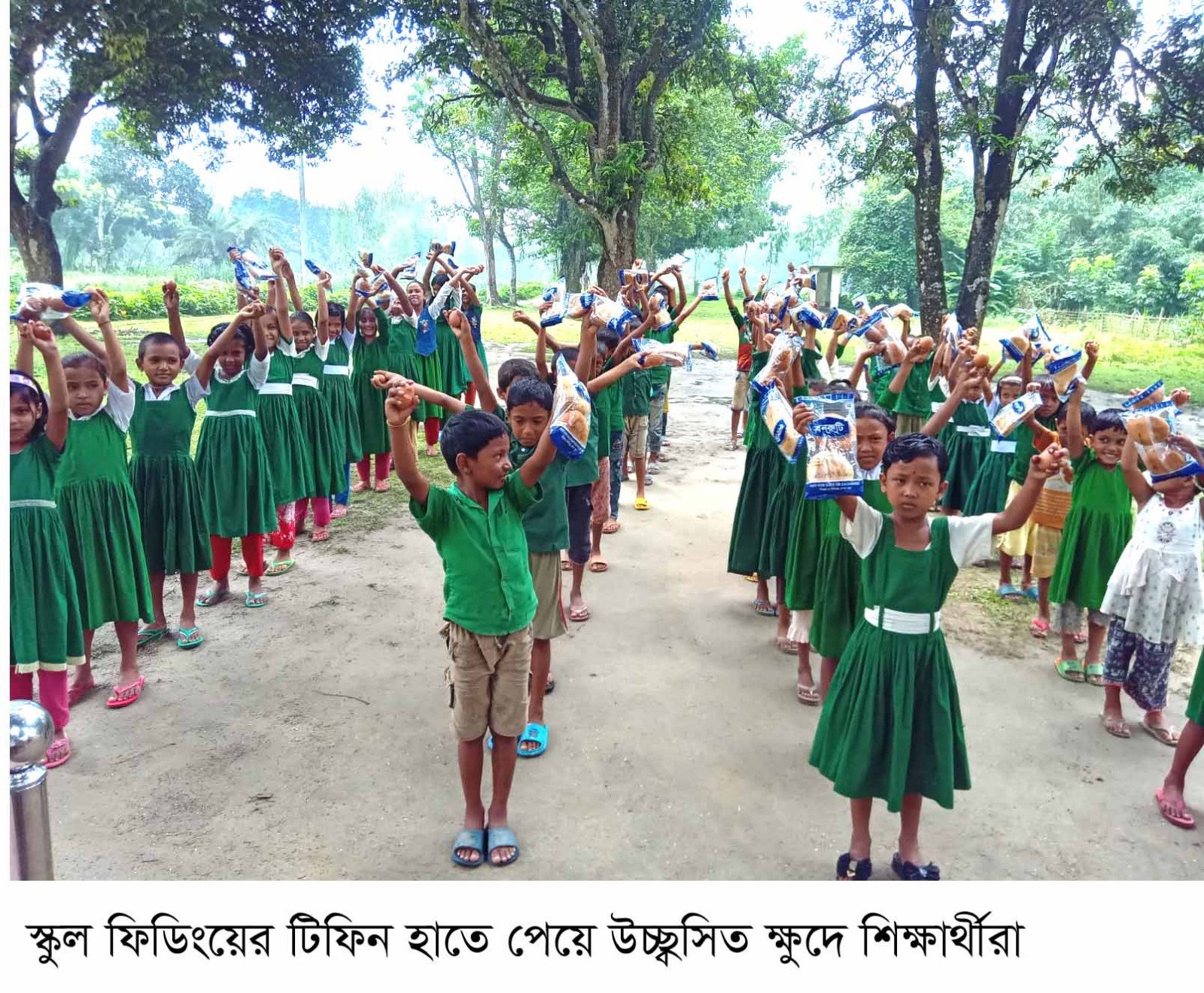
The programme began on 28 December last year. Students are scheduled to receive two buns and a boiled egg five days a week, while bananas and buns are provided on one day. The food is distributed at designated times at schools.
A visit to several schools found students showing interest during snack distribution and eating the food on school premises.
Teachers said many students previously came to school without having enough food in the morning. Hunger later made it difficult, particularly for younger children, to concentrate in class. Some students would leave school to get food and fail to return.
Teacher Aminul Islam said the programme had ensured regular snacks for some students, reducing discomfort caused by hunger and helping them remain attentive in class.
However, he said improved attendance also depended on families’ financial conditions, the school environment and the quality of education.
In Kaharole upazila, 13,107 students from 121 government primary schools are covered by the programme, according to the Upazila Primary Education Office.
Shah Md Aminul Haque, school feeding programme manager of ESDO in Dinajpur, said 192 women entrepreneurs were involved in supplying the food. He claimed each earns a profit of around Tk 4,000 to Tk 5,000 per week.
Locals said the programme was providing necessary food support to children from low-income families during school hours while also creating employment opportunities by involving women entrepreneurs.
They stressed the need for regular monitoring of students’ nutritional status, learning outcomes, dropout rates, food quality and quantity, and the supply system to assess the programme’s effectiveness and long-term sustainability.
Meanwhile, the government has said it plans to introduce the school feeding programme in all government primary schools across the country from the 2027 academic year.
At a workshop held recently in Dinajpur, State Minister for Primary and Mass Education Bobby Hajjaj said the government planned to bring around 11 million students under the programme. #EK