21 Nov, NASA scientists in Antarctica showed off an experimental new undersea rover they believe could help them search for life on Jupiter’s partially frozen moon Europa and beyond.
Called the Buoyant Rover for Under-Ice Exploration (BRUIE), the device is being tested below the surface at Australia’s Casey research station in Antarctica.
Rather than diving deep under the ocean, BRUIE is designed to navigate on the underside of the sea ice, using buoyancy of the water to keep it firmly in position and lessen the energy cost of movement.
It’s also been equipped with an energy system that can preserve its power supply by shutting off while collecting samples or remaining stationary.
NASA scientists are particularly interested in using BRUIE to search regions they describe as ‘interfaces,’ or areas where ice and liquid meet.
‘The ice shells covering these distant oceans serve as a window into the oceans below, and the chemistry of the ice could help feed life within those oceans,’ NASA’s Kevin Hand said in a statement.
‘Here on Earth, the ice covering our polar oceans serves a similar role, and our team is particularly interested in what is happening where the water meets the ice.’
Researchers say the long-term goal is for BRUIE to be able to operate independently for several months without running out of power.

BRUIE’s current design includes two cameras and probes that will allow it to measure water temperature, salinity, and oxygen levels.
These measures were fundamental to life emerging on Earth, but NASA’s researchers acknowledge they may need to amend these tools to allow for the fact that life on other planets may well have involved different conditions.
NASA’s next major mission to Jupiter is scheduled for 2025, when the Europa Clipper will launch with the ultimate goal of taking various readings and images from the planet and its moon while in orbit.
Why Is Europa so special?
Jupiter's icy moon Europa is slightly smaller than Earth's moon.
Europa orbits Jupiter every 3.5 days and is tidally locked - just like Earth's Moon - so that the same side of Europa faces Jupiter at all times.
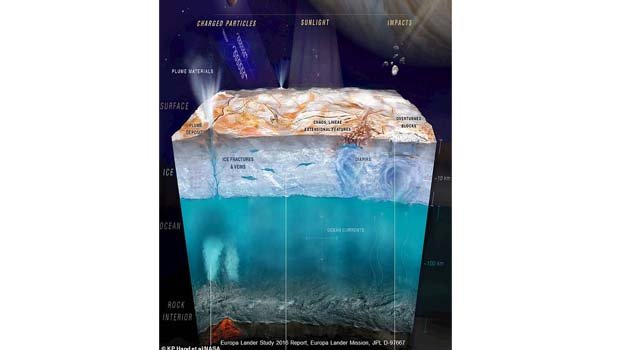
It is thought to have an iron core, a rocky mantle and a surface ocean of salty water, like Earth.
Unlike on Earth, however, this ocean is deep enough to cover the whole surface of Europa, and being far from the sun, the ocean surface is globally frozen over.
Many experts believe the hidden ocean surrounding Europa, warmed by powerful tidal forces caused by Jupiter's gravity, may have conditions favourable for life.
NASA scientists are on the verge of exploring Jupiter's ocean moon Europa for signs of alien life.
Europa is our best shot of finding biological life in the solar system, researchers say.
The space agency is priming two probes, including one that will land on its surface, to explore the distant moon in detail within the next decade, the agency says.