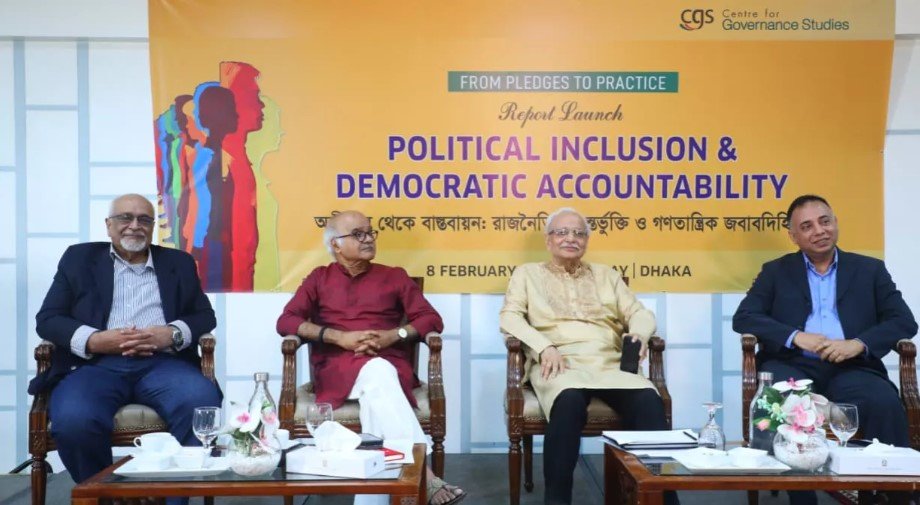
Speakers at report launching event on Sunday said minority concerns must be treated as national issues to sustain democracy in the country.
They said the rule of law has been dragged onto the streets through mob pressure while manifestos have no real value without accountability.
Gaps in oversight, enforcement, and institutional independence have created widespread doubts about election management, they observed.
The Center for Governance Studies (CGS) organised the report launching event titled “From Pledges to Practice: Political Inclusion & Democratic Accountability– Bangladesh’s Polls 2026.”
During the event, research findings and recommendations were presented on ensuring an inclusive, safe, and reliable election for minority and marginalised communities as Bangladesh approaches the national election.
The discussion highlighted the electoral realities and obstacles faced by religious minorities, ethnic groups, and gender-diverse populations, as well as the implementation of constitutional pledges regarding equality and non-discrimination.
Prominent economist Dr Debapriya Bhattacharya said he had no disagreement with the data and analysis presented in the CGS report and expressed agreement with its core findings.
He noted that justice, reform, and elections were the government’s three main priorities, with security as a critical fourth.
In his view, the most significant change has been in people’s expectations.
Those who had long remained marginalized are now visible, speaking out, and present in the public sphere.
He credited this shift to ordinary citizens, the media, and civil society.
Dr Debapriya added that political parties could have offered more progressive and inclusive manifestos, though what has been presented should not be dismissed outright.
However, he said, without accountability, even the most extensive manifestos hold little value.
The deficits in inclusivity and participation are difficult to articulate fully. Bangladesh, he said, remains capable of holding a participatory election, but those unwilling to do so do not view voting as beneficial to society.
"Without ensuring the safety of marginalized communities before and after elections, the democratic process will remain fragile," Dr Debapriya said.
He further stated that if the interim government succeeds in delivering a free and credible election at the end of its tenure, that achievement will be remembered in history.
"In reality, minority representation in elections has continued to decline, and even minority representatives in previous parliaments were unable to effectively raise minority concerns within the legislature. To sustain democracy, minority issues must be treated as national issues and never trivialized or politicized," Dr Debapriya said.
Failure to address the concerns of religious and minority communities could lead to broader national security challenges, he said.
He noted that while the Chief Adviser has spoken of unity across religions and identities under one umbrella, that umbrella has yet to be fully opened in practice.
Dr Debapriya concluded by asking whether the country truly seeks accountability and whether the expectations for change can be translated into action.
Without ensuring minority representation across administrative structures, challenges will only deepen, he said.
Bangladesh seeks change, he said, and he expressed optimism and satisfaction at being part of that process.
At the beginning of the event, CGS President Zillur Rahman said although the research report was prepared with the upcoming national election in mind, its significance goes far beyond a single electoral cycle.
The report reflects a long-standing democratic crisis and structural inequalities.
He recalled that the core pledge of the 1971 Liberation War was to establish an egalitarian society, yet more than five decades after independence, that promise remains unfulfilled.
The 2024 mass uprising, he said, was fundamentally directed against inequality.
"Today, inequality persists across Bangladesh—between men and women, across religions and identities, and between the center and the periphery."
Dr. Badiul Alam Majumdar said over the years there has been no meaningful improvement in the conditions of marginalized communities, including women and all forms of minorities.
Despite numerous proposals and recommendations for electoral reform, most have not been implemented in practice, he said.
As a result, he said serious doubts remain about whether the upcoming election will be genuinely free, fair, and inclusive.
Dr. Selim Jahan said although the Constitution guarantees equal rights for all citizens and envisions an inclusive electoral system, the recurring question of how inclusive elections in Bangladesh truly are reflects a deep institutional failure.
In practice, constitutional commitments have repeatedly been violated, and the rights and security of minority communities have not been adequately protected or prioritized.
He noted that over time the state has failed to consistently recognize, safeguard, and ensure accountability for minority political participation, allowing structural patterns of exclusion to persist.
The event was moderated by Zillur Rahman, President of the Center for Governance Studies (CGS).
Politicians, teachers, economists, civil society members, media professionals, and representatives from minority communities were present at the event.