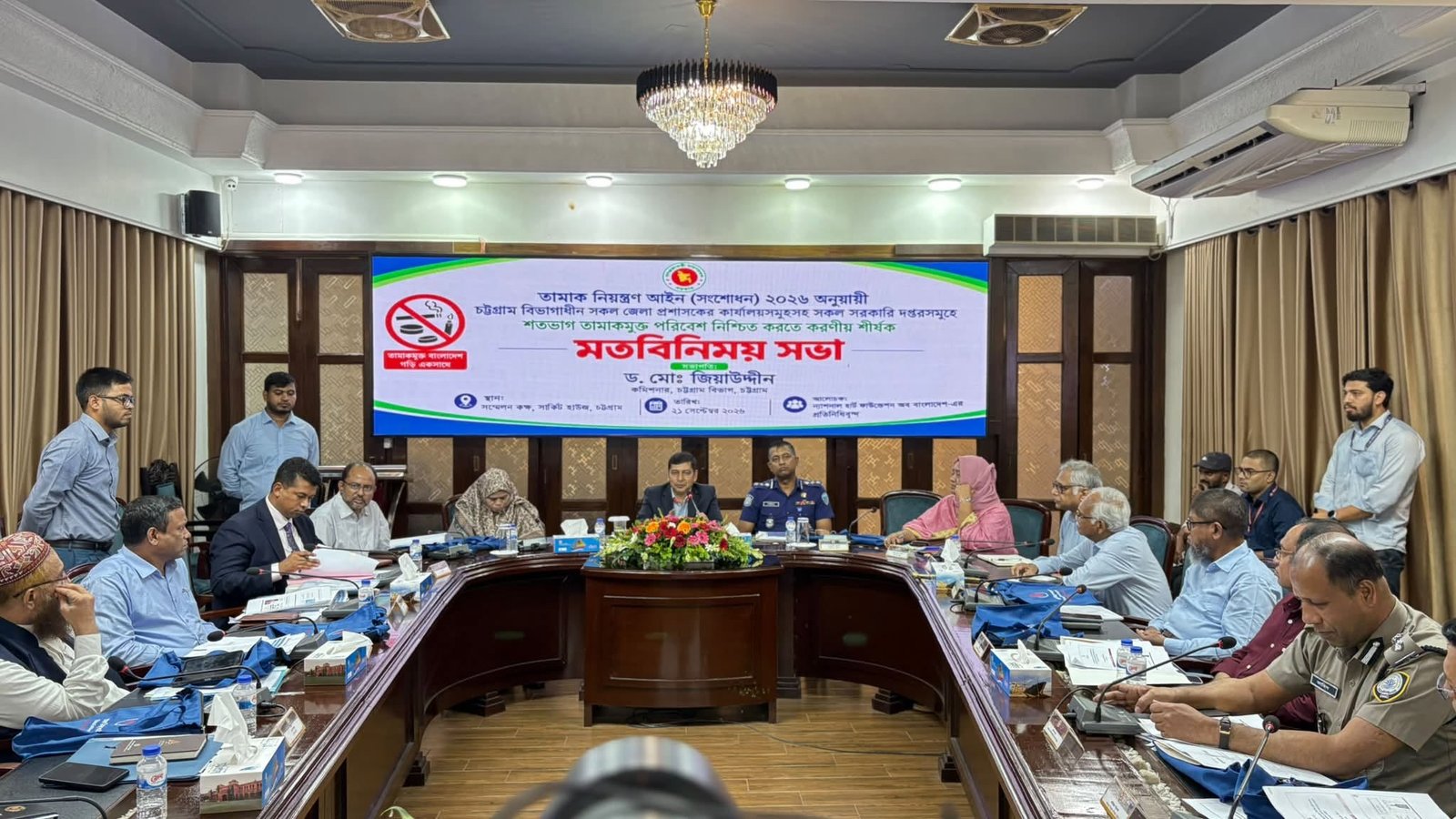
A discussion meeting was held in Chattogram on Monday to ensure a 100 percent tobacco-free environment at the divisional commissioner’s office, offices of deputy commissioners and other government institutions across the division.
The meeting, titled “Measures to Ensure a 100% Tobacco-Free Environment in the Chattogram Divisional Commissioner’s Office, District Commissioner’s Offices and Government Offices under the Tobacco Control (Amendment) Act 2026”, was organised by the National Heart Foundation of Bangladesh (NHFB) at the conference room of Chattogram Circuit House.
Chattogram Divisional Commissioner Dr Md Ziauddin chaired the meeting. Deputy commissioners of all 11 districts in the division and heads of various divisional-level government offices attended it.
NHFB representatives said, citing the Global Adult Tobacco Survey (GATS) 2017, that 37.8 million adults in Bangladesh use tobacco, while around 38.4 million adults are exposed to secondhand smoke.
According to the survey, 42.7 percent of adults are exposed to secondhand smoke at workplaces, 49.7 percent in restaurants and 44 percent on public transport.
The meeting also cited a study published in The Lancet Public Health in 2026, which estimated that nearly 1.66 million deaths worldwide in 2023 were attributable to secondhand smoke exposure.
Participants stressed that there is no safe level of exposure to secondhand smoke and called for completely smoke-free environments, particularly to protect women and children.
Prof Sohel Reza Choudhury, head of the Department of Epidemiology and Research at National Heart Foundation Hospital & Research Institute, said designated smoking areas cannot effectively protect non-smokers from exposure to secondhand smoke.
He stressed the need to ensure completely tobacco-free environments in all public places, including government and private offices.
Such measures would not only protect non-smokers from the harmful effects of secondhand smoke but could also encourage people to refrain from smoking and using smokeless tobacco products, he said.
Prof Choudhury said tobacco use is a major risk factor for non-communicable diseases, including cardiovascular disease, stroke and cancer.
He stressed that ensuring tobacco-free environments in every government institution is necessary to build a tobacco-free Bangladesh.
The meeting recommended several measures, including issuing office orders, installing clearly visible “No Smoking” signs, appointing focal persons for tobacco control activities, informing officials and employees about tobacco control measures, establishing mechanisms to receive and address complaints, and conducting regular monitoring and reporting.
Divisional Commissioner Dr Md Ziauddin said the Smoking and Tobacco Products Usage (Control) (Amendment) Act, 2026 makes it important to ensure a safe, healthy and tobacco-free environment for government officials and employees as well as members of the public seeking services at government offices.
Ensuring tobacco-free environments in government offices would contribute to the government’s tobacco-control efforts and send a positive message to the public, he said.
Among others, Dr Mohammad Mushtuq Hosain, consultant of the Tobacco Control Program at the National Heart Foundation Hospital & Research Institute; Dr Aruna Sarker, coordinator of the Tobacco Control Program; Abu Jafor, senior communications officer of the programme; Dr Md Shahinul Islam, divisional programme officer of the Bangladesh Hypertension Control Initiative; Dr Udit Proyash Sikdar, surveillance medical officer; and research officer Syeda Mosallama Sharmin attended the meeting.