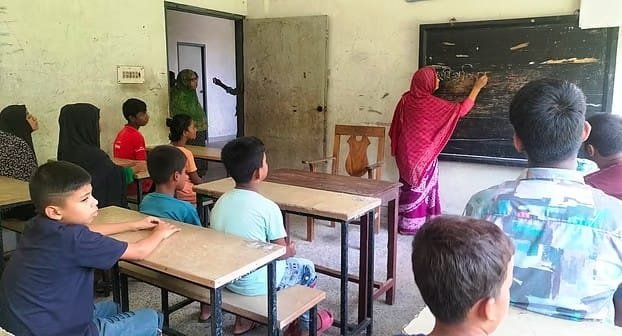
Where a lack of government support would normally bring a school to its knees, one has instead survived for 35 years — sustained solely by the affection and maternal care of its teachers. This is the remarkable story of the Dinajpur Badhir Institute, located in the Gunjabari area of Dinajpur town in northern Bangladesh.
Once a beacon of hope for children with speech and hearing disabilities in the northern region, the institute now stands as a shadow of its former self — neglected, crumbling, and struggling to survive. Yet, within its decaying walls, the devotion of a few teachers continues to light the way for dozens of differently-abled children.
At the heart of this story is Rabeya Khatun, a 69-year-old teacher and hostel superintendent who has served the school for over 35 years. From dawn till night, she looks after 24 residential students — ensuring their meals, studies, hygiene, and sleep. In return for this lifelong service, she receives no government salary — only a small monthly allowance of Tk 600 from local donations.
But Rabeya harbours no complaint. Her only motivation, she says, is love. “We have 24 residential students — none of them can speak or hear. Where would I go leaving them behind? I’ve been bound by love for 35 years. I want to stay with them until my last breath,” she says softly. Having two speech-impaired children of her own has made her even more compassionate toward her students.
Rabeya is not alone. All seven teachers at the institute have been working without pay for years, driven purely by affection for their pupils.
Head teacher Nazneen Akter, who has been teaching there for 18 years, shares the same emotion. “Even without a salary, we run classes from 10 a.m. to 2 p.m. regularly. I can’t bear to stay away. If I miss a day, I feel uneasy,” she said.
The institute began in 1989 through the personal initiative of Badiul Alam, a resident of Lalmonirhat, with support from local donors. It initially flourished, aided by land from Jubilee School and patronage from former Prime Minister Khaleda Zia’s mother, Tayeba Majumder. Later, in 2005, a five-storey building was constructed with funds from the Ministry of Social Welfare. The school even operated a van service and provided computer and tailoring training for students.
Today, however, that five-storey building tells a story of neglect. Nearly every room is in disrepair; doors on the upper floors are broken, and 10 computers lie unused on the second floor. Tailoring machines and other training tools gather dust. The dining hall is damp and unhygienic. Once, a doctor used to visit regularly, but now, when students fall ill, Rabeya must take them to a local village healer.
Out of 120 enrolled students, nearly half have stopped attending classes due to poor conditions.
According to the District Social Services Office, there are 9,826 people with speech and hearing disabilities in the district. Jubilee School teacher Tapon Kumar Biswas emphasised that government intervention is crucial: “If proper facilities and skilled teachers are provided, these children can thrive in technical education and vocational skills.”
SM Habibul Hasan, Additional Deputy Commissioner (Education and ICT), said the institute has been inspected and efforts are underway to restore its operations. “We are prioritising technical education and providing small allowances to teachers. Residential students are also receiving Tk 2,000 per month from the Department of Social Services,” he noted.
Still, such minimal efforts pale in comparison to the teachers’ 35 years of unpaid service and emotional commitment. The Dinajpur Badhir Institute stands as a living example of how, in the absence of state support, human compassion and selfless love can sustain an institution.
Education activists say that unless the government intervenes urgently, the tears of these teachers and the dreams of these children may fade together — silenced not by disability, but by neglect.