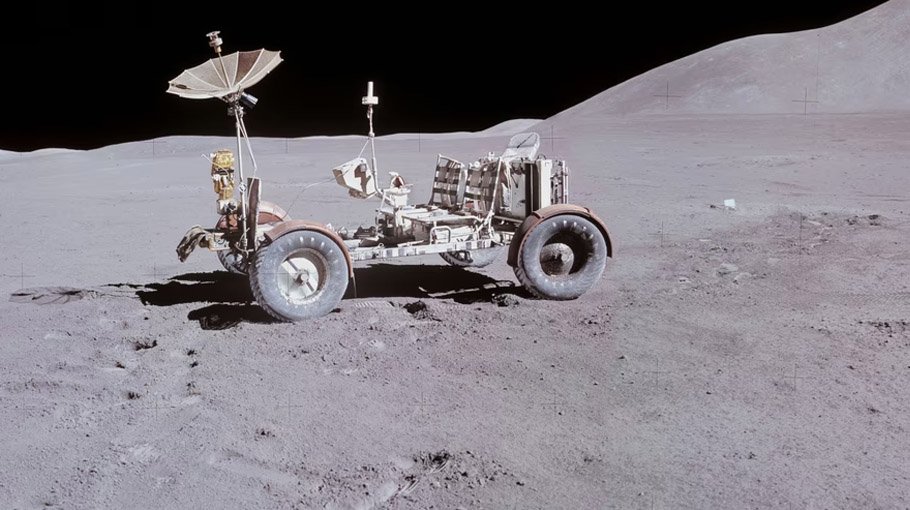
On this day in 1971, Apollo 15 astronauts James B. Irwin and David Scott first used the four-wheeled battery-powered Lunar Roving Vehicle to extensively explore the Moon's surface, in particular the Hadley-Apennine sit.
This week in 1971, Apollo 15 became the first mission to use the Lunar Roving Vehicle. The LRV was a lightweight, electric vehicle designed to operate in the low-gravity vacuum of the Moon. It was capable of traversing the lunar surface, allowing Apollo astronauts to extend the range of their extravehicular activities. Here, the LRV is photographed alone against the desolate lunar background following the third Apollo 15 EVA. This July, in a series of special events, NASA is marking the 50th anniversary of the Apollo Program — the historic effort that sent the first U.S. astronauts into orbit around the Moon in 1968, and landed a dozen astronauts on the lunar surface between 1969 and 1972. For more pictures, and to connect to NASA’s remarkable history, visit the Marshall History Program’s webpage. (NASA).
The LRV was capable of traversing the lunar surface, allowing Apollo astronauts to extend the range of their extravehicular activities. The rover was used on three traverses, one per day over the three day course of the mission. On Apollo 15 the LRV was driven a total of 27.8 km in 3 hours, 2 minutes of driving time. The longest single traverse was 12.5 km and the maximum range from the LM was 5.0 km.
Source: internet