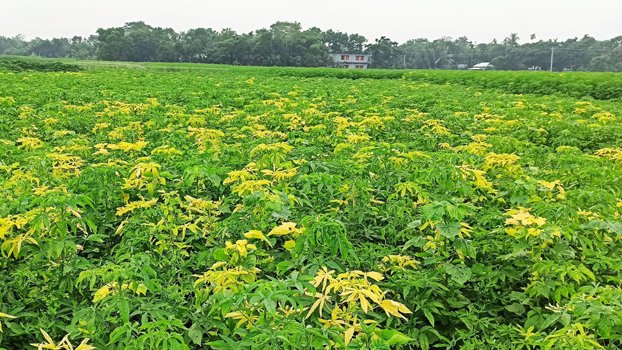
Farmers of Kishoreganj are worried about jute cultivation due to severe drought and lack of expected rains. Farmers of the region have planted jute as much as possible in the hope of making more profit this year after getting good price of jute last year.
However, the intense heat is hindering the growth and development of jute in the local fields and if the hostile weather continues for a few more days, they fear that there may be a shortage in production. Besides, the leaves of jute tree are turning yellow due to unknown virus. Local jute farmers have become anxious in the faces of this crisis.
According to Kishoreganj District office of the Department of Agricultural Extension, 17,430 hectares of land has been targeted to bring under jute cultivation this year. Of these, Desi jute was targeted to be sown on 1,850 hectares of land, Tosha jute on 7,550 hectares, Kenaf jute on 7,450 hectares and Mesta jute on 580 hectares of land in the district. Meanwhile, Deshi jute seed was sown on 1,630 hectares, Tosha jute on 7,215 hectares, Kenaf jute on 7,180 hectares and Mesta jute on 755 hectares.
According to the source, there was no problem at the beginning as the weather was favorable during the jute cultivation season. However, when the jute of the field started growing up, long drought and heat wave occurred in the region. Local farmers depend on irrigation for most of the land. Scientists at the Jute Research Institute are blaming Indian seeds for the yellowing of jute leaves.
Farmers said that they had almost given up jute cultivation due to falling prices even in the last few years. But they have cultivated more jute this year as they have got better prices in the last few years. But the intense heat is hindering the growth and development of jute in the fields. Added to this is the yellowing of jute leaves.
Abul Kashem, a farmer from Kashorarchar village in Kishoreganj Sadar upazila, said he has planted jute on one bigha of land this year. At first the jute seedlings in the field were quite beautiful as the weather was good. However, at the right time for the jute to grow, the jute seedlings are being damaged due to low rainfall and severe drought. If there is no heavy rain at the moment, the jute tree will not grow tall. And if the size is small, the yield will be less.
Md. Saiful Alam, Deputy Director of the Department of Agricultural Extension said, the rainfall this year was less than other years along with increased temperature. Due to this there have been some problems in jute cultivation.
However, the problem will be lessened in the rain on Monday night. If it rains more then there will be no more problems. He added that jute requires both rain and drought. Sometimes there will be drought and sometimes there will be rain. But this time it's getting a bit rhythmic.
Dr. Md. Ashraful Alam, Chief Scientific Officer of Kishoreganj Jute Research Institute said, jute cultivation has been hampered by severe drought. Again, the unnamed virus was caused by sowing Indian seeds. The virus has been detected in the fields of those who have sown only Indian seeds. Necessary advice is being given. I hope to get rid of this quickly.