Osama Al-Sharif
As Israel and Lebanon prepare to hold a second round of direct negotiations in Washington on Thursday, President Joseph Aoun has said he has chosen to negotiate to save Lebanon, adding that the objective of the talks would be to end hostilities and remove the Israeli presence from southern Lebanon. He has avoided committing to signing a peace treaty with Israel, a controversial and divisive issue for the Lebanese, which, according to Israeli Prime Minister Netanyahu and the Americans, is the endgame of the negotiations.
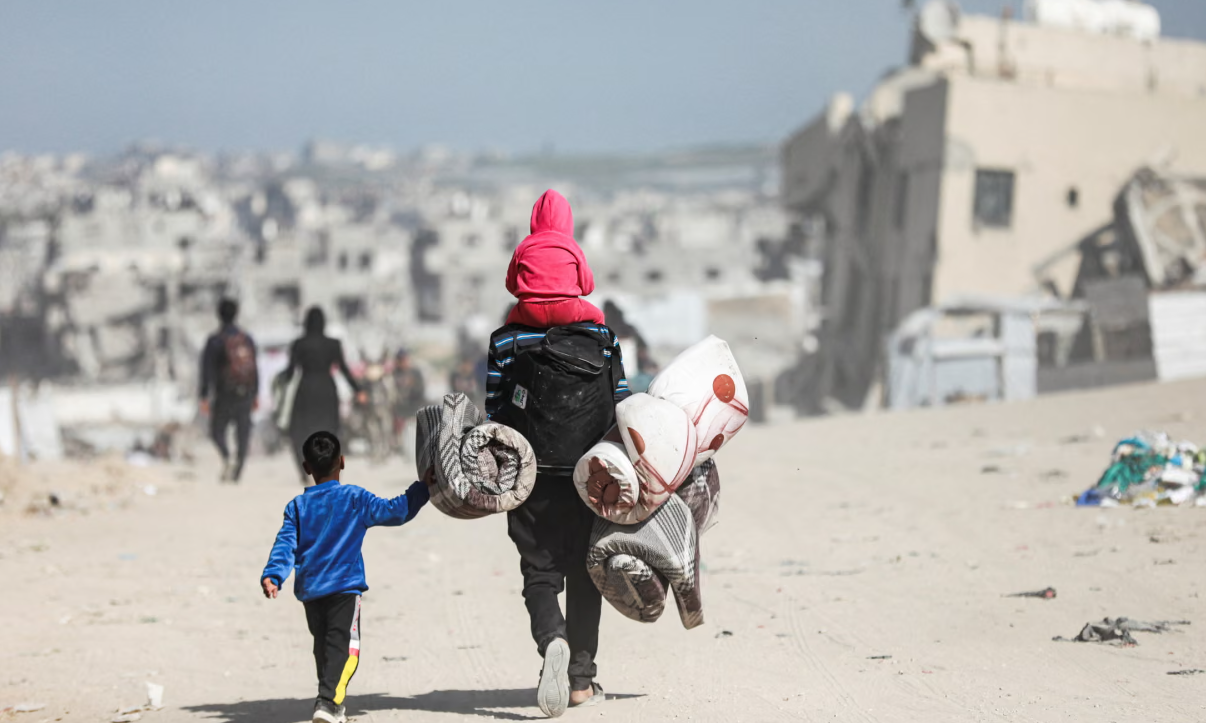
An Israeli condition for reaching that goal depends on the ability of the Lebanese government to fully disarm the pro-Iran militia, Hezbollah. Israel has already declared Lebanon’s efforts in that regard a failure. After almost 40 days of fighting between Israel and Hezbollah, now suspended through a US-mediated ceasefire, Israeli forces have created a 10-km so-called buffer zone inside southern Lebanon that includes more than 55 villages, which Israel has systematically destroyed and declared off-limits, rendering tens of thousands of inhabitants displaced and homeless.
Borrowing from its Gaza experience, Israel has created a “Yellow Line” that demarcates the territory under its control. The Israeli military released a map showing the buffer zone forming a continuous belt from Lebanon’s Mediterranean territorial waters all the way to the Mount Hermon area near the Syrian border. As Netanyahu himself put it: “This is a security strip 10 km deep, which is much stronger, more intense, more continuous and more solid than what we had previously. That is where we are and we are not leaving.”
Together, in Lebanon and Syria, Israel seeks to maintain permanent control of some 14,000 sq. km of land under the “buffer zone” banner. It also has full territorial control of the West Bank (about 5,640 sq. km), across the so-called Green Line, with effective annexation of about 60 percent of that territory. And it occupies another 60 percent of the Gaza Strip behind what Israel calls the “Yellow Line” (about 219 sq. km). This means Israel is now illegally occupying about 19,850 sq. km of territory beyond its recognized borders.
Instead of using the word occupation, Israel has come up with alternative terms, such as “security strip,” “buffer zone” or what the Israeli army now calls areas under its control in southern Lebanon: “forward defense area.” These terminological tools are euphemisms for occupation. Israel is applying a colored lines doctrine to obscure its real intentions.
Israeli Finance Minister Bezalel Smotrich has been explicit about the broader agenda. He this month publicly announced border expansion plans covering Gaza, the West Bank, Lebanon up to the Litani River and Syria’s Mount Hermon area — framing it as the “final leg” of a “greater Israel” project.
The call for direct negotiations with Lebanon is largely a tactical maneuver. Israel knows the complexity of Lebanon’s internal political environment. Without Lebanese consensus, which includes Hezbollah’s engagement and acceptance, the disarmament of the militia will not happen overnight. For the time being, Israel’s occupation of areas up to the Yellow Line will not end anytime soon.
It is also worrying that the Israeli army’s map extends to Lebanon’s maritime areas, which the two countries demarcated in October 2022, when they finally signed a US-brokered agreement establishing maritime boundaries and bringing clarity to their respective economic zones in the Mediterranean Sea.
The current Yellow Line in Lebanon abrogates the UN-designated Blue Line, adopted in June 2000, which stretches 120 km along Lebanon’s southern frontier. It was not meant to be a border but a “line of withdrawal” for the practical purpose of confirming Israel’s withdrawal from southern Lebanon and is explicitly described as temporary.
While the Green Line of the 1949 armistice was meant to define ceasefire demarcation — and as a temporary rather than permanent international border — Israel’s occupation of the West Bank in 1967 rendered this line irrelevant, as it moved quickly to annex East Jerusalem and authorize the building of illegal settlements in the newly conquered territory.
Under the current far-right Israeli government, the pace of colonizing West Bank lands has accelerated, with Israeli law imposed on hundreds of illegal settlements and creeping annexation actively facilitated. Jewish settlers are waging a campaign of terror on Palestinians, tolerated and encouraged by the government, to drive the natives from their lands.
As for Gaza, the Yellow Line carves off more than 60 percent of the narrow Strip. Israel is digging trenches across the line to physically separate areas it occupies from the rest of Gaza. It has carried out ethnic cleansing in that area and is showing no signs of pulling out from that so-called buffer zone.
The systematic destruction of Lebanese villages in the areas that Israel now occupies is proof that it has no intention of ever allowing their inhabitants to return. Regardless of the outcome of the negotiations, Israel will claim to hold that territory as a guarantee that southern Lebanon will never pose a threat to its northern border. If the fighting erupts again — which is a strong possibility — Israel will seek to extend that zone even further. Even now, it is issuing warnings to Lebanese not to cross the Litani River and return to villages it has severely damaged but not occupied.
Israel is applying the same approach in Syria. Its forces carved out a buffer zone beyond the Golan Heights following the fall of President Bashar Assad — and the international community has largely looked away. The silence is telling: each time Israel establishes a new line, the absence of meaningful protest emboldens it to draw the next one. Each line follows the same logic: a ceasefire or withdrawal creates a boundary, Israel militarizes beyond it and ambiguity hardens into permanence.
Netanyahu and other Israeli officials have affirmed permanent Israeli control over the Golan Heights and expanded the Syrian buffer zone, citing security needs following the collapse of the Assad regime. He initially called the occupation a “temporary defensive position,” but later stated Israel would hold it “until another arrangement is found that ensures Israel's security,” with plans to settle and develop the area.
Whether under the pretext of security or some alleged biblical right, Israel’s colored lines serve one purpose only — land grabs through the use of brute force, mass destruction of villages and farmland, ethnic cleansing, economic strangulation, and terror. Real and equitable peace is never on the agenda.
Osama Al-Sharif is a journalist and political commentator based in Amman. X: @plato010