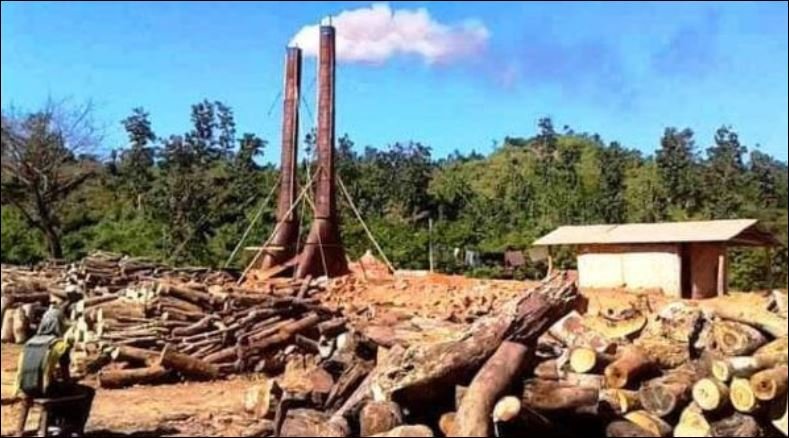
The unchecked establishment of illegal brick kilns in Lama upazila of Bandarban is causing severe environmental damage and steadily shrinking land used for Joom cultivation, local residents say. Smoke and pollution from the kilns are reducing crop yields, while declining soil fertility is discouraging farmers from continuing traditional Joom farming.
For hill communities, Joom cultivation has long been a primary source of food and income. The method involves growing rice, maize, potatoes, and vegetables on steep hill slopes. After the monsoon, forest vegetation is cleared and burned to prepare the land—an approach that enables low-cost food production.
According to local sources, more than 40 brick kilns are currently operating in Lama upazila, with 32 located in Fythong Union alone. In the Shibatali area of Fythong, three hills have been cut away to build illegal brick kilns, none of which have environmental clearance. Wood from nearby forests is being burned as fuel in the kilns, worsening pollution and increasing health risks.
Local farmers say interest in Joom cultivation has declined significantly. Rabiul Islam, a farmer from Fythong Union, said, “We don’t get the same yields from Joom farming anymore. Crops are damaged by smoke from the brick kilns. Working at the kilns brings in a bit more income, so seeing losses in farming, we choose kiln work instead.”
Another local farmer, Fatema Khatun, said, “Areas where rice and potatoes were once grown have now been turned into brick kilns after hills were cut down. It’s not just that we’re losing land; crop production has also suffered. People prefer working at the kilns because they earn more there.”
Mobile courts run by the Department of Environment (DoE) and the local administration regularly conduct drives against illegal brick kilns. However, effective action is often hampered by resistance from kiln owners and workers.
Lama’s Upazila Nirbahi Officer (UNO) Md Moin Uddin said operations are carried out to shut down illegal kilns. “We frequently impose fines and demolish kilns. But we often see owners resuming operations within a week of demolition,” he said.
Investigations reveal that local landowners are leasing land to brick kiln operators to have hills cut and levelled, increasing the land’s market value. Most individuals involved in brick kiln operations in Bandarban are outsiders, who are drawn to the area due to the easy availability of firewood.
Rezaul Karim, Assistant Director at the Department of Environment, said illegal brick kilns would effectively shut down if the Forest Department could strictly control the use of firewood. However, manpower shortages and financial constraints make it difficult to conduct regular and large-scale enforcement operations.
Local residents say illegal brick kilns are not only destroying hills but are also reducing Joom farmland and water sources, placing livelihoods at risk. They stress the need for immediate and strict measures to shut down illegal brick kilns.