Robert Ward
Ties between the United Kingdom and Japan are stronger than at any time since their previous peak during the 1902–23 Anglo-Japanese alliance. This reflects the relationship’s rapid transformation against a backdrop of a series of major geopolitical and economic shocks like the COVID-19 pandemic and Russia’s invasion of Ukraine.
These events — compounded in 2025 by US President Donald Trump’s ‘reciprocal’ tariff policy and China’s increasing diplomatic aggression against Taiwan — have contributed to a flurry of bilateral initiatives and agreements. They range from the Comprehensive Economic Partnership Agreement of 2021, the Reciprocal Access Agreement of 2023 and the Hiroshima Accord in the same year, which committed both countries to a global strategic partnership.
Other examples of the relationship’s expansion include the 2022 announcement of UK–Japan–Italy collaboration on the Global Combat Air Programme, Japan’s first partnership with a country other than the United States to build a major defence capability.
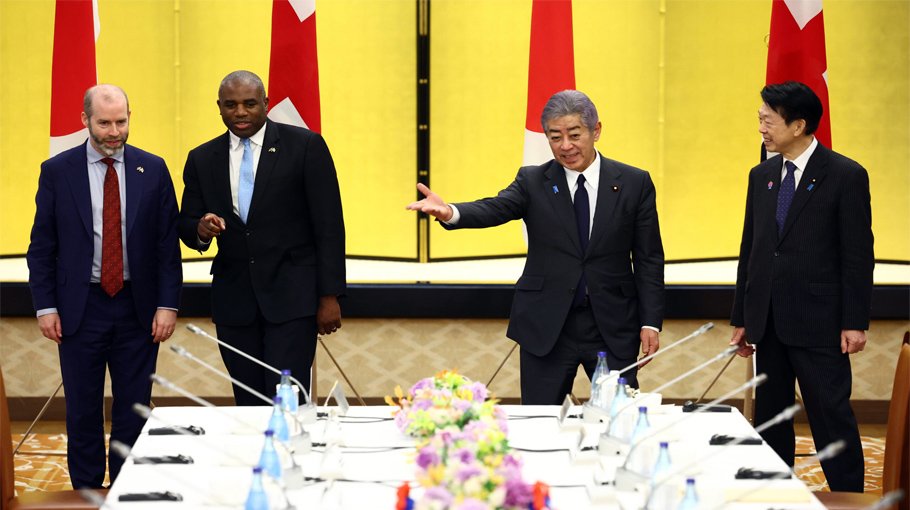
In March 2025, the first UK–Japan ‘Economic 2+2’ ministerial meeting took place involving the United Kingdom’s foreign secretary and business and trade secretary, and their Japanese counterparts.
This was Japan’s first ‘Economic 2+2’ meeting with a country other than the United States. The breadth of the areas covered by the ‘2+2’ — economic security, supporting open international trade, energy security and greater ‘Global South’ engagement — suggested an attempt mainly to set the strategic direction for the bilateral relationship and to build on the Hiroshima Accord. Fleshing out the details needs greater alignment in policy priorities across government departments on both sides.
Progress towards advanced technology partnerships and closer trade relations may be more efficient than in any other domain, given strong bilateral synergies in these areas. The United Kingdom and Japan have complementary strengths — the United Kingdom is a leader in artificial intelligence (AI) and semiconductor design. Japan has a depth of expertise in quantum computing and chip production.
The United Kingdom’s accession to the Comprehensive and Progressive Agreement for Trans-Pacific Partnership (CPTPP) at the end of 2024 will provide Japan with critical support for upholding the free and open global trading order. Japan has been a strong supporter of the United Kingdom’s accession to the bloc.
Japan and the United Kingdom are the two largest economies in the CPTPP by a large margin, with the United Kingdom bringing a strategic economic depth in services and intellectual property. Japan also hopes that the United Kingdom’s presence in the CPTPP will help it to manage the geopolitical challenge of China and Taiwan both wanting to join the bloc.
The United Kingdom’s CPTPP accession also adds an economic pillar to their strategic presence. London is also an ASEAN Dialogue Partner and signatory of the AUKUS agreement.
Japan’s expertise in areas including quantum computing could also provide a pathway to Japanese engagement with the non-nuclear pillar of the AUKUS security partnership. This focuses on areas of advanced technology. These also include hypersonic and counter-hypersonic capabilities. This would open a further avenue for bilateral cooperation.
Since the establishment of the Regional Comprehensive Economic Partnership trade bloc, the CPTPP has become a critical tool for Tokyo in managing China’s increasing economic influence in the region.
The CPTPP’s emphasis on the industrial and trading standards of its members is integral to this aim. Trump’s isolationist policy lurch will further boost the CPTPP’s importance as a bulwark protecting the existing ‘open’ trading order.
‘Structured cooperation’ between the EU, another target of President Trump’s tariff policy and the CPTPP will be pertinent, representing a tailwind for further Anglo–Japanese economic cooperation.
Sceptics question the ability of the United Kingdom and Japan to exert strategic agency given their various domestic economic problems, not least their stretched fiscal circumstances. There is some truth in this as higher inflation, debt or risk may impede the ‘Global South’ engagement pillar of the March meeting — apparent in London’s decision in early 2025 to cut foreign aid for higher defence spending.
But the strengths afforded by the complementarity of UK–Japan cooperation and the convening power of both countries are hard to replace as pillars of Indo-Pacific security. This is paramount given the abrupt shift in relations between the US and its allies since the start of President Trump’s second term. The United Kingdom and Japan have been proactive in signalling their desire to widen their roles within their respective US security alliances, while deepening their security relations with like-minded neighbours and beyond. Japan’s deepening partnership with NATO serves as an example of this attitude.=
The severity of the multi-pronged challenges posed to the global rules-based order is motivating developed middle powers to pool resources. This is the driving factor of the historic closeness of the UK–Japan relationship.
Absent this cooperation, little will stand in the way of the great powers rewriting the rules in their spheres of influence to the detriment of everyone else. The high degree of bilateral trust now existing between the UK and Japan gives these nations a special role to play in this rapidly changing world.
Robert Ward is Japan Chair at the International Institute for Strategic Studies.
Source: East Asia Forum