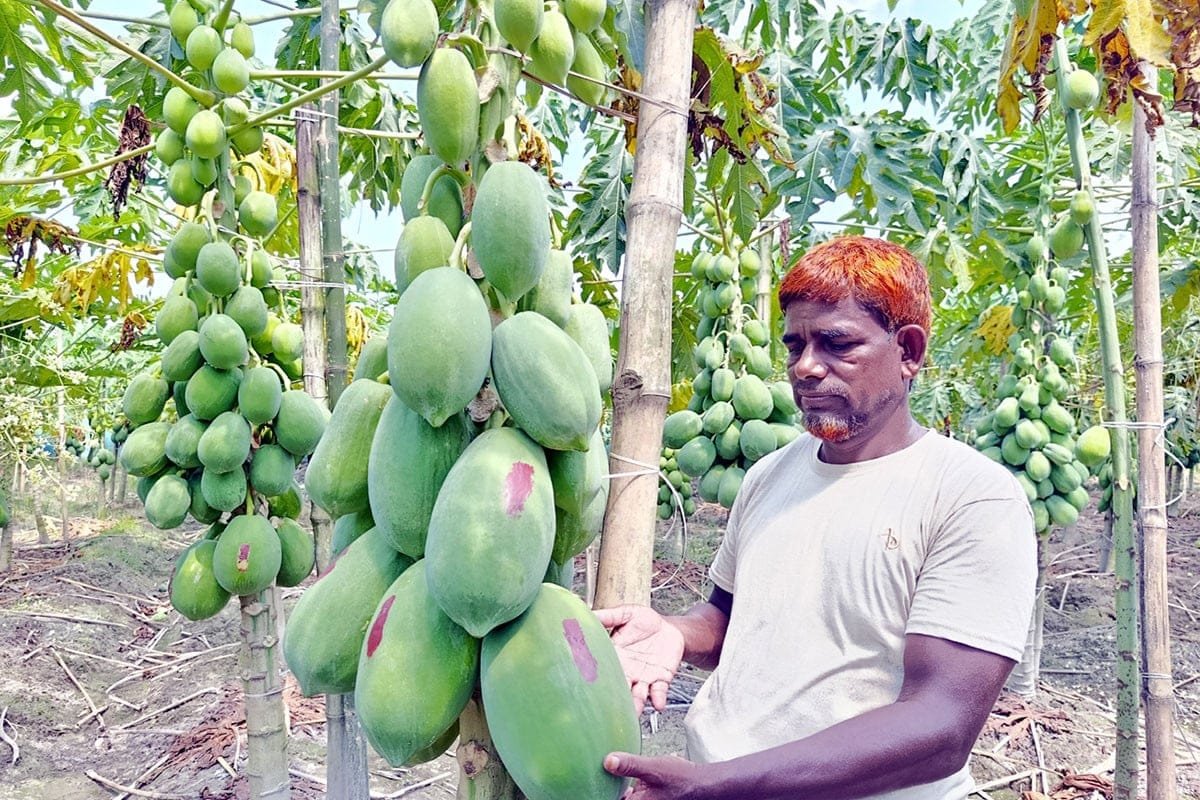
Breaking away from tradition, a farmer from Birganj upazila in Dinajpur has stunned his community by replacing his usual potato crop with papaya — and earning back his entire investment in just five months.
Musa Mia, a farmer from Bachhar village in Paltapur Union, decided to abandon potato farming after years of low returns. With guidance from the local agriculture office, he planted 3,000 hybrid saplings of the high-yielding “Babu” and “Sukhi” papaya varieties on his three bighas of land. His total investment came to around Tk 200,000.
What happened next surprised even him.
Within just five months, Musa sold Tk 200,000 worth of papayas — completely recovering his initial costs. Now, he continues to sell produce every month and earns over Tk 100,000 in profit after expenses each time.
His papaya orchard has quickly become the talk of the village. Each plant carries between 30 and 50 fruits, and they begin producing within three to four months of planting. On average, each papaya weighs between 1 and 1.5 kilograms.
The Babu and Sukhi varieties have several advantages. They start yielding within five to six months and continue to produce fruit for two years straight. The fruits do not spoil quickly, making them ideal for transporting to distant markets. They are also resistant to common viral diseases. Musa believes that over the next two years, his earnings will easily cross several lakh taka.
This success is not his alone. His nephew Ashraful Islam and friend Biplob invested alongside him. Their joint effort has shown how careful planning, improved seed varieties and hard work can lead to high profits even on a small budget.
Shariful Islam, the Agriculture Officer of Birganj upazila, praised Musa’s efforts, saying, “Farmers like Musa are our inspiration. His success with hybrid Babu papayas proves how quickly farmers can earn profit with the right approach. The agriculture department is ready to support all papaya growers.”
Musa’s remarkable achievement has sparked interest among unemployed youths and other farmers in the area. Many people visit his orchard daily, including locals like Farhad Hossain who said, “I never imagined such high yields could come from such a small area. I’m now considering planting the same papaya varieties myself.”
Farmers believe that if the government’s agriculture department increases support, Dinajpur could soon witness a papaya revolution. Musa’s story stands as proof that success always follows those who put their hands to the soil with dedication.
His papaya field is no longer just a farm — it is a symbol of hope for countless rural families seeking a better future.