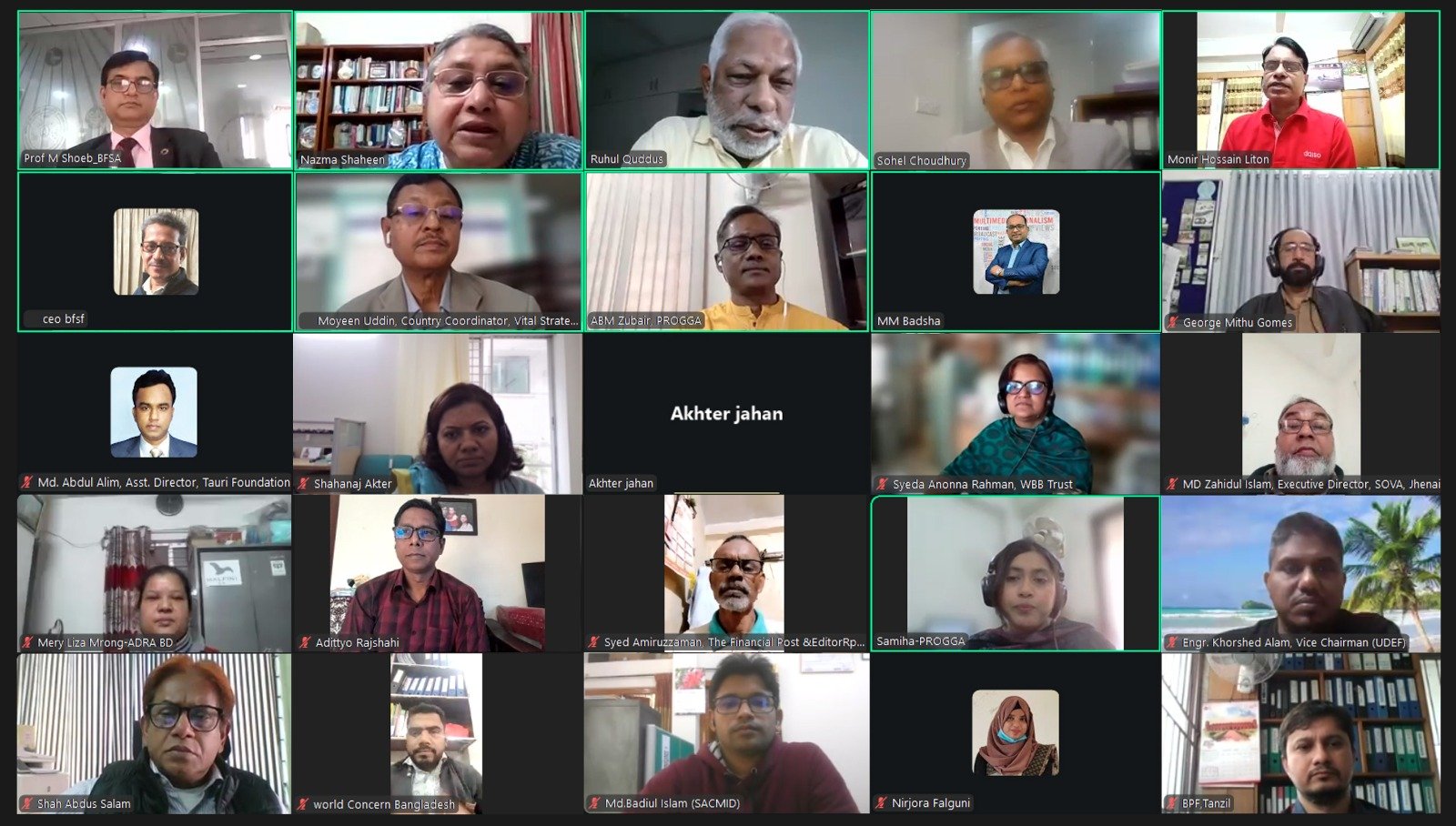
Consumer awareness, particularly through clear food labelling, is crucial to curbing the growing burden of non-communicable diseases (NCDs) in Bangladesh, speakers said at a webinar marking National Food Safety Day on February 1.
The prevalence of NCDs—including hypertension—is rising sharply due to unhealthy dietary habits and increased consumption of processed foods, they noted at the webinar titled “Safe Food to Combat Non-Communicable Diseases and Our Role”, organised by PROGGA with support from Global Health Advocacy Incubator.
This year, National Food Safety Day is being observed under the theme “Nirapod Khaddo Nishchit Kori, Sustho Sobol Jibon Gori.”
Citing World Health Organization data, speakers said foods high in salt, sugar and fat significantly increase the risk of hypertension and other NCDs, underscoring the importance of Front-of-Pack Labelling (FOPL) in informing consumers about unhealthy food components.
According to WHO estimates, around 570,263 people die every year in Bangladesh from NCDs. Meanwhile, the Global Burden of Disease Study 2021 indicates that approximately 27,387 annual deaths are linked to unhealthy dietary practices, including excessive sodium intake, trans-fat consumption and sugar-sweetened beverages.
Despite the scale of the problem, speakers pointed out that budgetary allocation for NCD control remains critically low, accounting for only 4.2 percent of the total health budget.
Professor Dr Sohel Reza Choudhury, head of epidemiology and research at the National Heart Foundation Hospital & Research Institute, said promoting healthy dietary habits and reducing reliance on processed foods are essential to lowering the risk of hypertension and other NCDs.
Professor Dr Nazma Shaheen, former director of the Institute of Nutrition and Food Science at the University of Dhaka, said introducing FOPL was necessary to alert consumers to excessive salt, sugar and trans-fat content in packaged foods.
Professor Dr Mohammad Shoeb, a member of the Bangladesh Food Safety Authority, said the government was working to introduce an easy-to-understand FOPL system to raise awareness of the health risks associated with processed foods.
Muhammad Ruhul Quddus, Bangladesh country lead of GHAI, stressed the need for sustainable financing alongside awareness initiatives to effectively tackle NCDs such as hypertension.
The webinar was chaired by ABM Zubair, executive director of PROGGA, and moderated by Samiha Bintay Kamal, programme officer of the organisation. Md Monir Hossain Liton, head of online (Bangla) at Daily Times of Bangladesh, participated as a discussant.
Journalists from print, television and online media, along with civil society representatives, health experts and stakeholders from across the country, joined the event.