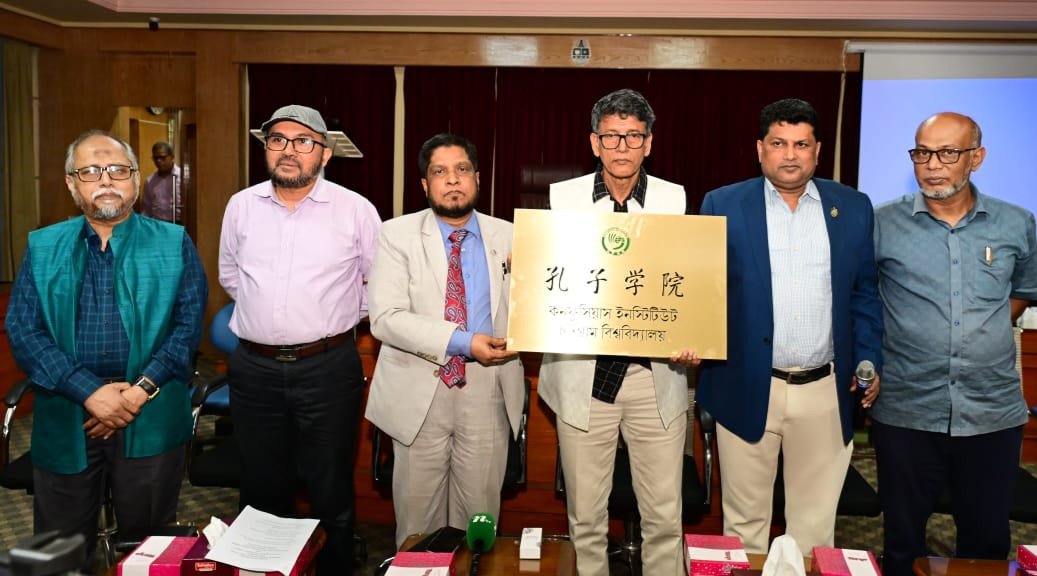
A fully funded Confucius Center, supported by the Chinese government, will be established at Chittagong University (CU), marking a significant step toward expanding Chinese–Bangladeshi academic and cultural cooperation. The center will be constructed next to the old Faculty of Arts, with infrastructure work expected to be completed by next year, likely by October.
Chittagong University Vice-Chancellor Professor Dr. Md. Yeahiya Akhtar disclosed the information at a press conference on Thursday afternoon following his visit to China. During the visit, he participated in several meetings with Chinese education officials and visited multiple universities that already operate Confucius Institutes.
The Vice-Chancellor said the Chinese side will bear all construction costs and operational expenses for the center’s infrastructure, including classrooms, offices, and cultural facilities. CU will only provide 0.5 acres of land on its campus.
“This time, the agreement is more comprehensive,” he said. “Earlier, two representatives from our university initiated discussions with China, but the work did not progress. Through the new tripartite agreement, the establishment of the Confucius Center is finally moving forward. The center will not only teach Chinese language and culture; it will also offer Bengali language courses for Chinese students.”
The institute will focus on three major areas: Chinese language education, offering Mandarin courses for CU students, researchers, and professionals; joint research and academic collaboration, enabling research partnerships between CU academics and Chinese scholars in areas such as language, culture, social sciences, and modern technology; and scholarships and higher education exchange, providing CU students opportunities for undergraduate, postgraduate, and short-term study in China while bringing Chinese students to CU to study Bengali language, society, and culture.
A major feature of the proposed institute is employment-oriented training. Under the agreement, technical training programs will be launched in areas such as mobile servicing, automobile technology, motorbike maintenance, and language-based skill development. CU students completing the programs may get internship and job opportunities in China.
CU Registrar Professor Dr. Saiful Islam confirmed that a tripartite agreement has been signed involving Chittagong University, a partner Chinese university, and the Chinese government.
“A 12-member Board of Directors will manage the Confucius Center, with six representatives from CU,” he said. “Separate classrooms, office rooms, and academic facilities will be constructed. We expect this institution to significantly enhance language and cultural exchange between the two countries.”
CU Pro-Vice-Chancellor (Administration) Professor Dr. Kamal Uddin, who was involved directly in the negotiation process, said the Confucius Center at CU will stand out for its scale and scope.
“Although Confucius Institutes are not new in Bangladesh, the one at Chittagong University will be larger and more comprehensive. Two directors—one from CU and one from China—will jointly oversee operations. The Chinese side will cover all financial and infrastructural expenditures, while profits and academic benefits will be shared with CU.”
He added that initial preparations for the institute will formally start in October 2026.
Officials believe the institute will open new academic pathways for students, strengthen international collaboration, and enhance CU’s profile as a global education hub. The presence of Chinese students and researchers on campus will also support cultural diversity and people-to-people connectivity.
“The initiative will be a landmark achievement for Chittagong University," the Pro-VC said. “It will help our students gain global exposure, improve language skills, and access new forms of employment and training.”