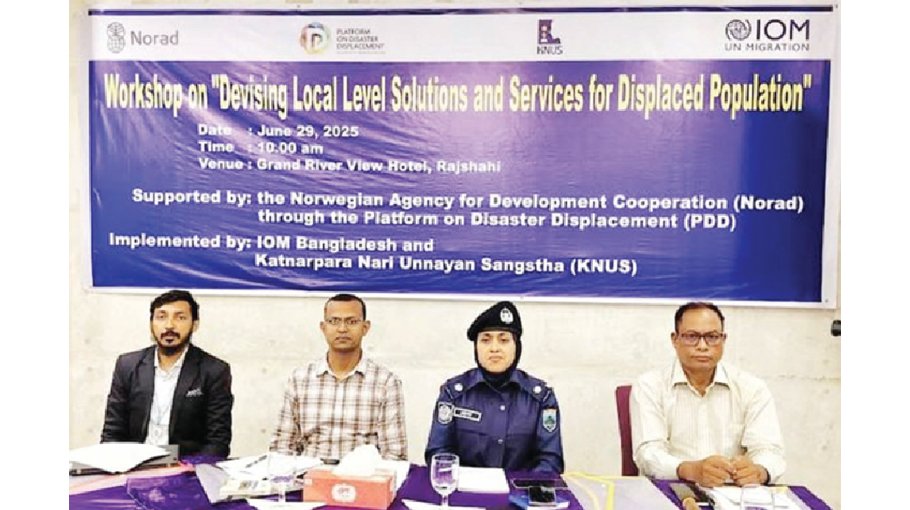
Speakers at a stakeholders meeting unanimously viewed that adverse impact of climate change has been triggering the number of displaced people every year.
This year, around 24 lakh new people have been displaced. Apart from this, around 1.90 lakh more people remained vulnerable. Government officials and development activists came up with the observations while disseminating their expertise in a workshop titled "Devising Local Level Solutions and Services for Displaced Population" in Rajshahi on Sunday.
International Organization for Migration (IOM) Bangladesh and Katnarpara Nari Unnayan Sangstha (KNUS) jointly organised the event at Hotel River View here with the support of Norwegian Agency for Development Cooperation (Norad) through the platform on Disaster Displacement (PDD).
Additional Deputy Commissioner of Rajshahi Mirja Imam Uddin, Additional Superintendent of Police Helena Akter, Deputy Director of Department of Youth Development Golam Mahbub and District Fisheries Officer Jahangir Alam addressed the meeting as resource persons.
Deputy Regional Director of Bangladesh Betar Jannatul Ferdous, Deputy Director of Department of Social Service Ridia Khatun and Assistant Director of Department of Employment and Manpower Atikur Rahman also spoke on the occasion.
During their keynote presentations, IOM Representative Ashraful Islam, KNUS Project Coordinators Mahfuzur Rahman and Asutosh Dev told the meeting that facing the adverse impact of climate change is a global challenge and its local impact is more.
Integrated efforts of all the government and non-government organizations concerned can be the crucial eans of quelling the crises.
There is no way but to unite initiative towards protection and rehabilitation of the displaced population.
Mahfuzur Rahman mentioned adverse impact of climate change has been posing a serious threat to the overall living and livelihood condition in the region including its vast Barind tract.
He also viewed the climate change has been acknowledged as the depletion of natural resources and as a major threat to the humanity in the region and urged the policy planners and others concerned to take immediate effective measures to address the adverse impact of the change caused by global warming.
The meeting shortlisted the roles of the district level government and non-government organizations to do welfare for the displaced people.
It also discussed and devised ways and means on how to prevent displacement, protect displaced people and sustainable solutions.