According to a statement by Commerce and Industries Minister Khandakar Abdul Muktadir in Parliament, Bangladesh’s widening trade deficit with India—now standing at a staggering $7.86 billion in FY2024–25—demands urgent and strategic attention. While trade deficits are not inherently harmful in isolation, the scale and persistence of this imbalance signal deeper structural weaknesses in Bangladesh’s trade policy, export capacity, and negotiation effectiveness. Without decisive reforms, the gap risks becoming entrenched, undermining industrial growth and economic resilience.
At the heart of the problem lies a stark asymmetry: Bangladesh exported goods worth only $1.76 billion to India, while imports surged past $9.6 billion. This imbalance persists despite preferential market access under the South Asian Free Trade Area framework. The reality is that tariff concessions alone have failed to ensure equitable trade outcomes. Instead, non-tariff barriers (NTBs), infrastructural bottlenecks, and limited export diversification continue to constrain Bangladesh’s competitiveness.
Indian non-tariff and technical barriers remain a formidable obstacle. Certification requirements—particularly from the Bureau of Indian Standards—are often slow, complex, and non-transparent. The lack of mutual recognition between Bangladesh’s testing institution and Indian authorities delays market entry for key products such as garments, jute goods, and processed foods. Moreover, anti-dumping duties imposed on competitive Bangladeshi exports, including batteries and jute products, have repeatedly curtailed market access. These measures, whether justified or not, erode trust and undermine the spirit of regional cooperation.
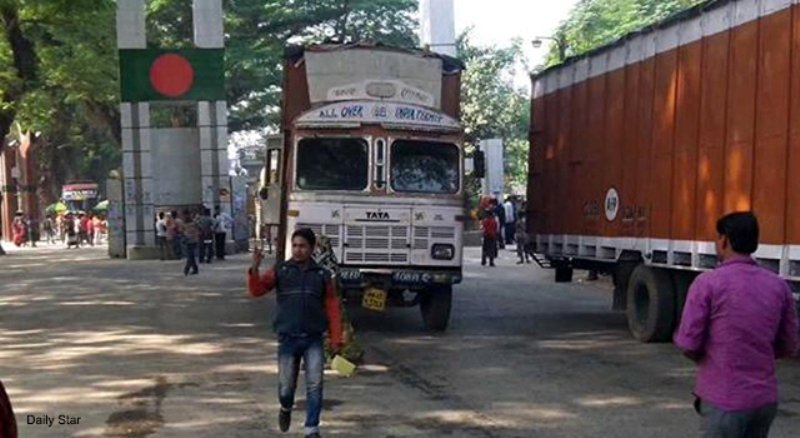
Equally troubling are the logistical and infrastructural deficiencies at land ports, through which nearly half of bilateral trade flows. Congested border points like Benapole-Petrapole suffer from narrow roads, inadequate warehousing, and mismatched operating hours. The absence of seamless customs procedures forces repeated loading and unloading of goods, inflating costs and damaging products. In an era of integrated supply chains, such inefficiencies are unacceptable and self-defeating.
Bangladesh must also confront its own structural limitations. Export concentration remains a critical vulnerability, with a heavy reliance on ready-made garments. While garments have found a modest foothold in the Indian market, their net value addition is diminished by dependence on imported raw materials—often sourced from India itself. This circular trade pattern limits real earnings and perpetuates dependency. Diversifying into higher-value and non-traditional exports—such as pharmaceuticals, leather goods, ICT services, and agro-processed items—is no longer optional; it is imperative.
Currency fluctuations and inconsistent policy environments further complicate the picture. Exchange rate volatility affects price competitiveness, while bureaucratic inertia delays critical trade facilitation reforms. The lack of coordinated institutional response has allowed the deficit to widen unchecked.
Yet, the situation is far from irreversible. Bangladesh must prioritise high-level bilateral negotiations with India to address non-tariff barriers, streamline certification processes, and establish mutual recognition agreements. Upgrading land port infrastructure and digitizing customs procedures should be fast-tracked. At the same time, domestic policies must incentivise export diversification and value addition, reducing overdependence on a narrow product base.
The growing trade imbalance is not merely an economic statistic—it is a reflection of missed opportunities and policy gaps. Bridging this gap requires political will, institutional coordination, and a forward-looking trade strategy. Bangladesh must act now to ensure that its trade relationship with India evolves from one of imbalance to one of mutual benefit and sustainable growth.