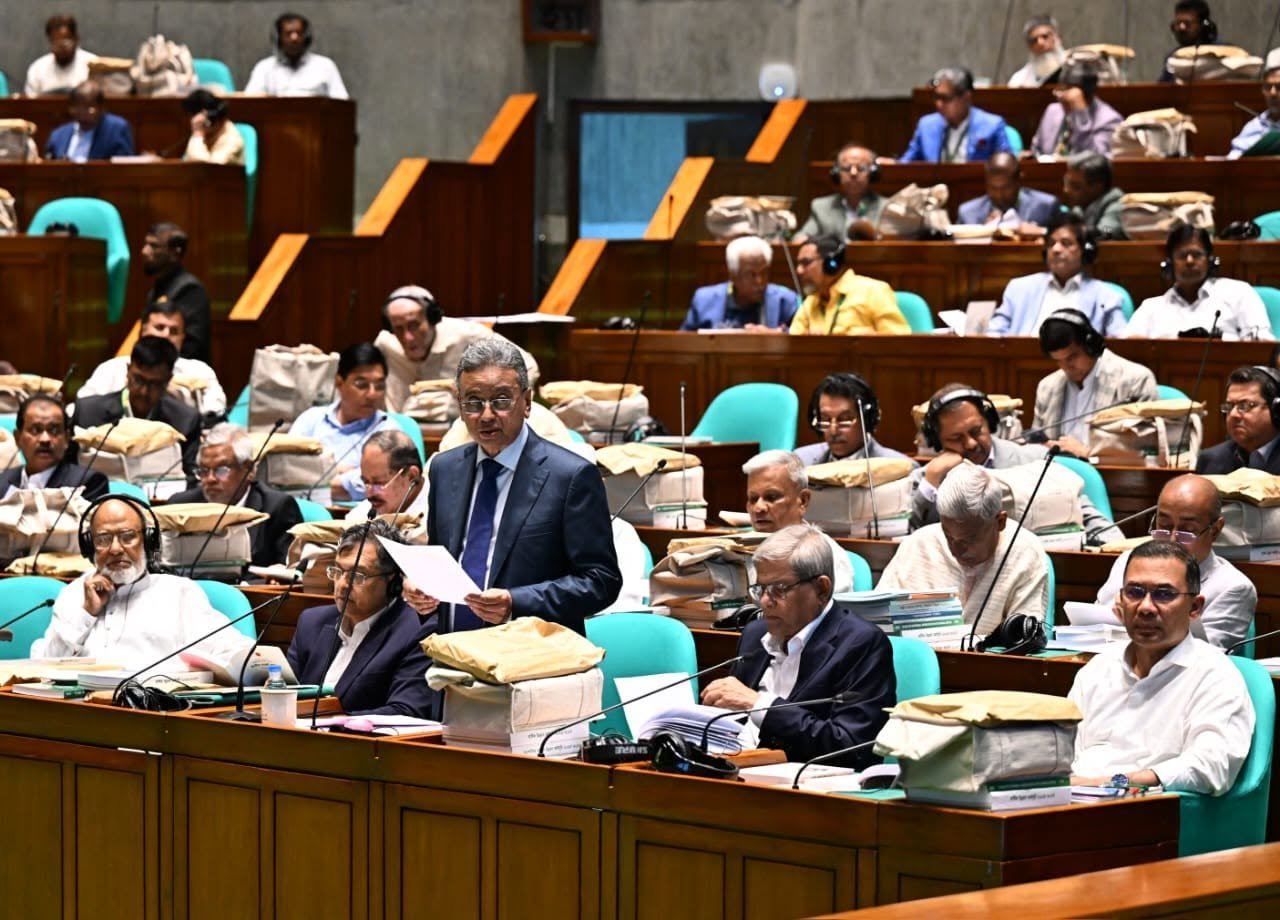
Finance Minister Amir Khosru Mahmud Chowdhury on Thursday placed the first national budget of the BNP-led government under Prime Minister Tarique Rahman in Parliament, proposing a total outlay of Tk 9.38 lakh crore for the fiscal year 2026–27. The budget outlines a broad agenda focused on macroeconomic stabilisation, fiscal reform, and a shift toward investment- and production-led growth.
Presenting the financial blueprint, the Finance Minister said the government aims to build an inclusive and accountable society anchored in human dignity, sustainable development, and economic progress driven by real sector expansion. He added that the administration intends to move away from what he described as debt-dependent growth patterns of the past 15 years, instead prioritising productivity, private investment, and institutional reform.
The budget sets an ambitious revenue mobilisation target of Tk 6.95 lakh crore to finance public expenditure. Of this, Tk 6.04 lakh crore is expected from taxes and duties, while Tk 25,000 crore will come from non-NBR tax sources. Non-tax revenue is projected at Tk 66,000 crore, reflecting efforts to broaden the fiscal base and improve collection efficiency.
On the expenditure side, Tk 3.16 lakh crore has been allocated for development spending, including Tk 3 lakh crore for the Annual Development Programme (ADP). The remaining Tk 6.21 lakh crore is earmarked for operating and other recurrent expenditures, covering public administration, subsidies, salaries, and essential services.
The overall budget deficit is estimated at Tk 2.43 lakh crore. To bridge the gap, the government plans to secure Tk 1.09 lakh crore from foreign sources and Tk 1.12 lakh crore from the domestic banking system. An additional Tk 15,000 crore is expected from the sale of national savings certificates, reflecting a diversified borrowing strategy aimed at maintaining liquidity stability in the financial sector.
Debt servicing remains a major fiscal burden, with Tk 1.27 lakh crore allocated for repayments and interest. Of this, Tk 1.05 lakh crore will go toward domestic debt servicing, while Tk 22,500 crore is reserved for foreign loan obligations.
In his speech, Chowdhury paid tribute to the martyrs of the July 2024 uprising and reiterated the government’s commitment to implementing the July Charter under the leadership of Prime Minister Tarique Rahman. He said the BNP has historically stood with the aspirations of the people at critical junctures, citing the leadership legacy of Shaheed President Ziaur Rahman and former Prime Minister Begum Khaleda Zia.
The Finance Minister also painted a stark picture of the inherited macroeconomic situation, citing widening inequality, financial sector irregularities, and alleged large-scale capital flight. He claimed that economic mismanagement over previous years had significantly increased the national debt burden and weakened key institutions, requiring comprehensive reform and recovery measures.
He further noted that global instability, particularly tensions in the Middle East, has added fresh uncertainty to the international economic environment, making domestic resilience even more critical.
Chowdhury emphasized that political reform and economic reform must go hand in hand. He argued that without democratizing the economy, strengthening accountability, and ensuring inclusive access to opportunity, political reforms alone would not be sustainable.
He alleged that past governance failures had undermined public institutions through corruption and misuse of state power, weakening the foundations of long-term growth. In this context, he said, the current government has been entrusted with the responsibility of rebuilding the economy and placing it on a sustainable growth trajectory.
Seeking broad national cooperation, the Finance Minister called on lawmakers, farmers, workers, students, women, youth, entrepreneurs, professionals, and expatriates to support the implementation of the budget’s reform agenda. He stressed that inclusive participation would be essential to achieving development goals.
“We are committed to building a Bangladesh where opportunity is equal for all, enterprise is encouraged, and the fruits of development are shared widely,” he said, adding that economic deregulation, investment promotion, and institutional reform would be key pillars of the government’s strategy.
He concluded that through coordinated reform efforts and national unity, Bangladesh could move toward a more prosperous, resilient, and equitable economic future.