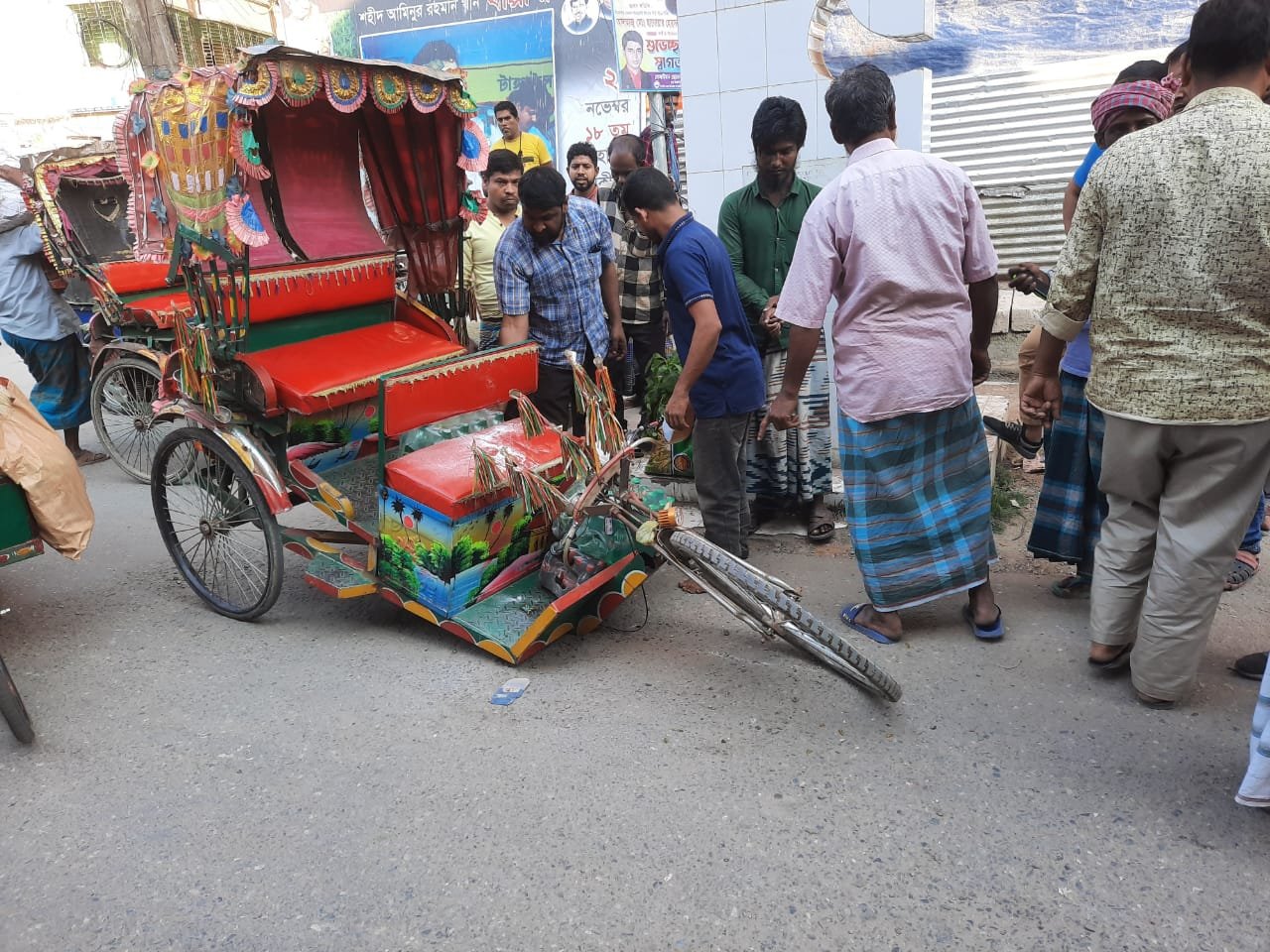
Passengers in Tangail town are left with little choice but to travel in unsafe battery and motor-powered rickshaws, as traditional pedal rickshaws have almost disappeared from the streets. These modified vehicles are fast but dangerously fragile, lacking basic safety features such as proper brakes, rear-view mirrors or signal lights. Most are driven by untrained operators, turning daily commutes into constant hazards.
Unlike standard pedal rickshaws, the speed of these battery-operated ones is much higher. Yet their braking systems remain the same as the older models, making it nearly impossible to control the vehicle in an emergency. Drivers frequently make sudden turns without checking traffic, often causing collisions with other vehicles. Due to their lightweight frames, many of these rickshaws suffer mechanical failures — broken axles or snapped front forks — leaving passengers injured in the middle of the road.
According to the licensing branch of Tangail Municipality, 6,000 rickshaw licences were issued during the previous government’s term. Each licence cost Tk 1,000 and was meant only for pedal rickshaws — yet most have been unlawfully used for battery and motorised versions, in violation of municipal regulations. Some owners reportedly obtained 10 or more licences under the same name and rented out vehicles to drivers. Due to political syndicates, these licences were resold on the black market for Tk 15,000 to 25,000 each, while the municipality received only the official fee.
Drivers are issued two types of licences — one for rickshaws and one for e-bikes — but shockingly, no written or practical tests are required. Applicants are simply given verbal instructions by municipal staff before being allowed to operate on public roads.
In 2020, the district administration attempted to control the growing chaos by shutting down unauthorised rickshaw manufacturing workshops in and around the town. Factory owners agreed in writing not to produce new vehicles, after which the seals were lifted. Yet only weeks later, most resumed operations openly.
Md. Abdur Razzak, former General Secretary and current convening committee member of Tangail Rickshaw and E-bike Workers’ Union, said there are around 8,000 workers operating rickshaws and e-bikes in the town. Several garages rent out fleets of 40 to 50 rickshaws each, charging Tk 400 to 450 per day from drivers. Most of the current vehicles are converted pedal rickshaws reinforced with steel bodies and fitted with motors and batteries. Since drivers lack proper training, accidents and traffic congestion are increasing daily.
He argued that if the municipality had provided proper screening and training, drivers would be more skilled. He suggested that instead of makeshift battery conversions, the authorities should approve safer rickshaws with stronger braking systems and thicker tyres. To reduce congestion, new manufacturing should be stopped altogether.
One passenger, requesting anonymity, said nearly all rickshaws in the city are now motorised. “We are forced to ride in unsafe vehicles. Drivers come not only from nearby areas but from other districts too. Sometimes even robbers disguise themselves as rickshaw pullers. If the municipality issued proper licences with ID cards to be worn around the neck, it would be safer.”
Tangail Municipality Administrator and Deputy Director of Local Government, Md. Shihab Rayhan, said the licensing issue dates back to before his tenure. “No new licences have been issued under my administration,” he stated.