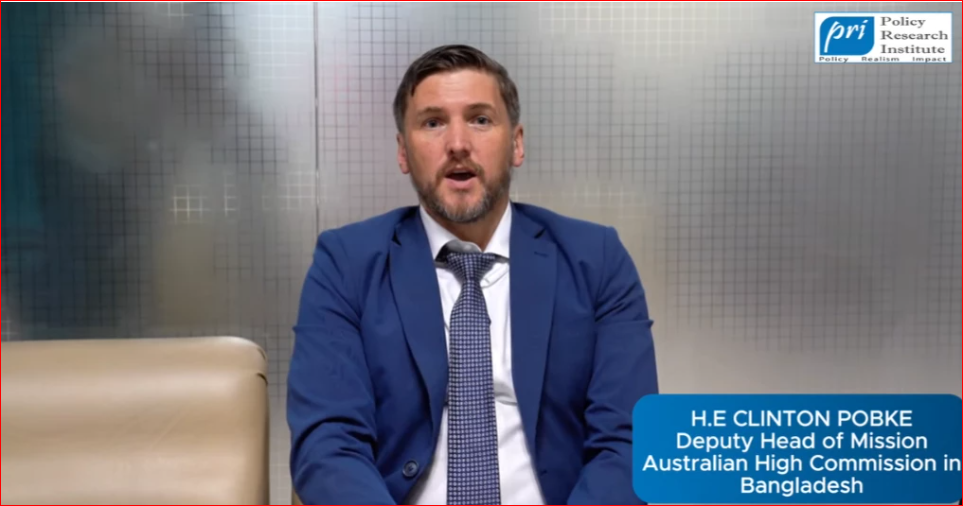
Deputy High Commissioner of the High Commission of Australia to Bangladesh Clinton Pobke has expressed strong optimism about Bangladesh’s economic prospects, saying the country has the potential to achieve sustained high growth if ongoing reforms are strengthened and institutionalised.
Speaking at a discussion hosted by the Policy Research Institute (PRI) in Dhaka, Pobke praised the role of the think tank in generating data and policy analysis, describing its work as vital for informing policymakers and engaging the public.
“It’s wonderful to see so many people here tonight for this discussion,” he said, noting that he had closely followed PRI’s activities over the past year.
He said such events create space for open debate and allow diverse voices from across society to exchange ideas and perspectives.
The Australian diplomat also acknowledged the contributions of Bangladesh’s economic community, including professionals in government, academia, think tanks, the private sector and industry groups, calling them a “true asset for the country.”
While making it clear that it is not his role as a foreign diplomat to prescribe policy solutions, Pobke reflected on Bangladesh’s underlying economic potential and the significance of the country’s current moment.
He described Bangladesh’s growth trajectory since independence as remarkable, pointing out that the country has consistently maintained annual growth rates of 5 to 6 percent despite various challenges and periods of instability.
Referring to global development frameworks, he said several foundational policy elements often associated with strong economic performance were not historically prominent in Bangladesh, yet the country still achieved steady expansion.
According to him, if a future government is able to strengthen these core foundations, Bangladesh could realistically sustain growth of 8 to 10 percent and emerge as a major economic powerhouse.
Pobke highlighted several reform initiatives undertaken over the past 18 months, including changes in exchange rate management, regulatory steps in the banking sector such as the bank resolution regime, measures to reinforce central bank independence, reforms in the energy sector, and improvements in tax administration and governance.
He also noted that judicial reforms, including the recent establishment of commercial courts, could have significant economic benefits by improving the business climate and strengthening confidence in the rule of law.
However, he stressed that these measures should be seen as initial steps rather than final achievements.
“If Bangladesh is to reach 8, 9 or even 10 percent economic growth, these reforms must be locked in and carried forward,” he said, adding that one of the key challenges for any incoming elected government would be ensuring continuity.
He cautioned that several reforms introduced through ordinances may expire unless they are formally placed before parliament and enacted into law, creating a pressing timeline for policymakers.
At the same time, Pobke underlined that decisions about which reforms to continue or modify rest entirely with Bangladesh’s elected leadership. “It will be the democratic prerogative of an elected government what it does and how it does it,” he said.
He expressed hope that the momentum for economic reform would not slow down but instead continue to build, helping the country unlock its full potential.
Reaffirming Australia’s commitment to supporting Bangladesh, Pobke said his country would continue to assist where desired by the people and government of Bangladesh.
He noted that Australia’s support through the World Bank is aligned with Bangladesh’s reform priorities, while collaboration through the International Finance Corporation aims to boost private sector development.
He added that Australia would also continue to support the country’s think tank ecosystem to encourage informed public debate, and expand trade and investment ties through its strengthened trade engagement.
Pobke wished Bangladesh success in what he described as an important phase in both its democratic and economic journey, expressing confidence in the country’s ability to move forward.