Chuadanga Correspondent
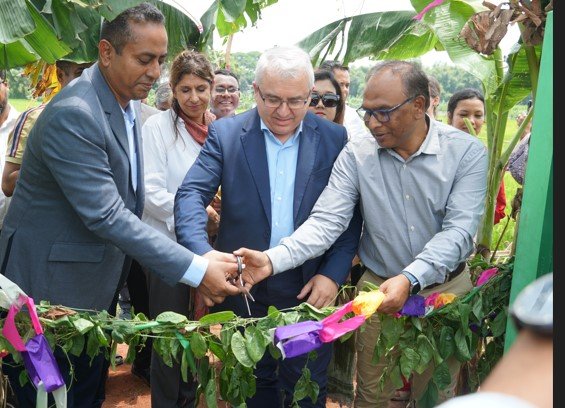
An Agrivoltaics Pilot Project integrating agricultural activities, solar power generation and solar-powered irrigation on the same land was inaugurated at Uzolpur village in Sadar Upazila of Chuadanga district on August 19.
The project was established at Bedepota field under the initiative of Wave Foundation and organised by the German-based development organisation GIZ Bangladesh. Joint Secretary Mohammad Khalequzzaman inaugurated the project.
Director (Deputy Secretary) of the Renewable Energy Development Department of the Sustainable and Renewable Energy Development Authority, Engineer Mujib Rahman, attended the event as a special guest.
Among others, Wave Foundation Deputy Executive Director Nasifa Ali, Tanzina Dilshad, Manager of Environment and Energy at the Bangladesh Delegation of the European Union’s Green and Inclusive Development Programme, and Stajank Stich, Energy Cluster Coordinator of GIZ Bangladesh, were present.
Speakers at the event included Infrastructure Development Company Limited (IDCOL) Managing Director S.M. Munirul Islam, KfW Development Bank Dhaka Office Senior Portfolio Manager (Energy) Christine Sies, and Ulrich Kleppmann, Head of Development Cooperation at the Embassy of the Federal Republic of Germany in Dhaka.
The speakers highlighted the importance of integrating agriculture with renewable energy and stressed the need to make irrigation more sustainable, cost-effective and environmentally friendly through solar power.
They said a key feature of the project is the integration of solar power generation and solar-powered irrigation while maintaining agricultural productivity on the same land.
The initiative is expected to serve as an important example of building climate-resilient agricultural systems through the integrated use of agriculture and renewable energy. By bringing solar power generation, irrigation and agricultural production under a single system, the project could help reduce farmers’ production costs and increase the use of clean energy in the future.
The project also seeks to demonstrate the practical benefits of making better use of limited agricultural land while meeting growing energy and irrigation needs. Under the agrivoltaic model, solar panels are installed above or alongside cultivated areas, allowing farming activities to continue while electricity is generated. The approach can help farmers access reliable and affordable power for irrigation, particularly during peak farming seasons, while reducing dependence on conventional fuel-based energy. Participants at the event expressed hope that the pilot initiative would generate useful experience and data that could support the wider adoption of agrivoltaic systems in Bangladesh, particularly in areas facing increasing climate and energy challenges. #EK